

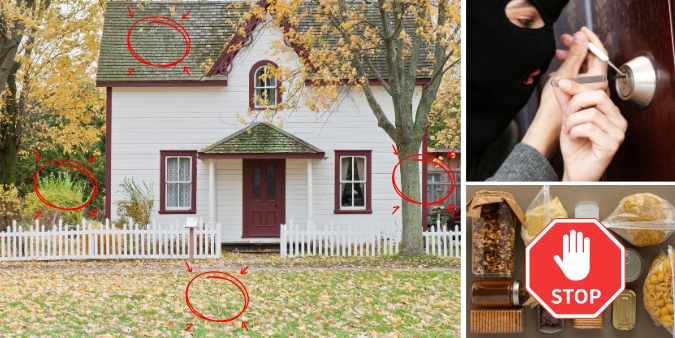


When disaster strikes, those caught off guard will see the well-prepared as easy targets – a source of the supplies they’re desperate to get their hands on. The simple fact that you were wise enough to thoroughly stock up on food, water, and basic survival supplies can make you a big juicy target for looters.
Keeping your stockpile invisible before and after a disaster strike will make all the difference between surviving and struggling. In a true SHTF scenario, it’s not just about having what you need, it’s about keeping it out of unwanted hands. And it’s far better to never get into a confrontation than to constantly have to fight off people who want to steal what you were wise enough to save.
The Quiet Before the Storm
If no one knows about your stockpile before disaster strikes, the less likely you are to have to deal with troublesome looters. When your neighbors and your kid’s friend’s parents hear about your stockpile during normal times, they’re bound to come to you when the day comes. They’re also likely to let word slip to their friends and neighbors, thus increasing the size of the target on your stockpile.
The smartest thing you can do is to keep quiet about your supplies. As much as you want to brag to your buddy or post about it on a seemingly anonymous internet forum, loose lips will sink your stockpile’s ship. Make sure your significant other and your kids are also clear that talking about or showing off the family stockpile is forbidden.
Think Like a Looter
Thinking like a looter when deciding where to store your supplies is also an important part of keeping your stockpile hidden. They’ll head straight for the obvious spots – pantries, garages, basements, and sheds. If they find a lot of supplies, they’ll take it. If they find zero supplies, they’ll know you’re hiding your stockpile and keep looking.
Want to know how looters size up a target? Watch THIS VIDEO of a former CIA officer who breaks down the looter mindset and shares practical, no-nonsense tips to harden your home.

Leave a Sacrificial Stash
Leave a few meager supplies in the obvious places. You can also keep a spot in the basement or someplace out of the way that has a bunch of opened boxes with just a little bit of food left in it. Also, empty water jugs that are down to their last few sips.
This strategy gives any looters the impression that you’ve been foolish with your supplies instead of rationing them. They’ll likely take what meager food and water they find and leave without being overly tempted to rough you up or toss the place for whatever invisible stockpile they suspect is lurking about.
Diversify Your Hiding Spots in Plain Sight
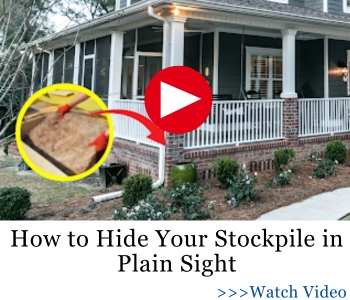 A single stash for all your supplies is a gamble. Instead, divide your stockpile into several hidden caches. We’re talking tucked-away nooks, decoy containers, and spots no one would think to check. That way if looters do get into your home or your empty off-the-grid cabin, they might find one spot, but they likely won’t find everything you own.
Furniture Safes
Hollowed-out ottomans, bed frames, and even air vents are also great places to hide your supplies. There might be a little carpentry involved, but there’s usually a significant amount of space under a couch between the springs and the feet. You just peel back the fabric liner and install quarter-inch plywood to act like a shelf.
False Walls
Shelves or a narrow bookcase that’s paneled over discretely to match the rest of the room’s décor is a great way to make your supplies invisible to looters. The trick is to keep it narrow, so as to not be obvious.
I would also only use this for long-term non-perishable storage. The sort of thing that you will fall back on weeks into a disaster. The more you access it, the more obvious it will be to would-be looters and peeping toms.
False Floor Storage
Depending on the foundation and number of stories in your house, small hidden in-floor storage areas can be a great place to hide supplies. You can nail a series of old milk crates to the stringers under closet floors and cover them with thin flooring and carpets.
No one steps into a small closet to notice the floor is weaker, and you can peel back the carpet from the corner to access the milk crates. This is literally how I hid my stash from my mother in my teenage years!
Hidden Root Cellar
With a few cinderblocks and paint you can create a modest basement storage space to keep canned goods completely out of sight. Looters don’t think about the dimensions of a home’s foundation. Adding some bricks in just the right spot and painting them to match the rest of your basement will essentially wall up your supplies.
Placing it under a closet will give you reasonable access when you need it, without an obvious door anywhere in the actual basement itself. This is exactly what my grandfather did during the Great Depression when he suspected people were snooping around the house while he was out in the field.
An Old Fuel Oil Tank
If you have a fuel oil furnace or your home has one, but you’ve upgraded, that old tank lurking in the basement is a perfect stash repository. You’ll need to cut it open on the seam to create a door on one end. Then seal it back up with a plumber’s putty or JB Weld. Then simply spray the entire thing the same color. The seam will be indistinguishable from the original weld.
Buried Outdoor Supplies
A 55-gallon barrel, or even a five-gallon bucket with a sealed lid can be buried with the top just an inch or two under the surface to create outdoor stockpile stashes. When properly sealed they’re watertight, and the surrounding soil helps regulate the temperature inside the barrels.
I would say you absolutely have to have a few of these stashes at the fringes of your property. Then if your house is overrun, you can flee and return to the property in the dark of night to get enough supplies to survive while you figure out your next steps.
At the end of the day, it all comes down to one thing: self-sufficiency. Now is the time to use whatever resources you have to build your own water, power, and medical systems and tailor everything to the space, tools, and supplies you actually have on hand.
A False Rain Barrel Against Looting
These days everyone has cute rain barrel systems that looters will walk right by. You can add an empty rain barrel that’s not properly attached to your existing system to create an outdoor storage area.
You could even open up an existing rain barrel, put supplies in a sealed plastic bag, and submerge it. If looters try to draw out water, they’ll get a little suggesting that it’s a normal rain barrel, without knowing there are other supplies within.
Final Thoughts
In a survival situation, it’s not just about what you have, it’s about what others don’t know you have. Making your stockpile invisible calls for a combination of strategy, secrecy, and smart planning. Hide it well, speak of it rarely, and you’ll have a far better chance of outlasting the chaos.
But even if you manage to keep looters away from your home, that doesn’t mean your stockpile is truly safe. If you’re not paying attention, it could vanish before you even notice. You know what I’m talking about, right? Drop your guess in the comments below!
You may also like:
 Why Looters are Targeting Your Home
Battle-Tested Army Survival Tactics You Can Rely On When Crisis Strikes (VIDEO)
The Biggest Enemies of Long-Term Food Storage (It’s Not Looters)



















DO NOT CUT AN OIL TANK OR FUEL TANK!
You will hurt yourself!
Yes it can and is done safety if very specific methods and precautions are taken. You really need to know how to do this type of work. Be safe.
Exactly. I’ve seen and had to deal with some interesting fires in my career as a welder/fabricator. Fuel tanks need to be cleaned ( solvent and or steam) or, depending on volume, filled with water before cutting, or welding. I typically don’t do fuel tanks, they can burn enough to warrant fire dept/EMS response.
Old Para – Agreed and even the dry ice method to inert the fumes internally can burn you (frostbite) or possibly suffocate you if you mess up (the fix protection method is as dangerous as the fix work itself). Research methods and know what you are doing, getting help may be the better path!
Yes could cause severe explosion when trying to cut it open.
But it’s the contamination of the tank, that bothers me most…
There is a differents between oil and fuel.
Just yesterday I welded a diesel tank and yes I been a welder for 40 yrs.
Better think before you try this, as a place to stash supplies.
stay sharp
Absolutely! I have cut, welded, and brazed gasoline, propane and oil tanks before, but the tanks were filled with water after having been steam cleaned. Dry ice would also work, as carbon dioxide is inert. Even if it was a long time ago that the tank held something volatile, there can be enough left in the tank to explode violently.
Err on the side of caution.
Hi Final Thoughts….are you talking about your best friend that you unknowing ticked off just stolen all your stash by poisoning you ?
I Know…your talking about the stash monster….its all-ways out there ….just waiting for you to drop your guard.
Water is more important than most people think about.
“I” follow the Survival “Rule of 3’s” :
3 minutes w/o Air
3 hrs w/o Cover(in freezing weather)
3 days w/o water and you are about Done.
3 Weeks w/o Food
I bought 3 new 55gal plastic drums, filled them with water, keep them in basement, I put a few drops of bleach in them on regular basis to keep germs down.
I also have a dehumidifier that can be a source of water. from atmospheric air. Assuming you have power. Solar Generator.
Also Rain-Barrels for my house Downspouts.
A permanent supply of water.
Have to purify it to use though.
Don’t forget about neighbor Swimming Pools. Might be handy.
And ID – Now – Local Creeks. Holding ponds etc.
Defender, I like your line of thought, your rule of three helps one keep their priorities right. Earlier this year I was going to buy some 5 gal glass jugs to store water in. Then I got to looking online and found 20 gallon milk cans for about $100, decided I could afford a couple of them. They are cheap imports but they are stainless steel so I will trust the water stored in them to be my highest quality and ready to go.
x
Just leave out some nice POISONED food stuffs.
Sooner or later there won’t be any looters left.
Forget poisoning the food supply, grab some liquor and add a bit of Hemlock to it. Most loots cannot pass up booze!
chime in on the fuel tank –
MANY different types of “fuel/ petroleum products” and every one is different in its explosive nature. Some are virtually identical, fuel oil / Diesel. Temperature, humidity, atmospheric pressure affect them all differently.
those welders that posted, they know their stuff, so listen.
I just want to add this bit of wisdom, A full tank of fuel is dangerous, but an empty tank is much worse. Why ? because there is more room for vapors ! ! !
If you want to cut an empty tank, think twice, still committed, don’t cut it any time soon, RINSE, dry, rinse, dry, leave it full of water for MONTHS, empty it and open ALL passages into it, dry it, come back a month later, build a fire near an opening and add some wood right up to the opening. No reaction, cut away.
But why ? if SHTF, they will be checking it out CLOSELY, because they expect to steal FUEL, they wont complain when they find, food, fuel, ammo, tools, gold and those pictures of your wife. No looter ever said, oh look a tank full of fuel, but I only want to steal onions, so I wont look closer.
Water storage, do you know how fast a family of 4 can drink an Olympic pool ?
Do you think storing 1,000 gallons will help you 9 months into SHTF ? ( hint, family of 4, it will run out in 8.5 months). My point, don’t store it, source it. PS don’t store Oxygen for breathing, you cant, better have a source.
Kre, all of your points are fully valid. On the subject of water storage/sourcing maybe I should have explained myself better. I have a raw water source picked out but it is several hundred feet from my house, is a poor quality, will have to be filtered and purified. Also consider that I will be exposing my self while collecting it and carrying it back to the house. Therefore I keep some water that is already drinking quality stored. I keep some bottled water, some water bricks, some in larger plastic containers, and even a little bit in otherwise unused mason jars. My point here was the cost per gallon stored was in the same range as water bricks or glass containers, and therefore (for me) the stainless steel cans are worth including in my mix.
Thanks for keeping the discussion alive.
my water comment is not directed at any one person actually, but at anyone that thinks 25 gallons in a closet will “cover them” for the duration. dome is a great contributor, and I expect has layered plans for a hundred events. Depending on where your located, water has a thousand different answers. UP country, water gets FIRM 6 months a year, S west, water is just plain scarce, S east, you might get bit trying to get some. IF I could afford to relocate to the perfect spot, it would have a stream that flows year round and has enough drop to produce electricity., that ended in a pond large and able to support fish and divert as needed for food production. Maybe a waterfall high enough to illuminate with colored lights to bring in the tourists
Kre, you are exactly right about the water situation being completely dependant on the location. I am located on the great american plains but close enough to the mountains that the infrastructure has been built to provide us with good water. If that is interrupted by something like a power outage I will be forced to make do with river water (downstream of Denver’s wastewater) or shallow wells that the EPA cautions has way to much nitrate content. You are right that I have thought it through and made plans and they include some compromises from the ideal arrangements but they are what they are. I hope that people will take both of us to heart and plan their water needs even ahead of food storage.
Its been said many times before, 6 days without water, your DEAD, 12 days without food, your HUNGRY.
3 days no water, your well diminished and in deep trouble.
I’m in the country portion of the north east, we have water close and LOTS more a mile away, But, if I had a choice, I would like a long stainless pipe direct from Poland Maine.