

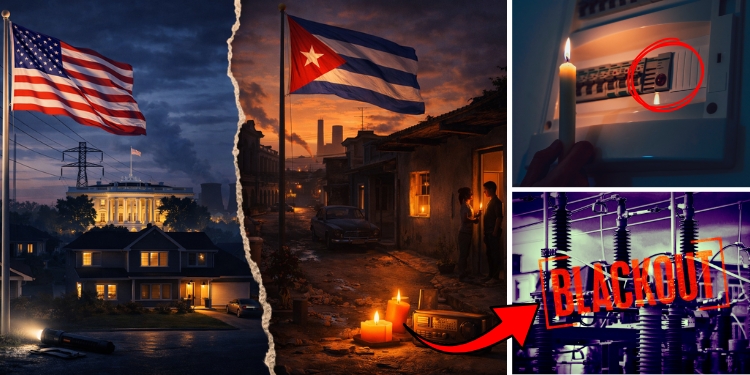


You don’t need a real collapse to understand where things are going. Right now, the grid is being pushed harder than it should be. In fact, that pressure is coming from decisions that are already in motion.
According to recent reports, production is moving back inside the country. It sounds like progress, but it also means more constant demand, more pressure, and fewer margins for error. And when that pressure builds, something has to give. And the US grid is the first to go down.
But even if the grid is strong, the government is deliberately causing blackouts. The reasons behind it will surprise you.
The Real Cost of Bringing Industry Back Home
Production is moving back into the country. That shift is already happening, and it comes from a clear direction. Trump’s plan pushes for tariffs, local manufacturing, and control over key industries like steel, energy, and semiconductors. The goal is to rely less on other countries and keep critical systems closer to home.
It sounds like a win at first glance – fewer weak points and more control.
But the reality is more complicated. The U.S. still leans on the outside world in ways that don’t just disappear. Oil prices still react to the current war with Iran. Manufacturing still depends heavily on Mexico for parts, labor, and cross-border supply chains that run every day. These connections are still in place, even as production shifts back.
New Import Tariffs Could Hit Your Wallet Faster Than You Think
Now layer this on top – all that returning industry needs power, and it doesn’t come in small amounts. Factories run constantly, pulling energy every hour of the day. Once they start, that demand stays there. The grid has to carry it without breaks.
For example, think about what happens on a very hot day. Homes are using more power for cooling, and at the same time factories are running at full capacity. The total demand gets very close to what the grid can handle.
At that point, operators have two choices. Let the system overload and risk a wider blackout, or reduce pressure in a controlled way. So they cut power in certain areas on purpose. Not everywhere, just enough to bring the load back under control.
That’s why some outages are not pure accidents – they are planned moves to keep the rest of the system running.
Why Outside Pressure Still Reaches You
Even if everything inside the country were perfectly balanced, the grid would still be exposed to what happens beyond U.S. borders.
Like it or not, energy is tied to global fuel supply, and that supply is under pressure from several directions right now. Shipping routes, political decisions, and restrictions on fuel all feed into the same system.
When fuel becomes harder to transport or more expensive to secure, problems show up almost immediately. The grid does not operate in isolation, so it reacts to those changes.
You may not see it at first. But then you might notice it in things like rolling outages in California or short peak-hour cuts in Texas, where power is shut off in specific areas to ease the load.
A Survival Lesson from Cuba
Cuba is dealing with a massive-scale blackout that shouldn’t be ignored. It’s been happening in the last few weeks, and it has repeated several times in a short span.
The Consequences of Relying on Imported Fuel
On March 16, 2026, more than 11 million Cubans lost electricity. By March 17–18, some areas had power restored, but millions still had no access.
Why did this happen? The country depends heavily on imported oil to keep its power plants running. In 2026, the U.S. Government tightened pressure by blocking oil shipments, including fuel coming from Venezuela and other suppliers. As a consequence, tankers were stopped, companies were warned off, and within weeks, fuel stopped arriving.
Why the Amish Are NOT Afraid of TEOTWAWKI
Once shipments were blocked, the effect showed up fast. Oil stopped reaching the main thermoelectric plants that supply most of the country’s electricity, so output dropped within days. The system couldn’t hold steady, and large parts of the island went dark at once, with the grid shutting down and struggling to restart.
They tried to restart it, but it didn’t hold. Power came back in sections, then failed again because the same problem was still there – not enough fuel going in.
Cuba’s current situation should be a cautionary tale of what happens when a system depends on external supplies that are restricted at a political level.
What Is Actually Happening on the Ground?
Cubans didn’t have it easy, but they did what they could to get through it. According to reports, homes were too dark and too hot to stay in, so streets in Havana filled up fast. Inside, people relied on phone flashlights or small improvised lights just to get through the night.
Soon after, food started to become a problem. That’s when the system showed how resourceful Cubans are. Living for years in a controlled economy, many were already used to shortages and knew how to adapt.
The worst situation was in hospitals. Some patients didn’t make it due to a lack of stable electricity, while others remained in critical condition. Births still took place, with staff working under reduced lighting and difficult conditions.
As for the government, officials focused on restoring the grid step by step. Crews worked to reconnect parts of the system, bringing power back in sections of the country. In Havana, only part of the city had electricity by the next morning, and even then, it wasn’t stable.
There were no large protests, even with growing frustration. Most people adapted, waited, and tried to get through it without knowing when things would fully return to normal.
Why is the Government Creating Blackouts on Purpose?
If you’re wondering why the government would create blackouts on purpose, the reasons are not always obvious. These outages don’t just happen because something breaks. In many cases, they are done deliberately, either as a test or a safety measure. Sometimes it’s a drill. Other times, the grid is simply under too much pressure, and something has to give. Here are a few examples worth mentioning:
California Rolling Blackouts (2020 Heatwave and After)
In August 2020, California ordered its first rolling blackouts in nearly two decades. A record heatwave pushed electricity demand beyond what the grid could supply, especially in the evening when solar power dropped but usage stayed high.
3 Subtle Signs that the Government Is Collapsing. #1 Is Taking Place at This Moment!
Grid operators (CAISO) stepped in and ordered utilities to cut power in rotating areas. Hundreds of thousands of homes lost electricity for short periods, sometimes more than once in the same day.
The goal was to prevent a full system collapse. Officials later admitted the grid had not been prepared for that level of stress, with limited reserve capacity available.
Texas ERCOT Controlled Outages (2021 Winter Storm)
In February 2021, Texas faced one of the most severe grid failures in U.S. history. A winter storm froze natural gas infrastructure and knocked power plants offline, cutting supply while demand surged.
ERCOT, the grid operator, ordered controlled outages to avoid a total grid collapse. What was supposed to be short, rotating blackouts turned into multi-day outages for millions of people. The system came close to failing completely. Officials later said that if the grid had gone down entirely, it could have taken weeks to restart.
While the blackout was controlled, the consequences were actually severe. Over 200 deaths were linked to the event, many from exposure to cold.
California Wildfire Power Shutoffs (2019–Present)
 Starting in 2019, California utilities like PG&E began using Public Safety Power Shutoffs (PSPS). These are planned outages triggered during high winds and dry conditions to prevent power lines from starting wildfires.
Entire regions have been shut down for days at a time, sometimes affecting hundreds of thousands of people.
Schools closed, businesses stopped, and residents had to prepare in advance or leave affected areas.
These shutoffs came after deadly wildfires, including the 2018 Camp Fire, which was linked to electrical infrastructure and caused massive loss of life and property. The policy reduced fire risk, but it also showed how power can be intentionally removed on a large scale.
National Grid Simulations
GridEx is a nationwide drill run by NERC every two years, involving utilities, federal agencies, and grid operators across the U.S. It doesn’t just “simulate” problems on paper. It walks through real scenarios that mirror what would happen during a major grid event.
How to Identify Federal Snitches in Prepper Groups
During these exercises, teams are given crisis situations like coordinated cyberattacks, physical damage to substations, or sudden loss of large power plants. Control rooms respond in real time, making decisions under pressure, just like they would during an actual emergency.
Operators practice isolating parts of the grid to stop failures from spreading. That means deciding which areas would lose power first, how to reroute electricity, and how to keep critical systems running while other sections go offline. Communication is also tested, between utilities, government, and emergency services, because delays can make the situation worse.
When This Starts to Affect You

You don’t need a nationwide failure for this to reach you. A regional imbalance is enough. High demand, fuel pressure, or increased industrial load can push the grid close to its limit, and that’s when operators step in to reduce pressure.
Most of the time, they don’t really have a choice. Cutting power in one area keeps the rest of the system from going down. On paper, it works. In reality, the consequences don’t always stay controlled.
Even short outages can turn serious fast. Hospitals switch to backup, food spoils, essential services slow down, and not every situation can afford even a few hours without power. What starts as a controlled move can still end badly for the people caught in it. And it doesn’t end when the lights come back. Supply chains take time to recover, losses pile up, and each disruption leaves something behind.
At some point, these situations raise a bigger question. If the system needs these kinds of measures to stay stable, how strong is it really, and how long can it hold?
Where You Stand in That System
When the grid comes under pressure, someone has to lose power so the rest can keep running. That decision is not random. It follows a clear order, and most people are not at the top of that list.
The Most Dangerous Day of a Blackout (It’s Not Day One)
If you’re reading this from home, you’re first in line to lose power. As a prepper, the real risk comes from repeated disruptions that wear you down and leave less room to recover. This is how it reaches you – not all at once, but in waves that make everyday life harder.
The Question You Should Be Asking Now
Cuba shows what happens when fuel supply is restricted and the grid cannot recover. The United States shows how a larger system handles pressure by distributing the impact instead of allowing total collapse.
Both situations point in the same direction. Power is no longer something that can be taken for granted in every condition. You are already inside a system that is being pushed harder and managed more tightly.
The real question is: how well can you handle a blackout when it really happens?
If that question made you stop for a second, then you already know this is no longer something to ignore. A blackout does not ask whether your pantry is full or whether your family knows what to do. It simply happens, and you will regret it if you’re not truly prepared.
Dark Reset: Survival Before the Silence was written inspired by real situations, where people had to adapt fast or deal with the consequences.
This is not just another “guide.” It’s the blackout protocol you need for survival.
Think of it like this. Right now, you still have time to test things while nothing is wrong. You can open your fridge and actually see how long food lasts without power. You can check if you have water when the tap stops. You can figure out what breaks first in your routine, not in theory, but in your own house.
Because when the outage comes, you won’t be reading, comparing options, or thinking things through. You’ll be dealing with whatever you already have in place.
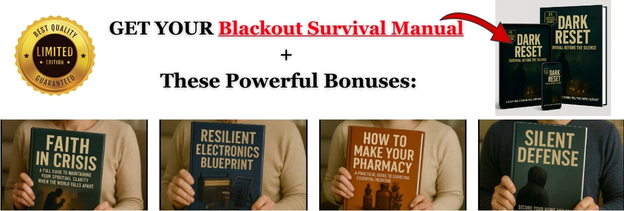
Dark Reset is just a shortcut through that trial-and-error phase. It shows you what fails first, what actually matters, and what people usually overlook until it’s too late.
You can figure all of that out on your own, slowly, over time. Or you can see it laid out clearly, before you have to learn it the hard way.
You may also like:
 We Have a New WhatsApp Channel – Click Here to Join Our Community!
You Won’t Survive an EMP Without This (VIDEO)
What the Government Won’t Tell You About Surviving the Next SHTF
The Complete Guide to Finding the Best Generator for Home Use
Do This Before the Next Blackout
The Federal Government Creates Blackouts on Purpose. When Will It Hit You?












Power loss may come from overloaded grid, earthquake, fire, seasonal storm, terrorism/war or EMP. I try to center my prepping on zero grid, reason for loss of grid is academic. Manual tools for the shop, garden and kitchen as well as firewood processing. Propane stove and gen set as back up for as long as propane lasts. Keep your vehicles fuel tanks full. That fuel may be enough to power equipment at home or a few miles between you and medical aid. Have enough for the return trip, no power, no more pumped fuel. Keep some cash on hand, card readers won’t work, but the neighborhood store may still take cash. Having at least a years property taxes in cash stashed away wouldn’t be a bad idea either. The assessor’s office possibly won’t care that you can’t access your bank account.
Like Para said, LOTS of reasons the grid may go down. The Gov out to get me by cutting the grid, not my idea of a threat. So, lets prep for the most likely – at some point it will go down, today or in a thousand years.
Mostly, I worry about EMP or Cyber attack.
EMP, time to protect the controls
Cyber & EMP TIME TO DISCONNECT FROM internet ! use the phone, call a human, tell them to make the change, if YOU can control the plant thru a piece of wire- so can the wrong people ! ! ! !
Yeah, most blackouts are intentional grid management o prevent a full collapse. Not fun, but well-intentioned, even when they hit people hard. The darker side though? Blackouts are becoming a legitimate war strategy. Countries that depend on fuel imports — think US, Russian, or any major supplier — are exposed. Cut the supply, and within days the grid starts failing. No missiles needed. Cuba is the clearest example. The government restricted fuel coming in, and the power went with it. So you are right Kre, being preppared is the only way to deal with it.
Speaking as a retired certified System Operator, the Federal government does not “create blackouts on purpose”. If the author had said state governments create blackouts on purpose, I would say, “Hmmm …Could be.”. (Hello, California?”)
What this article is talking about is “load shedding”.
Think of your bulk power power system like a swimming pool. Some people are putting water into the pool. Some people are taking water out of the pool. The amount of water being put into the pool (generation) has to be balanced to the amount of water being taken out of the pool (load), in order to maintain the level of water in the pool (frequency). Let’s just say, bad things happen when that balancing of load and generation doesn’t occur. This holds true for bulk power systems, and even your small home solar system. For large and small systems, the biggest challenge occurs when there is insufficient generation to satisfy load. Bulk power systems are required to have extra generation capacity to handle increases in load, or loss of generation. This extra capacity takes the form of “spinning reserves” (generation that’s running, but not at maximum), and “quick-start” units (gas turbine generators, smaller diesel-powered generators that can be brought online in less than 15 minutes). In extreme cases, natural disasters, or often poor management, that’s not enough
Load shedding, IMO, is a last resort to be used to bring too much load and not enough generation into balance when all else has failed. It is a last-ditch response to insufficient generation for the load at hand. In the California and Texas examples, it’s the result of poor management. In the case of California, it is to be expected. In the case of Texas, it is disappointing.
For large bulk power systems, solar and wind are fine as supplemental sources of energy, but that’s all. Because of the transient nature of solar and wind, a stable, constant source of base-load energy is needed. Texas over-relied on wind and solar, and did not maintain their traditional generation. That was foolish, and we saw the results.
California, aside from suffering from the same foolishness, limits utilities from clear-cutting vegetation from underneath power lines. That is the peak of stupidity and short-sightedness. For the California state government, that is par for the course. Witness the California state government’s EV mandates. If they’re having a hard time now, where’s that energy going to come from?
I would not want to be system operator in California or Texas. I have hope for Texas. California, however, would require major change in the state’s government. I don’t see that happening.
Regardless of all that, having a small residential solar system with battery and small generator backup (hey, you know it’s cloudy sometimes, right?) is not a bad idea. Stuff happens. Be prepared (Thanks SBP).
My .02.
Thanks for sharing your experience, I really appreciate it. The article talks about specific cases where blackouts are done on purpose under certain conditions, and I included a full section on real examples in the U.S. It’s important for people to understand how this works, and your explanation helps make that clearer.
Ms. Gilmour,
Just to be clear, yes, load shedding is done on purpose. However, that decision is not made by the Federal government. It is made by the Reliability Coordinator (aka the RC). The RC is certified by the National Electric Reliability Corporation (aka NERC, a private organization created to set and enforce standards for the utility industry to avoid control by the US government). The RC has a wide-area view, and has authority over the system operators in it’s area (aka balancing authority). The RC is the “capo di tuti capi”. If the RC calls and says, “We have an energy emergency in you area. I need you to shed ten percent of your load”, your only response as a System Operator is to repeat the command back (3-way communication) and get to it. As a system operator, it’s your choice who goes dark, and each utility has a predetermined list of circuits to shed, but you WILL shed at least ten percent ASAP, if that is what’s requested.
To sum it up, Reliability Coordinators, and System Operators, make load shed decisions. These individuals are not part of the Federal government. They will typically be employees of a non-governmental entity or electric utility. That has been my experience.
Thank-you for a thought-provoking article!
As a retired nuclear power plant worker, I agree completely with you comments!
Thank you prof. I appreciate your professional input.
You’re welcome, Sir.
To be even more clear, lets change some words for other words, I Hope Kv can comment to say I have this right or to explain I am an idiot.
They dont decide to black you out, they do it to AVOID a much larger CRASH !
its turn off some, or quickly Loose a LOT.
I expect, those with serious knowledge and LOTS of think tank time, know if it is safer to take down a factory – where sudden failure might be a serious safety issue, OR to take down 8 cul-de-sac’s where your dinner might be delayed and thats about all.
If you dont have one, your PC should be hooked to an emergency stand by power supply. They act as a surge protector, and buy you time to shut down if power is out, and a cushion while your own back up gen spools up. These days, you can get one that will run for hours before its depleted when power is off.
Please correct or acknowledge Kv
I have a cousin that is a coal station opperator and a real Wiz at it
Kre, you are correct, Sir.
And sometimes, it’s not a human making the decision. UFLS (Under Frequency Load Shed) is an automatic protective system that quickly sheds load in proportion to a drop in system frequency over time. I’ve seen it operate only once. Before you can even say, “What?”, it’s done. As you were saying, it’s better than losing the whole ball of wax.
Fortunately, in a well-managed system, load shed is a rare occurrence.
My .02.
First, THANK YOU.
In ’72 in upstate NY electric was down for a massive area. Hinkley station ( coal burner) was under 3′ of water.
When they could re start it, they had a modern problem. Needed a sign wave to match for Freq. purposes. What they did was go up to local finger lake, cut the door lock off (no one had a key anymore) turn some valves, and the old water wheel generator came to life. Built in another time, it was all it needed to generate. The little water wheel put the BIG Coal burner back in action.
IF I had some real knowledge, I would like to set up my own water generation system.
Kre,
Check out YouTube. I remember seeing a video of a guy who had a small hydro-electric system he built. It was on a stream running down the side of a hill. Don’t know if it put out AC or DC, or how much, but it was pretty slick.
Fun project. Solar might be easier, and more reliable, too. No long term dry seasons. : )
We tested our “off-grid system” this past January by boondocking in Arizona for 3 weeks in our van. We carried our own power (including solar), heating, refrigeration/freezer, and cooking capabilities. We used 4 cases of drinking water and three 5-gallon containers of water for other purposes. We took one shower at a local laundromat during that time. We had small rechargable solar lights. In our cooking, we had butane, charcoal, but used solar whenever we could. We heated with diesel.
Because we could do all this in our van for that long, we know we can adapt a system at home that might be even easier, since we have access to wood for heating and cooking if needed.
Hello, thank you for your comment. Sounds like you’ve already got a strong setup and the right mindset. Scaling that to home with wood as backup puts you in a really good position.