


An electromagnetic pulse can arrive without warning. Whether it comes from a high-altitude nuclear detonation or a severe solar storm, the result is the same: unprotected electronics are destroyed in an instant. Radios go silent. Communication tools fail. Years of preparation become useless because the devices you depend on are fried.
A faraday box is one of the simplest and most effective ways to protect your critical electronics before that happens. You do not need expensive gear or specialized knowledge to build one. You need basic materials, a clear understanding of how they work, and the willingness to act before the threat arrives.
This guide walks you through everything you need to know about how to make a faraday box at home, including multiple build methods for different budgets and storage needs, the materials that actually work, the mistakes that will leave your electronics unprotected, and how to test your build before you trust your gear to it.
What Is a Faraday Box and Why Does It Matter?
A faraday box is a sealed enclosure made from conductive metal that blocks electromagnetic fields from reaching the electronics stored inside. The principle was first demonstrated by English physicist Michael Faraday in 1836, which is where the name comes from. Today, military installations, research labs, and cybersecurity operations all use faraday enclosures as standard practice.
For preppers, the purpose is straightforward. A faraday box works by intercepting an incoming electromagnetic pulse and conducting it around the outside surface of the enclosure, dispersing it harmlessly instead of allowing it to pass through to the contents inside. The electronics inside are shielded from the voltage surges and electromagnetic fields that would otherwise destroy their circuits.
The term faraday box and faraday cage are often used interchangeably. In prepper usage, a faraday box typically refers to a rigid, fully enclosed container such as an ammo can, metal trash can, or sheet metal box. A faraday cage can also refer to larger mesh or screen enclosures. For home protection of electronic gear, the box format is the most practical and the most widely used.
What Threats Does a Faraday Box Protect Against?
There are two primary threats a properly built faraday box defends against.
The first is a high-altitude nuclear EMP, referred to as HEMP. A nuclear weapon detonated at high altitude generates a powerful multi-component electromagnetic pulse. The E1 component is the most immediately destructive to solid-state electronics. It arrives in nanoseconds with extreme intensity, inducing transient voltages that destroy circuits before any protection circuit can react. A well-sealed faraday box with adequate shielding effectiveness provides meaningful protection against E1 damage.
The second threat is a coronal mass ejection, or CME, from the sun. A large CME primarily threatens power grid infrastructure through induced ground currents, as the 1989 Quebec blackout and the 1859 Carrington Event both demonstrated. While CMEs are less immediately destructive to small personal electronics than a direct HEMP event, extreme CME scenarios introduce enough uncertainty that protecting critical devices remains a sound precaution.
According to the Congressional EMP Commission, a large-scale EMP event over the continental United States could permanently disable major infrastructure systems, with consequences that could affect the lives of millions. See the full report at empcommission.org.
What You Need Before You Build
Before choosing a build method, you need to understand the three non-negotiable rules that apply to every faraday box regardless of which container you use.
Rule 1: The Conductive Shell Must Be Continuous
The shielding works because the electromagnetic energy travels across the surface of the conductive enclosure and disperses rather than penetrating to the interior. Any gap, crack, or hole in that conductive surface is a path for electromagnetic energy to enter. This is why sealing matters as much as the container itself. A single unsealed seam can significantly reduce shielding effectiveness.
Rule 2: The Electronics Must Not Touch the Metal
If your devices are in direct contact with the interior metal walls, any charge that travels along the surface can transfer directly into your electronics. The interior of every faraday box must be lined with non-conductive insulating material. Cardboard, Styrofoam, thick fabric, and plastic sheeting all work. Nothing inside the box should touch bare metal.
Rule 3: Devices Should Be Stored Powered Off
An operating device with active components, antennas, or powered circuits presents a different shielding challenge than a powered-down device. Where possible, store electronics inside your faraday box with the power off. Where you are protecting devices with batteries you cannot remove, such as some modern electronics, consider double-wrapping them individually in additional foil inside the box as a secondary layer.
Materials You Will Need
The specific materials depend on which build method you choose, but the following items appear across most faraday box builds and should be gathered before you start.
- A metal container with a tight-fitting metal lid (ammo can, galvanized steel trash can, or steel box)
- Aluminum HVAC tape, also called metallic foil tape (not standard duct tape, which is not conductive)
- Cardboard, Styrofoam panels, or thick felt for interior lining
- Heavy-duty scissors or a utility knife for cutting liner material
- A ruler or measuring tape
- Newspaper or bubble wrap for wrapping individual items
- Heavy-duty aluminum foil for wrapping items and reinforcing seams (optional but recommended)
- Zip-lock bags for a final moisture layer around wrapped items
- A marker for labeling contents
One important note on tape: aluminum HVAC tape is conductive and creates a continuous metal seal across lid seams. Standard duct tape is not conductive. Using the wrong tape on lid seams defeats much of the purpose of sealing the box.
How to Make a Faraday Box: Four Build Methods
The following four methods range from a five-minute emergency solution to a purpose-built box that can protect large electronics for years. Choose the method that fits your needs, budget, and the size of the devices you need to protect.
Method 1: The Ammo Can Build (Best All-Around Option)
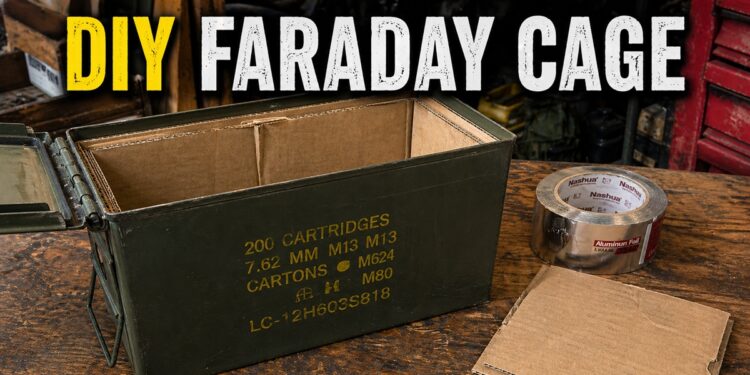
We actually built this project for the YouTube channel:
A military-style metal ammo can is widely considered the best entry-level faraday box for preppers. It is inexpensive, widely available at surplus stores and online, nearly indestructible, waterproof, and provides approximately 40 to 50 decibels of shielding effectiveness when properly sealed. It is the right size for handheld radios, GPS units, small tablets, USB drives, spare batteries, and communication devices.
What you need:
- One military surplus metal ammo can with a lid (30-caliber or 50-caliber are the most common sizes)
- Cardboard cut to fit the bottom, sides, and lid interior
- Aluminum HVAC tape
- Newspaper and heavy-duty foil for wrapping individual items
Step-by-step instructions:
- Clean the interior of the ammo can and remove any moisture.
- Measure and cut cardboard pieces to fit the bottom and all four interior walls. The goal is a complete non-conductive lining on every surface the electronics could touch. Cut pieces so they fit snugly with no gaps between them.
- Press the cardboard lining firmly into place. Secure it with a small amount of tape if needed, but keep the lining removable so you can repack the box.
- Wrap each device you plan to store individually: first a layer of newspaper, then a layer of aluminum foil, then another layer of newspaper, and finally seal it in a zip-lock bag. This gives each item its own layered protection inside the box.
- Remove batteries from devices where possible before storing them.
- Place a cardboard piece on the bottom of the lined interior, then arrange your wrapped devices so nothing is pressing directly against the cardboard hard enough to push through to the metal wall.
- Cut and fit a final cardboard piece for the top of the contents before closing the lid.
- Close the lid and run aluminum HVAC tape all the way around the lid seam, overlapping the tape on itself as you go. Cover the hinge and the handle bracket as well, since these are the most common gap points.
- Label the exterior with a marker listing the contents.
Best for: Handheld radios, walkie-talkies, GPS units, USB drives, backup cell phones, small solar charge controllers, spare batteries.
Method 2: The Galvanized Steel Trash Can Build (Best for Larger Electronics)
A galvanized steel trash can is the most popular large-format faraday box in the prepper community. A 20-gallon can gives you enough space to protect a portable radio, a laptop, a solar panel charge controller, and additional gear simultaneously. It costs roughly 25 to 40 dollars at most hardware stores and requires no specialized tools.
What you need:
- A galvanized steel trash can with a metal lid (not a plastic can)
- Cardboard sheets or Styrofoam panels for lining
- Aluminum HVAC tape
- Foam weather stripping (optional, to improve the lid seal)
- Newspaper and heavy-duty foil for wrapping items
Step-by-step instructions:
- Inspect the trash can and confirm it is made from galvanized or zinc-coated steel. The can must be metal, not plastic. A magnet will stick to steel but not to aluminum, which gives you a quick way to confirm the material.
- Cut cardboard or Styrofoam panels to line the bottom and interior walls. The liner does not need to be perfect, but there should be no gaps large enough for a device to slide through and contact the metal.
- Cut a separate liner piece for the inside of the lid.
- Wrap each device individually using the same newspaper, foil, newspaper, zip-lock bag method described in the ammo can build.
- Place all wrapped items inside on the cardboard floor, ensuring nothing presses into the side walls hard enough to contact the metal through the liner.
- Place the lid liner inside the lid and set the lid on the can.
- Run aluminum HVAC tape around the entire seam where the lid meets the can body. Overlap the tape and cover the full circumference twice. The lid seam is the most common failure point in trash can builds.
- For additional sealing, apply a strip of foam weather stripping around the inside of the lid rim before taping. This closes any gap between the lid edge and the can body.
- Store the can on a non-conductive surface such as wood, rubber matting, or a wooden pallet.
Best for: Portable shortwave radios, laptops, tablets, solar charge controllers, walkie-talkie sets, backup hard drives, handheld scanners.
Do not ground a portable faraday trash can. For EMP protection, grounding a portable enclosure can create a path for induced ground currents to enter the interior rather than dispersing them harmlessly. Leave it ungrounded and elevated off the floor.
Method 3: The Cardboard Box with Foil Wrap (Budget Emergency Option)
If you need a quick faraday box solution and do not have metal containers available, a cardboard box wrapped in multiple layers of heavy-duty aluminum foil is a legitimate option. It is not as robust as a metal container, but when built correctly it provides meaningful shielding and costs almost nothing.
What you need:
- A sturdy cardboard box with a separate lid (a shoebox or similar rigid box works well)
- Heavy-duty aluminum foil, not standard kitchen foil
- Aluminum HVAC tape to seal seams
- Additional cardboard for internal insulation
Step-by-step instructions:
- Wrap the entire exterior of the cardboard box in two complete layers of heavy-duty aluminum foil. Overlap every seam and fold edges tightly to avoid gaps.
- Wrap the lid separately with the same two-layer foil method.
- Seal every seam and overlap on both the box and lid with aluminum HVAC tape. Pay close attention to the corners.
- Line the inside of the box with an additional layer of cardboard or a thin layer of Styrofoam to ensure the devices inside do not contact the foil layer.
- Wrap each device individually as described in previous methods.
- Place devices inside the lined box, close the foil-wrapped lid, and seal the lid-to-box seam with a final strip of HVAC tape.
- Handle this build with care since foil tears easily. If the foil develops a hole, patch it immediately with HVAC tape.
Best for: Temporary protection, backup option, protecting items during transport, or as a secondary layer inside a larger container.
Method 4: Nested Containers (Maximum Protection)
For your most critical electronics, the best approach is nesting one faraday container inside another with an insulating layer between them. This layered shielding approach is used in professional and military applications and significantly improves total shielding effectiveness compared to a single container.
The concept is simple. Build a small faraday box using the ammo can method. Then place that sealed ammo can inside a larger faraday container such as a trash can, with a cardboard or Styrofoam layer between the two metal surfaces. The electromagnetic energy must now penetrate two independent shielded enclosures with an insulating air gap between them, which makes it exponentially harder for any damaging field to reach the electronics inside.
This method is the right choice for items like a backup handheld radio you are counting on for post-event communication, a spare phone loaded with critical offline maps and reference material, or any medical device electronics you cannot afford to have fail.
Related: 6 Ingenious Ways to Communicate Post‑SHTF (It’s Not HAM Radio)
How to Test Your Faraday Box
Building a faraday box and trusting it without testing it is a mistake you may not get a second chance to correct. Testing is simple and should be done before you seal critical gear inside.
The Cell Phone Test
Place a powered-on cell phone inside the sealed faraday box. Use another phone to call it. If the call goes straight to voicemail without ringing, the box is blocking the signal. If it rings, the box has a gap in its shielding that needs to be found and sealed.
A cell phone signal operates at frequencies much lower in intensity than an E1 EMP pulse, so passing the phone test does not guarantee the box would fully protect against the highest-intensity EMP frequencies. However, it does confirm that the basic shielding principle is working and that there are no obvious gaps in the conductive enclosure. It is the most practical test available to the average prepper.
The FM Radio Test
Tune a small portable radio to a clear FM station and place it inside the sealed box. If the signal goes silent, the faraday enclosure is working. This tests at a different frequency range than the cell phone test and provides additional confirmation that the shield is continuous.
If Your Test Fails
A failed test means there is a gap somewhere in the conductive layer. The most common failure points are the lid seam, the hinge area, the handle mount, and any point where the foil or tape has a wrinkle, tear, or overlap that did not adhere fully. Apply additional HVAC tape to all seams and test again. On ammo cans, pay special attention to the hinge and the closure clasp, which are common leak points.
What to Store in Your Faraday Box
Not everything needs to go in a faraday box. The goal is to protect the items you would need most in a post-EMP scenario, particularly communication and navigation tools that cannot be replaced once the supply chain is gone.
High Priority Items
- Handheld ham radio or shortwave radio with its charging cable and manual
- Walkie-talkies for short-range communication within your group
- Backup cell phone loaded with offline maps, survival references, and contact lists
- Portable GPS unit
- USB drives containing important documents, medical records, and reference material
- Small AM/FM/NOAA weather radio
- Spare batteries, battery banks, and USB charging adapters
- Solar charge controller for any small-scale solar setup
Secondary Items Worth Protecting
- A spare laptop or tablet loaded with offline reference material
- Medical device electronics such as a backup insulin pump controller
- Night vision or thermal optics with digital components
- Small inverter for converting battery power
- Backup hearing aids or similar medical electronics
Keep an inventory list sealed inside your box so that if you ever need to open it quickly, you know exactly what is inside and where it is. Confusion during a crisis is a luxury you cannot afford.
According to the American Radio Relay League, ham radio operators represent one of the most critical communication networks in a post-disaster scenario. Protecting your radio equipment in a faraday box preserves your ability to receive information and coordinate with others when no other communication infrastructure is functioning. See arrl.org for licensing and preparedness resources.
Common Mistakes That Will Cost You Everything
Most faraday boxes that fail do not fail because of the container. They fail because of one of a small number of preventable mistakes.
Using Duct Tape Instead of HVAC Tape
Standard gray duct tape is not conductive. Using it to seal the lid seam of your faraday box creates a non-conductive gap right at the most vulnerable point of the enclosure. Always use aluminum HVAC tape, which creates a continuous metal seal.
Letting Electronics Touch the Metal Walls
Even a device wrapped in newspaper and foil can work its way against the interior wall if the liner is loose or the box is moved frequently. Check your liner periodically and make sure it is snug and complete, with no gaps where devices could shift into contact with the metal.
Skipping the Individual Wrapping Step
Lining the interior of the container is necessary but not sufficient on its own. Wrapping each device individually in its own foil layer creates a secondary shield around each item. If the outer container has even a small shielding leak, the individual foil wrap can still protect the device. Skipping this step removes a critical backup layer.
Using Plastic Containers
Plastic does not conduct electricity and provides zero electromagnetic shielding on its own. A plastic bin lined with foil can be made to work, but it requires significantly more careful foil application and sealing than a metal container. If you have a choice, always use a metal container.
Grounding a Portable Faraday Box
A common misconception is that grounding your faraday box improves EMP protection. For portable enclosures, the opposite is true. Grounding can create a path for induced ground currents to enter the cage rather than dispersing around it. Leave portable faraday boxes ungrounded and store them on a non-conductive surface.
Building It and Forgetting It
A faraday box is not a one-time project. Tape dries out. Foil tears. Cardboard liners compress and develop gaps. Check your faraday boxes at least once a year, reseal any compromised tape, and replace any damaged interior lining. Rotate batteries stored inside on the same schedule as your other emergency supplies.
How Much Does a Faraday Box Cost?
One of the advantages of the faraday box as a preparedness tool is that effective protection is genuinely inexpensive.
- Aluminum HVAC tape (one roll): approximately $10 to $15. One roll is enough for multiple builds.
- Military surplus 30-caliber ammo can: approximately $10 to $20 at surplus stores.
- Military surplus 50-caliber ammo can: approximately $20 to $30.
- 20-gallon galvanized steel trash can: approximately $25 to $40 at hardware stores.
- Cardboard for lining: free if you reuse boxes you already have.
- Heavy-duty aluminum foil: approximately $5 to $10 for a large roll.
A complete ammo can faraday box build costs under 30 dollars in most cases. A large trash can build costs under 60 dollars. For a threat that could permanently destroy every unprotected electronic device you own, that is among the best insurance investments in the prepper toolkit.
Frequently Asked Questions
Does a microwave oven work as a faraday box?
A microwave is designed to keep microwave-frequency energy contained inside it during operation, not to keep external electromagnetic fields out. It offers some shielding, but it is significantly inferior to a properly sealed metal container. A sealed metal trash can or ammo can outperforms an unplugged microwave for EMP protection. Use a proper build rather than relying on a kitchen appliance.
Related: Is A Microwave Oven A Faraday Cage?
Should I store my faraday box in the basement?
A basement location is reasonable because it adds additional mass between your box and the external environment. However, the most important factor is that the box itself is properly sealed, not where it is stored. A well-sealed ammo can stored on a wooden shelf anywhere in your home will protect its contents better than a poorly sealed container in a basement.
Do I need to remove batteries from devices before storing them?
Yes, wherever it is possible to remove batteries, you should do so. Batteries left inside devices for extended periods corrode and can permanently damage the electronics. Store spare batteries wrapped separately inside the same box, and reinsert them when you retrieve the devices.
Will one faraday box protect everything I own?
One box protects only what is inside it at the moment of an EMP event. Devices in use, plugged in, or left outside the box will be destroyed. The goal is not to protect every device you own but to protect your most critical backup electronics so that you have functional communication and navigation tools after the event.
Can I use aluminum window screen instead of solid metal?
Aluminum window screen works as a faraday material, but the mesh spacing matters. Standard window screen with openings under one millimeter is adequate for the threat levels most preppers are planning against. The critical requirement is that the mesh creates a continuous conductive surface across all faces of the enclosure with properly overlapping and electrically continuous seams. For a box-format build, solid metal containers are simpler and more reliable than screen-based builds.
Don’t Let One Pulse Wipe Out Everything You’ve Prepared
You can build the perfect faraday box. You can protect your radios, your backup phone, your solar gear.
But here’s the uncomfortable truth most people ignore:
Protecting your electronics is only step one.
Surviving what comes AFTER is the real fight.
When the grid goes down—whether from an EMP, a cyberattack, or a cascading infrastructure failure—you’re not just dealing with dead devices. You’re dealing with:
- No running water
- No resupply
- No emergency services
- No reliable communication
- And no second chances
That’s where most people fail.
Why the Smartest Preppers Think “Bug-In,” Not “Bug-Out”
The idea of grabbing a bag and heading into the wild sounds good… until reality hits.
In a real collapse:
- Roads are clogged within hours
- Fuel becomes scarce immediately
- Urban exits become choke points
- And moving your family exposes you to unnecessary risk
The people who actually make it through?
They stay put. They fortify. They outlast.
The Missing Piece: A Real Bug-In Strategy
Building a faraday box protects your gear.
But what protects:
- Your food supply over time?
- Your water when systems fail?
- Your home when things get unstable?
- Your family when help isn’t coming?
That’s exactly what Navy Seal Bug-In Guide was designed for.
This isn’t theory. It’s a step-by-step survival framework based on real-world tactical planning—adapted for civilians who want to be ready before things go bad.
What You’ll Learn Inside
- How to turn your home into a defensible, self-sufficient stronghold
- The exact 72-hour, 2-week, and 3-month survival layers most people miss
- How to secure water, food, and sanitation when infrastructure collapses
- Practical ways to stay off the radar and out of trouble
- How to think like someone trained for worst-case scenarios
Connect the Dots
You just learned how to protect your electronics from an EMP.
Now ask yourself:
👉 What’s your plan the day after?
👉 What’s your plan when the silence doesn’t end?
👉 What’s your plan when everyone else starts panicking?
Because having a working radio doesn’t matter…
if you don’t know what to do next.
Take Action While It Still Matters
Start simple:
- Build your faraday box ✔
- Protect your critical gear ✔
- Then build a real survival plan around it
Don’t wait for a warning you’ll never get.
👉 Get the Navy Seal Bug-In Guide now and build a plan you can actually rely on.
Your future self isn’t going to care what you meant to do.
Only what you actually prepared.
Build It Now, Before You Need It
An EMP event gives no warning. There is no broadcast alert, no 48-hour preparation window, and no second chance to protect the electronics you left outside your faraday box. The preparation happens before the event or it does not happen at all.
Building a faraday box is a one-afternoon project that costs less than dinner for two. The ammo can method takes under an hour from start to finish. The trash can build takes slightly longer. Both provide real, meaningful protection against one of the highest-impact scenarios in the prepper threat matrix.
Get an ammo can. Get a roll of HVAC tape. Cut your cardboard liner. Wrap your most critical devices. Seal the lid. Test it with your phone. That is the entire process. There is no reason to leave your communication tools unprotected for another week.
The grid is fragile. The threat is real. Build your faraday box today.
You may also like:
 What Is The Best Faraday Cage Fabric?
The Only 3 Shelters You’ll Need to Survive in the Wild (VIDEO)
Can 5G Penetrate a Faraday Cage?
5-Minutes DIY Tested Faraday Cage Out Of A Trash Can