


If you’ve ever driven through Amish country and noticed a solar panel on a barn roof or heard the hum of a diesel generator behind a woodworking shop, you probably did a double-take. The popular image of the Amish as people who flatly reject all electricity is one of the most widespread misconceptions in American culture. The real answer is layered, practical, and frankly, something every serious prepper should study.
The short version: most Amish do not connect to the public utility grid. But that is very different from saying they live without electricity. Millions of people across the country are only now beginning to figure out how to live off-grid, while Amish communities have been running independent power systems for generations. Understanding how they do it, and why, offers a blueprint that holds up whether you’re concerned about grid failure, economic collapse, or simply reducing your dependence on systems outside your control.
The Real Question Is Not Whether They Use Electricity, But Where It Comes From
The Amish relationship with electricity comes down to one core principle: separation from the world. Connecting to the public power grid means becoming dependent on an outside institution, one that delivers not just electricity but television signals, internet connections, and an endless stream of cultural influence directly into the home. That is what the Amish have historically refused, not electrons themselves.
Each Amish community operates under a set of community standards called the Ordnung, a German word meaning order. The Ordnung is not a written legal code but a living set of expectations maintained by each local church district. What one district permits, the next district might prohibit. This is why sweeping generalizations about the Amish and technology are almost always incomplete. According to the Young Center for Anabaptist and Pietist Studies at Elizabethtown College, the Old Order Amish forbid tapping electricity from public utility lines as a core restriction, but they do not prohibit electricity generated and controlled on their own property.
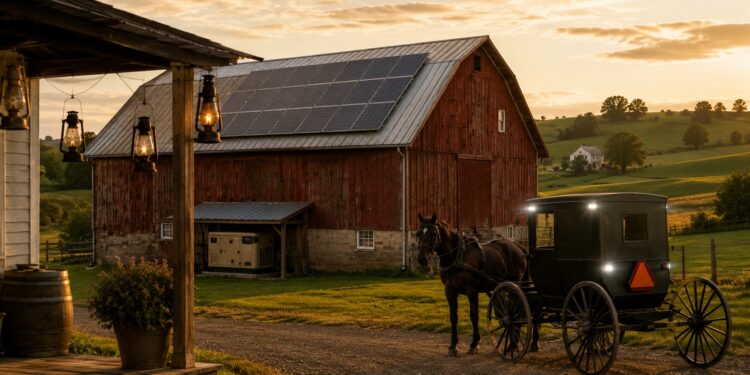
This distinction is everything. It means an Amish farmer can run a milking machine off a diesel generator, charge batteries with a solar panel, and power LED lighting through a 12-volt system, all without violating the Ordnung, as long as the power source is self-contained and owned by the community.
Why the Public Grid Specifically Is the Problem
To outsiders, avoiding power lines while accepting generators or solar panels can look contradictory. But from inside the Amish worldview, the logic is consistent. Running a power line from the street into the home is a physical connection to the outside world. Once that connection exists, there is no practical limit to what can be plugged into it.
Amish parents are deeply concerned about outside influence on their children. A house with standard electrical outlets becomes a house that could have televisions, gaming consoles, computers, and internet routers. By refusing the public grid entirely, the community creates a structural barrier against those influences, not just a rule that individuals have to enforce by willpower every day.
Scholar Donald Kraybill, who has studied Amish culture extensively, has described Amish-generated electricity from off-grid sources like solar as tapping into “God’s grid,” a phrase that captures how the Amish distinguish between power they control and power that connects them to the outside world. That framing matters. It is not about rejecting technology in some abstract sense. It is about maintaining sovereignty over what enters the community.
How Different Amish Groups Handle Electricity
Not all Amish communities draw the line in the same place. Understanding the major affiliations helps clarify why you might see one Amish farm with a generator shed and another that uses only propane and kerosene.
Old Order Amish
The Old Order represents the largest and most widely recognized Amish affiliation. They use horse-drawn transportation, conduct worship services in private homes, and prohibit connection to public utility lines. Within that constraint, individual districts vary considerably. Some allow 12-volt battery systems for lighting. Others permit diesel generators for farm operations. Many have adopted solar panels to charge batteries and power electric fencing or water pumps. The Old Order is not a monolith. A community in Lancaster County, Pennsylvania may have different rules than one in Holmes County, Ohio, even though both are considered Old Order.
New Order Amish
The New Order Amish split from the Old Order beginning in the 1960s over issues of spiritual practice and community discipline. They maintain horse-and-buggy transportation and plain dress but have generally more relaxed technology standards. Many New Order churches permit electricity in the home, though rules still vary by region. Some New Order churches in Holmes County, Ohio, for example, do not allow electric lights on the main floor of the house, while New Order communities in other areas permit household electricity more broadly. New Order Amish are also more open to telephones in the home and, in some cases, allow air travel.
Swartzentruber Amish
At the most conservative end of the spectrum sit the Swartzentruber Amish. They reject technologies that many Old Order communities permit, including indoor plumbing in some cases, rubber tires on farm equipment, and battery-powered lights in homes. Some Swartzentruber communities allow only kerosene lanterns and strictly limit generator use. Their restrictions are among the most comprehensive of any Amish affiliation still functioning in significant numbers.
Beachy Amish and Amish Mennonites
The Beachy Amish occupy a different category entirely. They own automobiles, connect to the public utility grid for home electricity, use computers for business purposes, and engage in active missionary work. According to Elizabethtown College’s Amish Studies program, the Beachy Amish and Amish Mennonites use public utility electricity. Theologically, they share roots with the Old Order but have accepted a significantly higher degree of modern technology. The Amish Mennonites sit further still in the direction of mainstream evangelical Christianity.
The Alternative Power Systems Amish Communities Actually Use
Understanding how Amish communities generate and use off-grid power is directly relevant to anyone building a self-sufficient household or retreat. These systems have been field-tested across generations of practical use.
Diesel and Gasoline Generators
Generators have been a staple of Amish power infrastructure for decades. When government regulations required dairy farmers to refrigerate milk before pickup, Amish farmers installed diesel generators to run milk coolers. That same generator then powered woodworking tools, air compressors, and other farm equipment. Generators are typically housed in separate sheds rather than inside homes or workshops, creating physical distance from the noise and fumes while keeping the technology visible as a separate system rather than a hidden household convenience.
12-Volt Battery Systems
The 12-volt DC system is one of the most widespread solutions in Amish communities. Deep-cycle batteries, similar to marine batteries or car batteries but designed for repeated discharge and recharge, store power for lighting, fans, water pumps, and small appliances. Inverters convert 12-volt DC into 110-volt AC for devices that require standard current. According to reporting in Anabaptist World, restrictions in many communities are placed on loads rather than on the systems themselves, meaning the battery bank may be permitted while specific high-power appliances remain off-limits.
Solar Power
Solar adoption among Amish communities has accelerated significantly over the past decade, and the trend shows no signs of slowing. What makes solar particularly compatible with Amish values is that it requires no monthly bill, no connection to outside infrastructure, and no grid dependency. A modest system of one to two panels with battery storage is sufficient to power LED lighting, a water pump, and a few essential appliances across a typical Amish household.
One Amish-owned solar installation company in Indiana, Wellspring Components, began as a buggy repair shop before expanding into solar installation over 27 years ago. The company reports that the same basic system that once cost over $1,000 now costs approximately $150, making off-grid solar accessible even to the most resource-conscious communities. Some Amish businesses have invested in large-scale solar arrays to replace diesel generators that were costing tens of thousands of dollars annually in fuel.
Compressed Air and Hydraulic Power
Many Amish workshops run power tools through compressed air rather than electric motors. A gasoline or diesel engine powers a compressor, which then drives pneumatic saws, drills, and other tools through air lines. This approach allows high-powered production work without direct electrical connections. Hydraulic systems work on the same principle, with fluid pressure doing the work that electric motors would otherwise handle. These systems are common in Amish furniture shops, construction crews, and farm operations.
Propane and Kerosene
Propane handles a substantial portion of Amish household energy needs. Gas-powered refrigerators, stoves, water heaters, and lights are standard equipment across most Old Order communities. Propane does not require any connection to the grid, can be delivered and stored on-site, and provides reliable energy for cooking and heating independent of weather or battery charge levels. Kerosene lamps remain in use in more conservative communities and as backup lighting elsewhere.
Wind Power
Windmills have long been used in Amish communities to pump water from wells. Roof-mounted small wind turbines have become more common in recent years in some regions, providing an additional charging source for battery systems. While wind power is less universally adopted than solar or diesel, it fits naturally with the Amish preference for self-generated, grid-independent energy.
How the Decision-Making Process Actually Works
One of the most instructive aspects of Amish technology management for preppers and self-sufficiency practitioners is the deliberate, community-based process through which new technologies are evaluated. The Amish do not adopt new tools because they are new. They also do not reject them because they are new. Each technology is assessed based on whether it strengthens or weakens community cohesion, family bonds, and spiritual focus.
When a new tool or system appears, a bishop or church leadership may permit one or several households to try it on a trial basis. The community observes whether the technology creates pride, introduces outside influence, encourages idleness, or disrupts relationships. If it passes that evaluation over time, wider adoption may follow. If it causes problems, it gets restricted or prohibited.
This process means Amish communities adapt slowly but purposefully. They are not technophobic. They are selective. The result is communities that have been quietly living off-grid, managing their own power systems, and maintaining food production and craft skills for generations while the surrounding world grew increasingly dependent on centralized infrastructure.
What the Population Numbers Tell You
As of June 2025, the Amish population in North America stands at approximately 410,955 people, according to the Young Center for Anabaptist and Pietist Studies. That represents a 131 percent increase since 2000, when the population was approximately 177,910. The population doubles roughly every 20 years, driven by large families and an average retention rate of 85 percent or more. Ohio, Pennsylvania, and Indiana together account for approximately 61 percent of the total North American Amish population.
These numbers matter because they tell you that Amish off-grid living is not a remnant of a dying tradition. It is a growing model practiced by over 400,000 people in 32 states and three Canadian provinces. Communities are not struggling to survive their energy choices. They are expanding.
What Preppers Should Take Away From the Amish Approach to Energy
The Amish are not running off-grid as an emergency contingency plan. They are running off-grid as a permanent operational model. That is a fundamentally different mindset than most preppers start with, and it produces fundamentally different results.
The key lessons from the Amish energy model:
- Grid independence is built through layered systems, not single solutions. Amish communities combine propane, diesel generators, battery banks, solar, and pneumatic power. No single failure takes down everything.
- Restricting the loads matters as much as building the supply. The Amish do not try to generate enough power to live a modern American lifestyle off-grid. They redesign the lifestyle to fit what off-grid power can reliably provide.
- Technology decisions should be tested before widespread adoption. Running one generator in a separate shed before wiring the whole farm is a risk management strategy as much as it is a cultural practice.
- Community infrastructure is more resilient than individual infrastructure. The Amish model of communal work, shared tools, and collective decision-making distributes both the costs and the risks.
- Low-tech backups are always maintained alongside higher-tech systems. Kerosene lamps do not disappear when a community adds solar panels. The fallback is always there.
For anyone building out a homestead, a retreat property, or a suburban backup power system, the Amish track record on these principles is worth more than any theoretical framework. These are people who have field-tested off-grid living under real-world conditions, across multiple generations, through economic downturns, harsh winters, and technological change, and they have done it while growing their communities rather than shrinking them.
Common Misconceptions Worth Clearing Up
“The Amish are completely against electricity”
This is the most common misunderstanding. Most Amish communities use electricity generated from sources they control. The restriction is against public grid connection, not against electric current.
“All Amish communities have the same rules”
There are hundreds of distinct Amish affiliations and thousands of individual church districts, each with its own Ordnung. Rules about solar panels, generators, battery-powered lights, and propane appliances vary significantly from district to district and state to state.
“Amish technology restrictions are arbitrary or irrational”
The restrictions follow an internal logic rooted in community protection and spiritual priorities. Whether you share those priorities or not, the framework is coherent. Technologies that strengthen self-sufficiency and family cohesion while limiting outside influence get permitted. Technologies that introduce dependency, distraction, or individualism get restricted.
“The Amish are falling behind because of their restrictions”
The population data does not support this. With over 410,000 people across North America as of 2025 and consistent growth, Amish communities are not failing. They are one of the fastest-growing religious communities in the United States by percentage. Their energy model has not prevented economic activity. Amish businesses in furniture, construction, agriculture, and specialty manufacturing are competitive and well-regarded. An Amish-owned solar company in Indiana now saves clients tens of thousands of dollars annually in fuel costs by designing off-grid systems that work within Amish restrictions while outperforming the diesel setups they replace.
The Amish Did Not Learn Self-Sufficiency From YouTube
Long before modern Americans started panic-buying generators and searching for off-grid tutorials online, Amish families were already building independent systems that worked without the public grid.
They mastered food preservation, low-tech resilience, livestock management, woodworking, water systems, home medicine, fuel independence, and community-based survival generations ago — not as a hobby, but as a way of life.
That is exactly why so many preparedness-minded people are turning to The Amish Ways.
This book pulls back the curtain on practical Amish skills and old-world systems that helped families survive without depending on fragile modern infrastructure. Inside, you’ll discover forgotten techniques for food storage, gardening, natural remedies, self-reliance, off-grid living, and sustainable homesteading methods most people have completely lost touch with.
What You’ll Discover Inside The Amish Ways
- Traditional Amish food preservation methods
- Practical off-grid household systems
- Self-sufficient gardening and farming techniques
- Old-world herbal remedies and home medicine
- Low-tech solutions that still work during outages and emergencies
- Simple, durable lifestyle systems designed around resilience instead of convenience
If this article made you realize how dependent modern life has become on centralized systems… this is the next thing you should read.
👉 Get your copy of The Amish Ways here!
Final Thoughts
The Amish do not plug into the public electricity grid. That is accurate and consistent across virtually all Amish communities. Beyond that single restriction, the picture becomes far more complicated and far more instructive. Different affiliations draw different lines. Different districts within the same affiliation interpret the Ordnung differently. What holds across essentially all Amish communities is the core principle: power should come from sources you own, control, and manage, not from systems that connect you to the outside world and all its influences.
For preppers, this is not just religious history. It is operational doctrine. A growing movement of over 400,000 people has demonstrated that grid independence is not a fringe concept or a temporary emergency measure. It is a viable, permanent way of organizing a productive community life. The Amish have the generators, the solar panels, the battery banks, the propane systems, and the agricultural skills to prove it.
The grid will fail at some point. It always does, whether locally or regionally, temporarily or for longer stretches. The question is not whether you will ever wish you had an independent power source. The question is whether you have built one before you need it. The Amish answered that question generations ago.
You may also like:

Amish Chicken Coops: The Self-Sufficient Prepper’s Ultimate Guide
The US Army’s Forgotten Food Miracle (VIDEO)
Amish Cinnamon Bread: Friendship Recipe