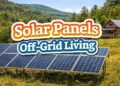

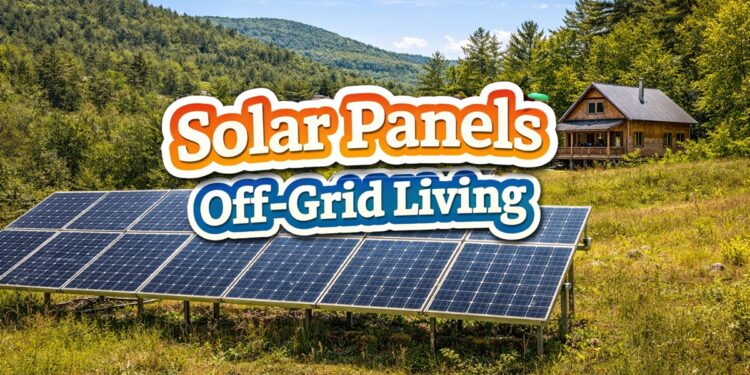


Going off-grid with solar is one of the most significant investments a self-reliant homesteader can make. Done right, it eliminates your utility bill permanently, keeps your property powered when the grid fails, and gives you the kind of energy independence that no amount of prepping supplies can replace. Done wrong, it drains your budget on undersized equipment, leaves you in the dark when you need power most, and sends you back to the hardware store for parts you should have bought the first time.
The difference between a system that works and one that fails is not brand loyalty or spending more money. It is understanding the fundamentals: how to calculate what you actually need, how to match your panels to your batteries and inverter, how to site and mount your array correctly, and where the common mistakes are before you make them.
This guide covers all of it in the order you need to know it. By the end you will have a clear framework for designing a solar system scaled to your actual energy needs. The U.S. Department of Energy Office of Energy Efficiency and Renewable Energy provides extensive technical resources on residential and off-grid solar installations, and we reference their guidelines throughout where they apply to off-grid design.
Why Solar Is the Right Choice for Off-Grid Power
Off-grid power options include generators, wind turbines, micro-hydro systems, and solar. For most homesteads in most locations, solar is the right primary system for three reasons: fuel independence, low maintenance, and scalability.
A generator runs on gasoline, propane, or diesel. Any of those fuels can become unavailable, expensive, or rationed during a supply disruption. A solar array runs on sunlight, which is not subject to supply chains or price spikes. A well-maintained solar system with quality components has no moving parts, requires minimal upkeep, and has a service life of 25 to 30 years on the panels themselves. And unlike a generator or wind turbine, a solar system can be expanded incrementally as your budget and energy needs grow.
Wind and micro-hydro are worth considering as supplements where the resource exists, and a backup generator is a sensible addition to any off-grid system for extended cloudy periods or heavy-use events. But for the foundational power system on a self-sufficient homestead, solar is the starting point. According to the National Renewable Energy Laboratory (NREL), most locations in the contiguous United States receive sufficient solar irradiance to support a well-designed off-grid system year-round, including northern states and cloudy climates, when the system is properly sized for seasonal variation.
The Four Core Components of an Off-Grid Solar System
Before you size anything, you need to understand what the four main components do and how they relate to each other. A system that is unbalanced, where one component is oversized or undersized relative to the others, will underperform regardless of the quality of individual parts.
1. Solar Panels
Solar panels convert sunlight into direct current (DC) electricity. Panel output is rated in watts under standard test conditions (STC), which represent ideal laboratory conditions that your actual installation will rarely match exactly. Real-world output typically runs 75 to 85 percent of the rated wattage under normal operating conditions due to heat, angle variation, and atmospheric factors.
Panels come in three main types: monocrystalline, polycrystalline, and thin-film. For off-grid homestead applications, monocrystalline panels are the standard recommendation. They offer the highest efficiency per square foot (typically 20 to 22 percent), perform better in low-light and high-heat conditions than polycrystalline, and have the longest documented service life. The higher upfront cost per watt is justified for a permanent installation where you are optimizing for long-term performance and space efficiency.
- Monocrystalline: Best efficiency, best low-light performance, longest lifespan, highest cost per watt
- Polycrystalline: Lower efficiency, lower cost, adequate for large open installations with no space constraints
- Thin-film: Flexible and lightweight, useful for curved or unconventional mounting surfaces, lower efficiency than crystalline types
2. Charge Controller
The charge controller sits between your panels and your battery bank. Its job is to regulate the voltage and current coming from the panels so it does not overcharge or damage the batteries. There are two types: PWM (Pulse Width Modulation) and MPPT (Maximum Power Point Tracking).
For any system over a few hundred watts, MPPT is the correct choice. An MPPT controller continuously finds the optimal operating point for your panels and can recover 10 to 30 percent more energy from the same array compared to a PWM controller, particularly in cold weather and low-light conditions. The higher cost of an MPPT controller pays for itself quickly in improved battery charging and system efficiency.
3. Battery Bank
The battery bank is the most critical and most expensive component in an off-grid solar system. Your panels generate power only when the sun shines. Your battery bank is what powers your homestead at night, on cloudy days, and during any extended period of low solar production. Undersizing your battery bank is the single most common and most costly mistake in off-grid solar design.
Battery options include flooded lead-acid (FLA), sealed AGM lead-acid, lithium iron phosphate (LiFePO4), and gel batteries. For a permanent off-grid installation where long service life and depth of discharge matter, lithium iron phosphate has become the preferred choice despite its higher upfront cost. LiFePO4 batteries offer 3,000 to 5,000 charge cycles at 80 percent depth of discharge, compared to 500 to 800 cycles for quality flooded lead-acid batteries at only 50 percent depth of discharge. The math over a 10-year ownership period typically favors lithium for serious installations.
- Flooded lead-acid: Lowest upfront cost, requires maintenance (watering), venting, shorter cycle life
- AGM sealed lead-acid: Maintenance-free, no venting required, moderate cycle life, higher cost than FLA
- LiFePO4 lithium: Highest upfront cost, longest cycle life, deepest usable discharge, lightest weight, safest lithium chemistry
- Gel: Maintenance-free, sensitive to overcharging, moderate performance, being largely displaced by AGM and lithium
4. Inverter
Your panels and batteries operate on DC power. Most household appliances run on AC power. The inverter converts DC from your battery bank into the 120V or 240V AC power your loads require. For an off-grid homestead, you need a pure sine wave inverter. Modified sine wave inverters are cheaper but cause problems with sensitive electronics, motors, and many modern appliances. Pure sine wave output matches grid quality power and works with everything.
Inverter sizing is based on your peak simultaneous load, not your average consumption. If you might run a well pump, a refrigerator, and a microwave at the same time, your inverter needs to handle that combined surge load. Many appliances, particularly motors, draw two to three times their rated wattage for the first few seconds at startup. Factor that surge current into your inverter sizing or you will trip it at the worst possible moment.
How to Size Your Off-Grid Solar System
System sizing is not guesswork. It is arithmetic. Work through the following steps in order and you will arrive at a system specification that matches your actual needs.
Step 1: Calculate Your Daily Energy Consumption
List every electrical load in your home or homestead: lights, refrigerator, freezer, well pump, water heater, washing machine, power tools, phone and laptop chargers, and anything else that draws power. For each item, note its wattage (usually printed on the label or in the manual) and how many hours per day you use it. Multiply watts by hours to get watt-hours per day for each item, then add them all up.
A modest off-grid cabin might use 1,500 to 3,000 watt-hours per day. A full-featured homestead with a well pump, chest freezer, and power tools might run 5,000 to 10,000 watt-hours per day or more. Be honest and thorough at this step. Underestimating your consumption is where most undersized systems start.
The NREL PVWatts Calculator is a free government tool that lets you estimate solar production for any U.S. location based on your panel wattage, tilt angle, and system losses. Run your design through it after you have calculated your consumption to verify your panel array is adequate for your location and season.
Step 2: Size Your Battery Bank
Determine how many days of autonomy you want, meaning how many days you can run your system without solar input. For most off-grid homesteads, two to three days of autonomy is the standard design target. This covers typical stretches of overcast weather without requiring a generator backup for every cloudy day.
The formula is: Daily consumption in watt-hours, multiplied by days of autonomy, divided by the usable depth of discharge for your battery type, divided by your system voltage. For LiFePO4 at 80 percent depth of discharge on a 48V system powering a homestead using 5,000 watt-hours per day with three days autonomy: 5,000 x 3 = 15,000 Wh needed, divided by 0.80 = 18,750 Wh total bank capacity required, which at 48V equals approximately 390 amp-hours of battery capacity.
48V battery systems are standard for homestead-scale installations because higher voltage means lower current for the same power, which allows smaller wire gauges and reduces resistive losses throughout the system. 12V systems are appropriate only for small cabins or vehicle installations.
Step 3: Size Your Solar Array
Once you know your daily consumption, you can determine how many panels you need to recharge your batteries within a reasonable solar window. The calculation depends on your location’s peak sun hours, which is a standardized measure of the equivalent number of hours per day your location receives solar irradiance at 1,000 watts per square meter.
Most of the contiguous United States receives between 4 and 6 peak sun hours per day on an annual average. Divide your daily consumption by your peak sun hours to get the panel wattage required before accounting for system losses. Then divide by an efficiency factor of 0.75 to 0.80 to account for real-world losses including inverter inefficiency, wiring losses, temperature derating, and dirt on panels. A homestead using 5,000 Wh per day in a location with 5 peak sun hours needs 5,000 divided by 5 = 1,000W, divided by 0.77 = approximately 1,300 watts of panel capacity as a starting point.
Size up rather than down. Solar panels are the least expensive component to add later, but designing short from the start means chronic battery undercharging, shortened battery life, and frustration every time a cloudy week hits.
Step 4: Size Your Charge Controller and Inverter
Your MPPT charge controller needs to be rated to handle the maximum current output of your solar array at your battery bank voltage. Most manufacturers provide online calculators or sizing guides. As a rule, do not exceed 80 percent of your controller’s rated input capacity to provide headroom for cold-weather peak production.
Your inverter should be sized to handle at least your largest single motor load’s surge current plus the continuous wattage of everything else you might run simultaneously. A 3,000-watt pure sine wave inverter is a common starting point for a full-featured homestead. Many off-grid installers use inverter-chargers, which combine the inverter with an automatic transfer switch and battery charger, allowing seamless integration of a backup generator for extended low-sun periods.
Installation: Siting, Mounting, and Wiring
Panel Orientation and Tilt
In the Northern Hemisphere, panels should face true south, not magnetic south. The difference between true and magnetic south varies by location and can be 10 to 20 degrees in parts of the United States. Pointing your array at magnetic south rather than true south costs you meaningful production over a year. Use a solar pathfinder tool or an online solar site analysis calculator to confirm your optimal azimuth.
Tilt angle affects seasonal production balance. A tilt angle equal to your latitude maximizes annual production. Steeper angles favor winter production when the sun is lower in the sky; shallower angles favor summer. For year-round off-grid use, latitude-matched tilt is the standard starting point. Adjustable mounting systems that allow you to steepen the angle in winter are worth considering in northern latitudes where winter solar production is the binding constraint on system sizing.
Ground Mount vs. Roof Mount
For a permanent off-grid homestead, a ground-mounted array is usually the better choice over a roof mount. Ground mounts are easier to clean, easier to adjust for seasonal tilt optimization, easier to service, and do not require penetrating your roof structure. They can also be positioned for optimal solar exposure independent of roof orientation. The tradeoff is higher material cost for the racking structure and longer wiring runs to your battery bank.
If a ground mount is not feasible, a well-engineered roof mount works fine. Ensure your roof structure can handle the added load, use proper flashing at all penetrations to prevent leaks, and verify you can access the panels safely for occasional cleaning and inspection.
Wiring and Safety
Off-grid solar systems operate at voltages that can cause serious injury or death if handled incorrectly. DC systems are in some ways more dangerous than AC systems because DC arc faults do not self-extinguish the way AC faults do. Use appropriately rated wire for every run in your system, follow the National Electrical Code (NEC) Article 690 which governs solar photovoltaic systems, install proper overcurrent protection at every transition point, and use a properly rated disconnect between your panels and charge controller and between your battery bank and inverter.
Keep your battery bank and inverter in a dedicated, ventilated enclosure away from living spaces. Even LiFePO4 batteries, which are the safest lithium chemistry, should be housed in a proper battery enclosure with appropriate ventilation and fire separation. Flooded lead-acid batteries produce hydrogen gas during charging and require active ventilation to prevent dangerous accumulation.
Real Cost Breakdown: What a Complete System Actually Costs
Off-grid solar costs have dropped dramatically over the past decade. A system that would have cost $30,000 to $50,000 ten years ago can now be built for significantly less with better components. That said, anyone who tells you going off-grid with solar is cheap is either selling something or describing a very small system.
Here is a realistic cost range for a mid-sized off-grid homestead system producing approximately 5,000 to 8,000 watt-hours per day:
- Solar panels (2,000 to 4,000 watts of monocrystalline): $1,500 to $4,000 depending on brand and source
- MPPT charge controller (60 to 80 amp): $300 to $600
- Battery bank (LiFePO4, 200 to 400 amp-hours at 48V): $3,000 to $8,000, representing the largest cost variable
- Pure sine wave inverter or inverter-charger (3,000 to 5,000 watts): $800 to $2,500
- Ground mount racking and hardware: $500 to $1,500
- Wiring, conduit, disconnects, fuse blocks, and overcurrent protection: $400 to $1,000
- Monitoring system and miscellaneous hardware: $200 to $500
Total installed cost for a self-installed system in this range runs approximately $6,700 to $18,000. Professional installation adds $3,000 to $8,000 or more depending on system complexity and labor rates in your area. The wide range reflects the battery bank cost, which varies more than any other component based on chemistry, brand, and capacity.
The long-term economics are compelling. The U.S. Energy Information Administration reports the average U.S. residential electricity rate at roughly 16 cents per kilowatt-hour as of recent data, with rates trending upward over time. A homestead using 150 to 250 kilowatt-hours per month at that rate is paying $24 to $40 per month or more, plus connection fees, which add up to $500 to $800 annually before any rate increases. A well-built off-grid solar system paid for itself in avoided utility costs typically within 8 to 15 years, after which power is effectively free for the remaining 15 to 20 years of the system’s service life.
Common Mistakes and How to Avoid Them
- Undersizing the battery bank: The most expensive mistake to correct after installation. Size for three days of autonomy minimum, not one.
- Ignoring winter solar production: Design your system around your worst solar month, not your best. Summer surplus is nice; winter shortfall is a crisis.
- Using modified sine wave inverters to save money: The compatibility problems with motors, electronics, and modern appliances will cost more in damaged equipment than the savings on the inverter.
- Skipping the charge controller on a small system: Even a modest battery bank needs overcurrent protection and proper charge regulation. There is no system too small to need a charge controller.
- Cheap wiring and connectors: Resistive losses and connection failures in undersized or low-quality wiring degrade system performance and create fire hazards. Use properly rated components throughout.
- No backup plan for extended low-sun periods: A generator-compatible inverter-charger and a properly sized propane or gasoline generator gives you a seamless backup for the weeks when solar production cannot keep up with demand. Plan for this before you need it.
- Roof mounting without structural assessment: Solar panels add meaningful dead and wind load to a roof structure. Have a structural engineer verify your roof can handle the load before you commit to a roof mount system.
Build It Right the First Time
An off-grid solar system built on solid fundamentals will power your homestead reliably for 25 years or more with minimal maintenance. The planning phase is where the work happens. Get your load calculations right, size your battery bank conservatively, match your components properly, and wire everything to code. The cost of doing it correctly upfront is always less than the cost of fixing an undersized or poorly wired system after the fact.
Energy independence is one of the most tangible forms of self-sufficiency you can build. It does not expire, does not depend on supply chains, and does not come with a monthly bill. That is worth doing right.
Solar power is one of the most powerful upgrades you can make to your homestead — but electricity is only one piece of the self-sufficiency puzzle.
True independence means knowing how to operate when every modern system becomes unreliable: power, water, heating, cooking, lighting, food storage, and communication.
That’s exactly where No-Grid Survival Projects becomes invaluable.
This practical guide goes far beyond solar panels. It shows you how to build the core systems that allow a homestead to function without relying on fragile infrastructure. The kind of systems that keep working when supply chains stall, utilities fail, or prices spike beyond affordability.
Inside, you’ll discover step-by-step projects designed to help you reduce dependence on external services and take control of your essential resources:
- Reliable off-grid energy solutions that complement solar systems
- Backup systems that keep your home functional during extended outages
- DIY heating and cooking setups that don’t rely on the grid
- Water collection and filtration systems for long-term independence
- Practical ways to maintain comfort and functionality without utility support
- Simple builds that increase resilience without requiring specialized skills
- Field-tested projects designed for real-world disruptions
Solar power gives you electricity. But real preparedness comes from having multiple independent systems that work together.
- What happens if your inverter fails?
- What happens during extended cloudy periods?
- What happens when fuel becomes expensive or unavailable?
- What happens when replacement parts are delayed for months?
Homesteaders who thrive long-term don’t rely on a single solution — they build layered resilience.
- That means backup cooking methods.
- Independent lighting options.
- Redundant heating systems.
- Water access that doesn’t depend on municipal infrastructure.
- Practical skills that reduce dependence on outside services.
No-Grid Survival Projects helps you build that redundancy step-by-step, using practical designs that prioritize reliability over complexity.
If your goal is to create a homestead that keeps functioning regardless of what happens to the grid, this is one of the most valuable resources you can own.
Because real self-reliance isn’t about one system — it’s about having a complete ecosystem of solutions that continue working when everything else stops. ⚡
You may also like:

Read This Before You Buy a Solar-Powered Generator
The US Army’s Forgotten Food Miracle (VIDEO)
The Complete Guide to Finding the Best Generator for Home Use
How Many Solar Panels Do You Need To Power Up Your Fridge?
Join The Ask A Prepper WhatsApp Channel for even more valuable articles