

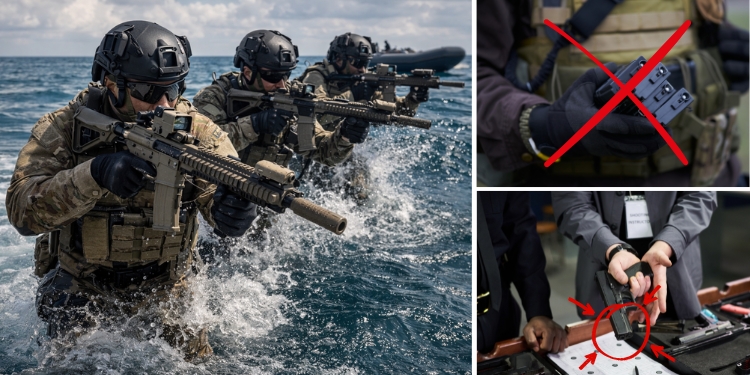


There is a reason elite warriors choose their weapons with extreme care. A Navy SEAL does not carry a firearm based on brand loyalty, marketing hype, or internet rumors. Every weapon in their hands has been tested under brutal conditions, such as extreme weather exposure or urban combat. They know that if a gun fails once, it is gone.
So when you see a firearm heavily promoted to civilians as “military grade,” it is worth asking a hard question: Would a Navy SEAL actually trust his life to it?
There is one category of firearm that consistently fails that test. It looks tactical, it is widely sold and looks modern. Yet you will never find it in the hands of special operations professionals during real-world missions.
Let’s break down why.
The Harsh Reality of Special Operations
Before naming the type of gun in question, you need to understand what SEAL teams demand from a weapon.
A Navy SEAL may deploy into freezing ocean water at night, swim miles with full gear, then move through mud, sand, and tight urban spaces before engaging a target. Their weapon has to function after saltwater immersion, cycle reliably with sand in the action, and keep running through thousands of rounds without a single failure.
When it comes to success, there is no room for mechanical weakness or cosmetic features that compromise reliability. It is also mandatory for the weapon to be simple to maintain, easy to clear under stress, and backed by a proven supply chain for parts and magazines. Anything less makes it a liability.
The Gun a Navy SEAL Would Avoid
The type of firearm that raises serious concern in special operations circles is the cheap, imported, magazine-fed tactical shotgun that fills civilian gun stores. Most of these models are built overseas, often in large production factories in places like Turkey, then brought into the U.S. under different brand names that change every few years.
DIY Backyard Looter Traps for Instant Revenge
They are designed to look aggressive, with detachable box magazines, adjustable stocks, rails, and other add-ons meant to give a military appearance. Behind that appearance, many of these shotguns have a record of feeding problems, weak internal parts, and uneven quality control from one batch to another. That pattern alone is enough to keep them out of real military use, and it is why a Navy SEAL would never choose one for a combat mission.
Why Magazine-Fed Shotguns Are a Risk
Traditional pump shotguns like the Remington 870 and Mossberg 590 have earned a reputation for reliability over decades. The U.S. military has used pump shotguns for door breaching and limited combat roles, and they have proven durable when properly maintained. Magazine-fed semi-automatic shotguns are different.
These systems rely on detachable magazines feeding bulky shotgun shells into a semi-automatic action. Shotgun shells are large, rimmed, and often vary slightly in length depending on load type. That design creates feeding challenges that are far more complex than rifle cartridges. Under stress, magazine-fed shotguns are more prone to:
- Feeding failures.
- Magazine seating issues.
- Shell deformation.
- Inconsistent cycling with different loads.
In controlled range environments, they may function well enough. In mud, sand, or freezing temperatures, those weaknesses become dangerous. Special operations units value simplicity and proven performance. The more moving parts and feeding complications you introduce, the greater the risk of malfunction.
What SEALs Actually Use
 Navy SEALs do use shotguns, though their role is limited. The most common models historically associated with special operations include:
- Benelli M4 (M1014).
- Mossberg 590A1.
- Remington 870.
The Benelli M4 stands out for a reason. Its gas-operated system was built to keep running in extreme conditions, from sand to saltwater.
The design uses a fixed tubular magazine instead of a detachable box system, which reduces feeding issues and keeps the mechanism simple. Before adoption, the platform went through military trials to prove it could handle real operational stress.
The difference between a Benelli M4 and a low-cost imported tactical shotgun is night and day. One went through military testing protocols, while the other went through marketing departments. And that difference matters when your life depends on the next trigger pull.
The Hidden Problem
There is a practical issue here that you might miss when shopping for gear. A large number of budget shotguns are built to look tactical, with rails, adjustable stocks, extended controls, and sharp styling that gives the impression of military strength. That appearance can create confidence, even if you have never tested it under serious stress.
Real military weapons usually look simple for a reason. The base platform is chosen for durability and reliability, and then any accessory is added only after it proves it will not affect feeding or long-term wear.
What to Do If You Come Face to Face with a Bear, Cougar, or Wolf
Extra parts are not installed just to improve appearance, since every added component increases weight and introduces another possible failure point.
Special operations units judge a weapon by how it performs after rough handling, exposure to water, dust, and repeated firing. If a shotgun cannot keep running when dirty, wet, or dropped, it offers little value no matter how aggressive it looks.
Worst-Case Scenario
 Navy SEALs avoid equipment that introduces uncertainty. A weapon that jams, a platform built around uncommon ammunition, or anything difficult to maintain in harsh conditions simply doesn’t make the cut.
Reliability and practicality matter more than novelty, because in a real breakdown every decision carries consequences.
Now picture the kind of situation professionals quietly plan for but hope never happens. The economy has taken a hard fall.
Supply chains stalled weeks ago, banks are limiting withdrawals, and fuel deliveries stopped reaching many towns. Grocery stores were emptied in a matter of days. What’s left is a slow shift toward local trading networks where people exchange whatever resources they still control.
In that environment, ammunition becomes extremely valuable. But the key detail most people overlook is that not all ammunition carries the same value. Odd calibers and specialty rounds become almost impossible to trade, while common ones move easily between people.
That’s why experts recommend focusing on widely used calibers and storing ammo correctly for the long term. Rounds like .22 long rifle, 9mm, .223/5.56 NATO, and 12-gauge shells remain the most practical because so many rifles and handguns depend on them.
Professionals often keep ammunition sealed in controlled environments where moisture and corrosion cannot reach it, sometimes using military-style coatings such as lacquer-sealed primers and case mouths, a method famously used in Russia to protect rounds from humidity. Find out how to properly seal it with lacquer here.
When stored properly in airtight containers with moisture control, ammunition can remain reliable for decades, which is exactly why SEALS treat it as a long-term resource rather than something casually stacked on a shelf.
The Supply Chain Question
 There is also a legal side that most buyers ignore.
Many of these imported magazine-fed shotguns fall into a gray area of U.S. firearm law, which limits how many foreign-made parts can be used in certain semi-automatic shotguns.
Some models are brought into the country in a “sporting” configuration, then modified after import with extended magazines or tactical furniture. If the parts count is not compliant, the owner can end up in violation without even realizing it.
That risk does not exist with platforms that were designed from the start to meet U.S. military or law enforcement standards. Established manufacturers usually provide clear guidance on compliant configurations and offer U.S.-made components to be legal.
There is also the issue of import bans and executive restrictions. Firearms brought in under import permits can disappear from the market overnight if trade policy changes or sanctions hit the exporting country. When that happens, spare parts, magazines, and warranty support can vanish just as quickly. Owners are left with a firearm that cannot be easily repaired or legally modified.
This is why professionals avoid platforms that depend on fragile import pipelines or unclear compliance status. Stability in manufacturing and clarity in legal standing matter just as much as performance, especially in a country where regulations can shift with a single administrative decision.
What This Means for Your Prepping Strategy
As long as you understand that a firearm is a tool you may have to depend on, and not a status symbol or some expensive toy, your chances of surviving a real crisis go up.
That mindset requires discipline and a steady nervous system, since panic and ego lead to bad choices. Without that foundation, the gun can turn into an overpriced accessory that looks impressive yet offers far less protection than you expected when pressure is real.
Here is how to approach it the right way:
- Choose platforms with a long service record. Look for shotguns that have been used for years by law enforcement or military units, since that history gives you real data on durability and failure patterns.
- Check parts availability before you buy. Make sure springs, extractors, firing pins, and magazines are sold by multiple suppliers, not just one importer who might disappear.
- Buy spare wear parts early. Small components fail first, and during panic buying they are often the hardest items to find.
- Test your exact setup. Run the ammunition you plan to store, not just whatever is cheapest at the range, and pay attention to feeding, ejection, and how the gun behaves when dirty.
- Study patterns, not opinions. If multiple owners report the same feeding or cycling issue, that points to a design problem, not bad luck.
When it comes to training, take this from me: get proper firearms instruction, then attend a serious home defense course so you know how to protect your home under real pressure.

Why Professionals Think Differently
A Navy SEAL looks at a weapon the same way a diver looks at an oxygen tank, as equipment that keeps him alive when everything around him is hostile. The focus stays on performance under pressure, repeatable function, and gear that has already proven itself in harsh conditions. There is no space for brand loyalty or trendy features when the mission depends on the next round of firing without hesitation.
That mindset is powerful, and it is one reason special operations units earn their reputation. They strip away ego, ignore hype, and select tools based on hard testing and real-world results. You can learn a lot from that approach, since survival planning follows the same logic.
But drawing inspiration from SEALs does not mean copying their exact gear; it means adopting their discipline. Choose equipment that has survived stress, train with it until it feels natural, and remove weak links before they have a chance to surface. That standard is what keeps elite units effective, and it is the same standard that will strengthen your prepping strategy.
Curious what a former Navy SEAL says most gun owners get wrong? Watch this short video and discover a few inside secrets you probably never considered. Tell us what you think in the comments section below!
You may also like:
 What a Green Beret Would Say about Your Guns
How to Prep Under the Radar (VIDEO)
Why You Should Think Like a Navy SEAL Instead of a Doomsday Preppers























The Russian Saiga 12 gauge is magazine-fed, and I have never had a malfunction.
That’s good to hear. Some Saiga shotguns run very well, yet quality can vary depending on where the parts come from or how the gun was assembled.
Fostech is faster and smoother than s benelli fostech is mag or drum fed own both benelli sbe and a vinci
I think the title should be changed from gun to shotgun – THATS the focus of the article.
Yes, parts of it, rub on all guns. that said, the part that says LOTS of practice, those ARE key words. When your new, your 45 acp will have feed problems – ITS YOU not the gun, unless you bought real junk. practice, practice, practice ! and yes, let it get dirty, find out how dirty is TOO DIRTY at practice ( maybe 7 or 800 practice rounds to find out) and yes use a LOT of what ever you plan to bulk store ( find out your defense system doesnt like it EARLY, before you stock up).
The grey beards and LEO’s already know all this, but if your new to all this, you need a lot of pushing in the right direction, to save your life.
Suggest you find a GOOD and active club. Shoot all the types of pistol competition, NRA action, IPSC combat, Bullseye. Some trap and skeet as well. NRA action and Bullseye will teach you to be a good marksmen, IPSC will teach you to think about defense ! Hide FIRST, be able to shoot back from ODD positions, weak hand only, every time the restrictions on the competitor are different – like in the real world.
Shot guns, I plan to eat BIRDS from the use of mine. Thats about what they are best for.
There are many others worth owning, those mentioned in the article are tried and true, but I own others. For pure defense, I would consider 00 buck, but it still would not be my first thought.
While all firearms are guns, not all guns are firearms. Technically not incorrect, but I understand your point.
So I have an older Gforce box fed 12gage. The reason I bought that gun was the rumor that its a Bennelli M4 without the tube, which turned out to be true. So I got a Bennelli for $250. Not sure how long the mags will last but I have had it for 3 years and so far it runs great. Fit and finish on the upper is a little rough, stock isn’t adjustable.
Very happy with my 590 and when you use mini shells it holds way more rounds.
Probably a pretty good article, and yet …. there are few of us readers who will ever be tasked with the duties of a Navy Seal … or have to endure a Navy Seal training environment. Yeah … I know … as preppers we want to be prepared for all risks that the uncertain future might bring. Including having the weapons that will last as long as we do … but at 75 years old, I am not likely to be crawling on my belly in a sandy wash, where my semi auto Turkish built 12ga semi auto will fail. In the vast majority of scenarios living and existing in suburb America, surrounded by a lot of dry desert … my Shotgun has fared quite well … and after all, every firearm is a backup.
If you enter a scenario with one firearm, (no matter what caliber / brand you have chosen) … you can consider yourself unprepared.