

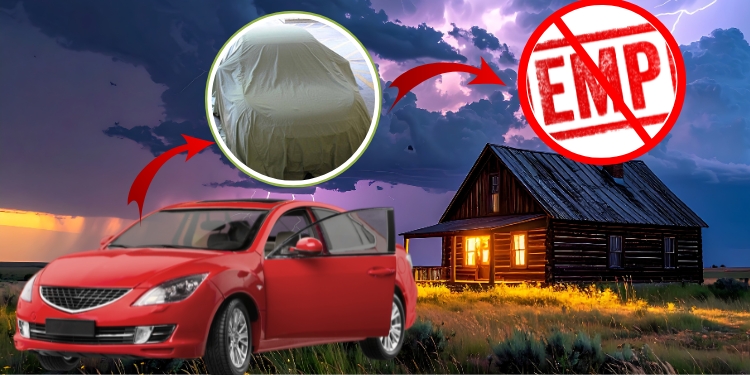


There is a lot of debate online about whether or not an EMP will affect a modern vehicle. We have already talked about how to choose an EMP proof car for SHTF and that is to buy a car or truck that was made before the 1980s. These vehicles will have more mechanical systems for the critical engine components, and the electronic systems that they do have will either not be critical for it to function or be easy to replace if an EMP fries them.
Of course, most of us don’t want to rely on a vintage car for daily driving. But if you’re building a dedicated bug-out vehicle, starting with something old enough to be naturally EMP-resistant is a smart move.
As most of you know, there are several other ways to protect modern vehicles from EMPs. But before we get into those, it helps to understand how recent solar storms have affected modern technology and how powerful the next one could be.
What the Latest Solar Storm Could Teach Us About EMPs
In November 2025, a powerful solar storm hit Earth, sending bursts of electromagnetic energy that disrupted radios and GPS signals across Europe and Africa. That flare was accompanied by a fast coronal mass ejection (CME) hurtling toward Earth; and when it arrived, it triggered a strong radio blackout over parts of Europe and Africa.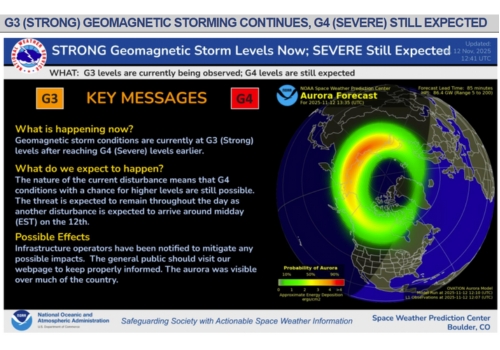 The consequence? High‑frequency communications suddenly went silent or badly degraded, especially on the sunlit side of the planet. The aftermath was subtle but telling: aircraft and maritime HF radio links experienced disturbances, satellite tracking and GPS signals showed anomalies, and auroras lit up the sky much further south than usual. In other words, this wasn’t just a distant space weather headline, but a real empirical “stress‑test” of our technologically‑dependent infrastructure.
Why the next one could be worse?
Think of this recent event as a warning shot. It showed that the Sun can send electromagnetic disruptions capable of interfering with communications and navigation. It did not take down your car, but it illustrated how vulnerable the infrastructure around your vehicle is. If a stronger event hit, one of the scenarios would include a full‑scale geomagnetic storm (G4 or G5) that could induce large currents in electrical grids, disable satellites, and create widespread electronics malfunctions.
How to Protect Your Vehicle from an EMP
Garage Faraday Cage
For experienced preppers, the old school garage Faraday cage is the most straightforward way to protect multiple vehicles at once. The goal is a fully enclosed metal barrier with no gaps, so every vehicle and piece of electronics inside is shielded from electromagnetic pulses.
Metal walls, ceiling, and a solid conductive door create a strong protective envelope. Even small openings can compromise protection, so attention to detail is a must.
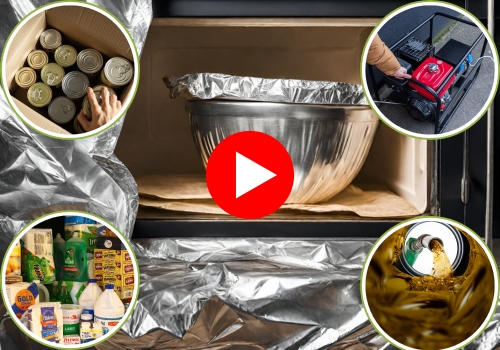
In this case, doors are always the tricky part. A standard garage door isn’t naturally EMP-proof, so it needs to be fully integrated into the cage. Many preppers use welded metal panels or conductive gaskets to seal edges, ensuring the door can still operate without breaking the protective barrier.
One useful method is grounding, because it adds an extra layer of defense. While a Faraday cage doesn’t require grounding to block EMP energy, a proper ground can help dissipate surges from lightning strikes or nearby electrical faults.
EMP Cloth
Made with woven with fine conductive fibers, usually copper, nickel, or silver, the EMP cloth create a flexible electromagnetic barrier. When wrapped and sealed along the edges, it blocks EMP energy in the same way a Faraday cage does, but without the bulk or rigidity.
The trick is in the application – coverage has to be complete, with no gaps or openings for the pulse to slip through. Even the underside of your vehicle has to be covered for complete protection.
Here’s a VIDEO that shows you how to do it in an effective way:
EMP Shield
There is a product called EMP Shield that you can install in a vehicle, and this will help to protect it from an EMP without resorting to building Faraday cages. Here’s what it means in plain terms:
- What it is: A small, hardwired surge-protection device that installs directly into your vehicle’s electrical system (or your home’s power system).
- What it does: It’s designed to divert or absorb sudden electrical surges caused by an EMP or solar event before they can fry sensitive electronics.
- Why people use it: Unlike a Faraday cage (which physically blocks electromagnetic energy), an EMP Shield connects to your system and acts as a filter or protector. Once installed, it supposedly provides constant passive protection.
Nevertheless, independent verification of these devices is limited, because EMPs are extremely hard to simulate outside of military testing, so most civilian products rely on surge and transient voltage testing as a proxy.
The Best Way to Protect Your Vehicle from an EMP Is…
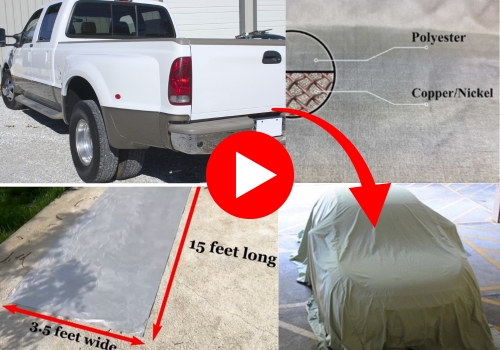
The EMP Cloth. But instead of lining your garage, you can create a portable EMP shield for your vehicle by sewing together a car cover out of EMP cloth. The advantage is clear: you can throw it over your car whenever you need it, and it works even for vehicles parked outdoors.
To start, you can buy an EMP cloth here, then gather a sewing machine and some basic sewing skills to get started on creating your protective car cover. One of the easiest approaches is to take an existing car cover and attach the EMP cloth to the outside.
Make sure to overlap all seams so there are no gaps in coverage. The original car cover acts as an extra layer of insulation between the vehicle and the conductive material, while the EMP cloth provides the actual electromagnetic protection.
If you want to make a cover entirely from scratch, you’ll need to measure your vehicle carefully, cut the EMP cloth to size, and sew panels together to fully cover the car. The downside is that this procedure is time-consuming and requires patience.
So, if your car is not an SUV or other larger model, it’s more convenient to use this military-approved EMP cloth. Simply overlap two or three sheets with duct tape, and your vehicle will be fully covered and protected.
 Here’s why this EMP cloth must be on your checklist:
- Large, Ready-to-Use Sheets: At 15 feet long by 3.5 feet wide, the cloth is big enough to cover a full-size home generator, reducing the need to piece together multiple panels.
- Military-Grade Reliability: Developed after years of research by top U.S. scientists, it provides 98% protection against electromagnetic waves, giving you confidence in its effectiveness.
- Conductive Fiber Reinforcement: Woven with copper, nickel, or silver fibers, the cloth creates a consistent electromagnetic barrier across the entire surface while remaining flexible.
- Flexible and Easy to Work With: Lightweight and pliable, it’s simple to cut, sew, or attach to existing car covers or other equipment without compromising protection.
- Privacy and Signal Protection: Beyond EMP protection, the cloth blocks Wi-Fi, Bluetooth, GPS, and RF signals, perfect for keeping mobile devices untrackable when wrapped inside.
Final Thoughts
As the next solar storm or electromagnetic event could have serious impacts, having reliable protection in place can give you peace of mind and help maintain your mobility when it matters most. All the methods we’ve covered can provide meaningful protection against an EMP, and each has its place depending on your situation and resources.
However, the EMP cloth stands out as the most flexible and practical solution. It’s proven to block electromagnetic pulses, adaptable for vehicles, generators, and electronics, and portable enough to deploy whenever and wherever you need it.
You may also like:
 EMP Myths You Need To Stop Believing Before It’s Too Late
The CIA-approved Kit Preppers Swear By (VIDEO)
EMP Prevention Plan: Why Our Government Has Done Nothing





















The EMP Shield that you mention has been military tested and certified. They are not cheap, but much easier than EMP cloth and the vehicle can be used and is protected while in use.
We don’t underestimate the usefulness of an EMP shield, but military-grade versions aren’t available to the public, so most products on the market aren’t as reliable. The EMP cloth mentioned in the article, however, has been tested and we can vouch for its reliability.
You are wrong. The EMP Shield available to the public is the same as the one supplied to the military. If you go to their website, you will read that it is military grade. Plus, it would be stupid of them to make one that is not military grade to sell to the public since it would require the same components and manufacture cost.
In have the opinion most of the power lines, substations, gas stations and basically almost everything is not protected. I have been doing my preps with no electricity in the thought because it happens all the time. I am wondering what this fella with the truck is going to do with it if it starts? Where do you go? Roads and bridges are clogged. If I have everything protected but the systems don’t? Now what?
I’ve also wondered where one would go if there was an EMP. Everything near cities will be shut down and hard to navigate around. Even out in the country side might be dangerous to drive. BUT, if someone needed to bug out because of imminent danger, the option of having a running vehicle sounds good to me.
A running vehicle could definitely help, but in an EMP or big disruption, roads and info could be unreliable. It’s smart to also know alternate routes, have a nearby safe spot, and keep a small go-bag ready in case driving isn’t possible. Here’s a useful article that could answer some of your questions => https://www.askaprepper.com/emp-the-first-72-hours/ . Hope that helps!
The moral of this story is if you can’t keep a horse and wagon, invest in a good bicycle.
how can a 3.5′ wide cloth cover an auto?
Doing the math: 15 foot long by 3.5 foot wide = 52.5 square foot of coverage.
2014 Chevy Silverado 4X4 Extended Cab (4 doors) – 20 foot long by 7 wide, Cab is 6 foot tall and 8 foot long, hood and hardcovered box are 4.5 foot high each area, Now add the front grill and tailgate areas. Covering the truck like a truck cover (which doesn’t cover the underside of the trruck), it would take 1,000 square foot of this material.
Now that would be at least 19 rolls of 15′ by 3.5′ material. Now multiply that by the cost of each roll. Not so cheap.
I am with Joe G
I have trouble with
At 15 feet long by 3.5 feet wide, the cloth is big enough to cover a standard car or a full-size home generator, reducing the need to piece together multiple panels.
With previous articles on the subject, they seem to dispute the idea that 3.5 feet wide strip would do anything to protect a vehicle. to protect my hard drive / I phone, I need a military ammo can, closed and then grounded, but now – 15 running feet of metal screen, That should do it. ? ? ? ? ? ?
I guess, I am just not smart enough.
Which brings me to the idea, stay away from targeted areas.
How many electronic items need the trash can after the recent northern lights ? I am thinking NONE. Radio static and or BLOCKED signal that went away in a few hours, not to be worried about. FRIED chips from a local detonation, different category.
I passed up a chance 6 yrs ago, to buy an ex Mil. Diesel engine, even capable of hand starting. Not a single chip. If you can fabricate, that could be re purposed for a hundred different projects.
As mentioned in the article, you’ll need to sew a few pieces of cloth together so the car is fully covered, including the underside. Hope that helps!
Large, Ready-to-Use Sheets: At 15 feet long by 3.5 feet wide, the cloth is big enough to cover a full-size home generator, reducing the need to piece together multiple panels.
I dont see this being accurate, unless you mean,
Less sewing than IF you bought 7 ‘ by 1’ size pieces
Sew, what happens if your parked at work ? or w mart ? or DRIVING when the EMP hits ?
I think, better get a vehicle with Points, not electronic Ign.
My Dad, a frustrated wrench twister, had 2 local shops unable to figure out the Ign problem with a ’79 Nova. After 3 weeks, he went to a scrap yard and got the Ign system from a 60’s engine same block, with points and installed it.
if your the only car on the road, Yes, you are a TARGET. 6 months later, you wont be the only car. The end of a gun types, will be much less a problem at 6 months than at 6 days. But, you wont be driving to work or W mart.
I think I am more worried about farm vehicles, plowing, fire wood, tending stock, generating power, pumping water. OR a one way drive to a different climate.
There is a series of books, Aaron Seven, that deals with different apocalyptic scenarios. In one, its a group trying to get to safety in an old motor home. Its a good read and it will make you understand what driving would be like.
Doomsday planning is essential.
Our Gov does it on all levels. Ray Nagen IGNORED the plans in the drawer, Thats why Katrina was so bad when it hit N.O. – thats why the busses sat empty and the trains moved inland, EMPTY. Thats what happened when the wrong people are in charge. If you vote for the color of skin, thats all you get, skin color. I dont care what color it is, its all you get when thats all you vote for. He was so far over his head, and people died.
Other than a completely protected (emp) parking structure, I can see no easy way to protect a vehicle. Unless it is only to be used (uncovered) in an emergency. How many of us would come home from work and spend the time, work, and replacement to cover our vehicle…..every day?
There’s one other thought that comes to mind. How far will we be able to go before some nut crack stops us in the middle of the road with his AK47 and demands our vehicle? Maybe a few miles? We’ll be a rolling target!
There is a lot of good information on ask a prepper, but this EMP cloth is one I just can’t get on board with. From my understanding of the need for a Faraday cage to be completely inclosing, fully bonded, no gaps, insulated from its contents, and some feel well grounded I just don’t see this living up to the claims or peoples expectations. The devil is in the details and in this case whether a field made seam or closer point can meet all of the requirements. A large EMP will likely be the undoing of our electric grids transformers and there is nothing I can do to prevent that. Therefore my approach is to plan on life going on without electricity or electronic devices, maybe for quite a long time.
I liked this article and the discussion.
Good job Staff!
I agree with you Gator that this is a subject that should be investigated and discussed, and I am glad several people have added their point of view. I guess I lean towards Citychicks idea, better find another way to get around, then improve your food preserving abilities, brush up on hand tools, and just in general revert to a life without electricity for a while.