


If you want to understand what a truly self-sufficient food production system looks like, stop looking at YouTube homestead channels and start paying attention to what Amish farmers have been doing for generations. Specifically, look at their greenhouses.
Amish and Old Order Mennonite communities across Pennsylvania, Ohio, Indiana, and the surrounding states have developed a greenhouse tradition that is quietly one of the most practical and replicable models of year-round food production available to anyone serious about reducing their dependence on the commercial food supply. These are not high-tech operations with automated climate controls and computer sensors. They are built with simple materials, heated with wood or passive solar, and managed with nothing more than accumulated skill and observation. And they work, season after season, in climates that would shut down an unprotected garden for five or six months of the year.
For the prepper, the homesteader, or anyone building toward genuine food independence, the Amish greenhouse model deserves a hard look. Here is what it involves, why it works, and how you can apply the same principles regardless of your land size or budget.
Why the Amish Greenhouse Is Different From What You’re Picturing
When most people think of a greenhouse, they imagine an expensive glass structure with a complex heating system, growing exotic plants for aesthetic reasons. The Amish greenhouse is built around a completely different set of priorities. It is a food production tool, designed for maximum practical output at minimum input cost, built to be maintained without specialized parts or technical expertise, and sized to feed families rather than to impress visitors.
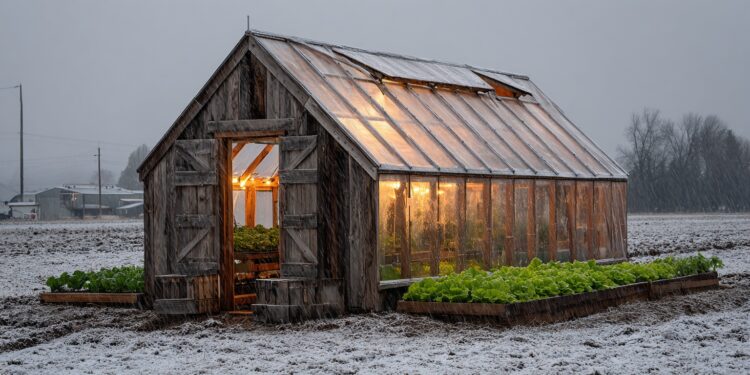
The typical Amish greenhouse is a simple hoop house or low-profile cold frame structure, often built from locally milled lumber and covered in heavy-gauge polyethylene film rather than glass. This keeps construction costs dramatically lower than glass alternatives while providing adequate light transmission for most food crops. Larger operations may use double-wall polycarbonate panels for improved insulation, but many functional Amish greenhouses are built almost entirely from materials available at any farm supply store for a few hundred dollars.
What makes these structures effective is not the materials but the design principles behind them and the crop management knowledge of the people running them. An Amish farmer who has grown food under cover for 20 years has accumulated a depth of practical knowledge about microclimates, cold-hardy varieties, pest management, and soil fertility that no amount of expensive equipment can substitute for.
Passive Solar: Heating a Greenhouse Without Electricity or Propane
One of the most important lessons the Amish greenhouse tradition offers the serious prepper is the effective use of passive solar heating. In a grid-down scenario, a greenhouse that depends on electric heaters or propane is a liability waiting to happen. One cold night without power and weeks of plant growth are gone. The Amish solution, developed out of necessity rather than ideology, is to design the greenhouse so that the sun does the heating work.
The core principles of passive solar greenhouse design are straightforward:
- Orient the greenhouse with the longest wall facing south to maximize sun exposure during the short days of winter
- Use thermal mass, water barrels, stone flooring, or packed earth, to absorb heat during daylight hours and release it slowly overnight
- Insulate the north wall heavily, since it receives no direct sun and is the primary source of heat loss
- Use double-layer plastic film with an air gap between layers, which provides insulation comparable to double-pane glass at a fraction of the cost
- Seal gaps and drafts aggressively, since a leaky structure loses heat faster than any passive system can replace it
A well-designed passive solar greenhouse in USDA hardiness zones 5 through 7 can maintain temperatures 20 to 30 degrees Fahrenheit above outdoor ambient temperature on a clear day with no supplemental heat source. In practical terms, that means growing cold-tolerant crops through winter months even in northern states, without a single dollar spent on fuel.
The USDA National Agricultural Library (nal.usda.gov) has published extensive research on passive solar greenhouse performance across different climate zones that is worth reviewing before you build. The fundamentals have been validated across decades of agricultural research and align precisely with what Amish farmers figured out through practical observation long before the research was conducted.
The Crops That Make an Amish Greenhouse Productive All Winter
Not every crop belongs in a winter greenhouse. The Amish approach to cold-season greenhouse production is built around a core group of crops that tolerate low light levels, survive temperature fluctuations, and produce usable harvests even when outdoor conditions are harsh. Understanding which crops belong in a winter greenhouse and which do not is one of the most important pieces of knowledge a prepper can carry into their own food production planning.
Cold-hardy greens form the backbone of the winter greenhouse. Spinach, kale, arugula, mache, claytonia, and various Asian mustard greens are all capable of surviving near-freezing temperatures and continuing to produce harvestable leaves as long as light levels are adequate. Many of these crops go dormant during the coldest weeks of winter and resume growth as day length increases in late January and February, providing fresh greens at exactly the time when stored food supplies are most depleted and fresh vegetables are hardest to find.
Root vegetables like carrots, beets, turnips, and radishes can be sown in a cold greenhouse in late summer and harvested through the winter as needed. These crops tolerate hard freezes when mulched adequately and provide caloric density that leafy greens cannot match. A bed of carrots stored in the ground under a greenhouse frame and a layer of straw is, in practical terms, a root cellar that replenishes itself.
Herbs deserve special mention in any serious discussion of winter greenhouse production. Parsley, chives, oregano, thyme, and cilantro all produce usable harvests in unheated or minimally heated cold frames through most of the winter in zones 5 and above. These crops add flavor, nutrition, and genuine medicinal value to a winter diet in ways that stored dried herbs simply cannot replicate.
Building Your Own Amish-Style Greenhouse: What You Actually Need
The barrier to entry for a functional cold-season growing structure is lower than most people assume. A basic hoop house adequate for year-round greens production can be built for $200 to $500 in materials, depending on size and the materials available locally. Here is the core framework:
- Bent electrical conduit or pre-formed hoops create the structural ribs of the tunnel
- Ground posts driven at regular intervals anchor the structure against wind
- Heavy-gauge greenhouse poly film, rated for UV resistance, covers the structure and provides the growing environment
- End walls can be built from lumber and poly film, or from salvaged materials
- Doors at both ends allow ventilation on warm days, which is essential for preventing disease in enclosed growing environments
For a more permanent structure with better insulation, a simple wood-framed greenhouse with double-wall polycarbonate panels on the south-facing roof and walls, and solid insulated panels on the north wall, provides a meaningful step up in cold tolerance without moving into expensive glass construction. A 10 by 16 foot structure of this type, built from materials available at most lumber yards and farm supply stores, can be constructed for under $2,000 and will produce food for decades with basic maintenance.
The key design decision that separates a useful prepper greenhouse from an expensive garden accessory is the heating strategy. If your greenhouse cannot maintain plant-safe temperatures during a power outage or fuel shortage, it is a vulnerability rather than an asset. Build passive solar and thermal mass into the design from the beginning. Add a small wood-burning heater as a backup for the coldest nights if your climate requires it. Keep the structure small enough that the thermal mass can actually maintain overnight temperatures without supplemental heat on most winter nights.
Seed Starting: The Greenhouse Function Most Preppers Overlook
The most immediately practical use of a small greenhouse for most preppers is not winter production but spring seed starting. Starting transplants under cover allows you to begin the growing season six to eight weeks earlier than outdoor direct seeding permits, dramatically extending your annual production window. It also gives you direct control over your seed supply, allowing you to start from saved heirloom seed without dependence on commercial nurseries that may not be operational in a serious grid-down scenario.
A greenhouse that is too small or too cold to maintain full winter production is almost always adequate for spring seed starting, which requires only frost protection rather than winter-level cold tolerance. This makes seed starting the lowest-barrier entry point for anyone building toward a self-sufficient food system. Even a simple cold frame, a bottomless box with a glass or plastic lid, parked against a south-facing wall, provides enough protection to start tomatoes, peppers, squash, and other warm-season crops six weeks before the last frost date in most of the continental United States.
The Security Dimension of Year-Round Food Production
Every serious prepper understands that food security is not just about storage. Stored food is finite. A production system is not. A functioning greenhouse that produces fresh food through the winter closes one of the most significant gaps in most preparedness plans: the inability to produce fresh, nutrient-dense food during the months when outdoor growing is impossible.
Fresh greens provide vitamins, particularly vitamin C and folate, that stored foods are often deficient in. In a long-term grid-down scenario, deficiency diseases like scurvy, which result from the absence of fresh food rather than total caloric shortage, represent a real and underappreciated threat. The Amish greenhouse tradition addresses this threat with elegant simplicity: keep something green growing all year, and the nutritional foundation of your food supply remains intact regardless of what happens to the supply chain outside your property line.
The National Institute of Food and Agriculture (nifa.usda.gov) has published research on the nutritional contribution of home food production to household dietary quality that underscores this point with data. Households with functioning kitchen gardens and cold-season production systems consistently show better micronutrient status than households relying entirely on stored and processed food, even when caloric intake is comparable.
What to Do Before You Build
Before committing materials and money to a greenhouse structure, spend one full growing season observing your land carefully. Note where the sun hits longest in midwinter, where frost settles first and last, where wind comes from, and where water drains or pools. The site decision is the most important decision in greenhouse construction, and getting it wrong is expensive to correct. A greenhouse sited in a frost pocket will underperform a cheaper structure on a better site every single time.
Talk to anyone in your area who already grows under cover, whether in a greenhouse, high tunnel, or cold frame. Local knowledge about pest pressure, disease challenges, variety performance, and winter weather patterns is invaluable and impossible to replicate from general reading. The Amish farming community built its greenhouse tradition through exactly this kind of accumulated local knowledge, passed down through direct observation and practical mentorship rather than manuals and YouTube tutorials.
Start smaller than you think you need. A 10 by 12 foot structure that you manage well and learn from will teach you more than a 30 by 60 foot structure you are overwhelmed by. Scale up once you have a season or two of experience behind you and a clear picture of what your specific situation actually requires.
The goal is not a beautiful greenhouse. The goal is food on the table in February when the stores are empty and the ground is frozen. Build toward that goal, keep it simple, and the rest will follow.
Rediscover the Practical Wisdom of Amish Self-Sufficiency
If the Amish greenhouse system intrigues you, it is only one small part of a much larger tradition of practical knowledge that Amish families have preserved for generations.
While the modern world has become increasingly dependent on fragile supply chains, expensive technology, and constant electricity, Amish communities continue to live by a completely different model. Their approach to food production, home building, gardening, and everyday living is built around a simple principle: self-reliance through practical skills.
That is exactly what The Amish Ways Book was created to share.
This remarkable guide pulls back the curtain on the everyday methods Amish families use to remain independent from modern systems. Inside, you will discover dozens of time-tested techniques for producing food, storing it safely, and maintaining a household that can function even when modern conveniences disappear.
Much like the greenhouse methods described in this article, the solutions are not complicated or high-tech. They rely on simple tools, observation, and practical knowledge passed down through generations.
Inside The Amish Ways Book, you’ll learn:
- Traditional gardening and food production techniques used by Amish homesteads
- Practical food preservation methods that work without expensive equipment
- Time-tested ways to store food for months or even years
- Simple household skills that reduce dependence on stores and supply chains
- Self-sufficient living strategies that have worked for generations
Many readers are surprised to discover just how achievable these methods really are. You don’t need hundreds of acres of land or expensive equipment to begin applying them. In many cases, all it takes is a small garden, a few simple tools, and the willingness to learn skills that modern society has largely forgotten.
And perhaps the most important lesson the Amish way of life teaches is this:
Preparedness is not about stockpiling. It’s about learning how to produce and maintain the things your family depends on.
If you’re serious about building a resilient lifestyle, reducing dependence on the modern food system, and learning the practical skills that helped entire communities thrive long before supermarkets existed, The Amish Ways Book is one of the best places to start.
👉 You can learn more about these time-tested Amish methods here!
Once you start applying even a few of these ideas, you may begin to see your land, your garden, and your home in a completely different way.
You may also like:
The US Army’s Forgotten Food Miracle (Video)