

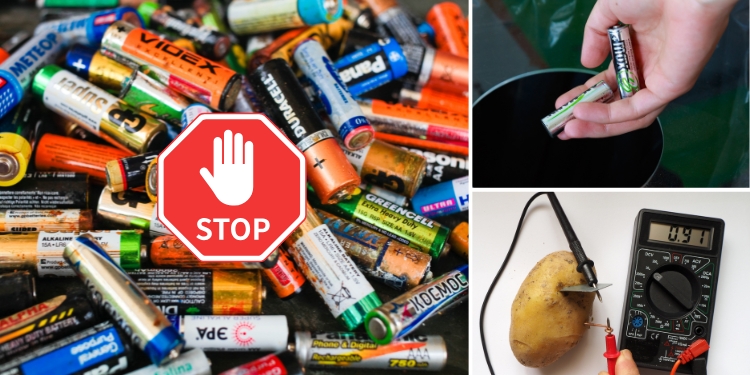


Most preppers have done the same thing for years, and it usually starts in a normal store aisle. You walk past the batteries, you see a big pack on sale, and you picture a power outage, a storm, or a time when stores are empty, so you toss the pack in the cart. You tell yourself it is smart planning, and it can be in the short term, because batteries do solve problems when the lights go out for a night or two.
The trouble begins when batteries turn into a long-term plan, because disposable batteries do not behave the way most people expect once time and storage conditions start doing what they always do. Over the years, many folks end up spending far more money than they realize on name-brand batteries that leak in storage or die right when the power has been out long enough that you truly need every tool to work.
The claims on the label may look confident, and the price may be high enough to make you assume the battery will be dependable. In real life, the result is often disappointing, while the companies selling those batteries still get paid either way.
Why are “Long Shelf Life Batteries” Misleading
When you see a label that says a battery lasts for years in storage, the claim sounds like a promise that the battery will be strong and ready whenever you finally open that package. The fine print and the testing conditions matter more than the big number printed on the front of the package.
Most shelf-life claims assume cool, stable temperatures and proper storage, not the heat and humidity many homes deal with throughout the year.
👉 Three Things You Need To Protect Before a Blackout
A battery stored in a climate-controlled room often holds up better than a battery stored in a hot garage. That difference alone explains why two people can buy the same brand and have completely different results years later. Even then, time still works against you, because batteries slowly lose charge sitting on a shelf, and the rate depends on the type of battery, its age when purchased, and the conditions where it sits.
The Part Nobody Likes to Talk About
 Battery leakage is one of the biggest reasons disposable batteries become a money trap. Why? Because a leaking battery does not just fail, it often destroys the device it sits in.
Many people have opened a flashlight or a radio after months or years, and they find white crust, green corrosion, and a battery that looks swollen or stuck.
So, by the time they pry it out the metal contacts are eaten up enough that the device never works properly again.
When that happens you lose the battery and the tool, and as a result you end up buying replacements for both. This is one of the quiet ways battery companies and cheap gear makers keep the cycle going. The worst part is that the damage often happens while everything looks normal on the outside, which gives a false sense of security until the exact moment you actually need it.
The more devices you keep loaded with batteries in storage, the more chances you give leakage to ruin something important. That is why a drawer full of “ready-to-go” flashlights can turn into a drawer full of broken plastic when you finally go to use them.
Why Name Brands Still Waste Your Money
Many people assume a big name brand prevents most of these problems, since the price is higher and the advertising sounds confident. In real life, a higher price does not remove the basic weaknesses of disposable batteries, as even premium batteries can lose charge over time and leak under the wrong conditions.
👉 How I Cut My Electricity Bill by a SHOCKING 80%
The name brand also gains from something many people overlook, since a battery that works fine in a TV remote or wall clock creates a sense of trust. That familiar experience leads people to assume the same battery will perform just as well after sitting for years in storage, which encourages them to keep buying large packs for emergencies.
Disposable batteries are built for convenience, and convenience is expensive when you pay for it again and again for years, while living into the illusion that you are building a long-term stockpile.
The Real Danger
 A short outage is one thing, while a long outage is a completely different world – the longer the grid stays down, the more everything else breaks down around it.
Stores sell out, deliveries stop, and people who never planned ahead suddenly panic-buy whatever still sits on a shelf, with batteries being one of the first items to disappear.
If your emergency plan leans heavily on devices that require disposable batteries, then your plan becomes limited by whatever battery supply you happen to have on hand. Once that supply is gone you face a problem that you cannot solve by “running to the store.”
A lot of people do not like thinking about that, but the whole point of prepping is facing uncomfortable realities while there is still time to adjust.
Many preppers also forget that some devices burn through batteries faster than expected, especially certain radios, headlamps, and high-output flashlights. A flashlight that feels bright and powerful in normal times can chew through batteries during long use. That alone can surprise you when you are already dealing with stress and fatigue.
A Better Long-Term Plan
Once you understand the limits of batteries, it becomes clear that relying on them alone is not the best long-term strategy. Batteries work best as support tools, not as the foundation of your preparedness. A stronger approach focuses on reducing battery use and adding power sources that are way more reliable on the long run.
The Simple Trick to Get Extra Power from “Dead” Batteries
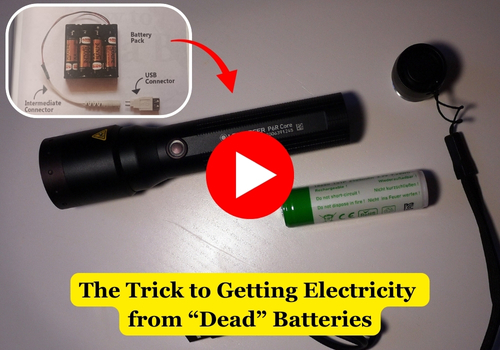
Most people throw batteries away the moment a flashlight goes dim or a device stops turning on, assuming there is nothing left to use. In reality, power cells that seem completely dead often still hold usable energy.
Battery companies make their money by convincing people those cells are finished long before all their power is actually gone. But, what you need to know about batteries is that a new one starts at around 1.6 volts and is usually treated as useless once it drops to about 1.3 volts. The truth is that a lot of energy is still trapped inside.
The good news is that with this simple device, made from common household items, it is possible to safely keep using that remaining energy until the voltage drops to around 0.867 volts. This way, you get far more use out of so-called “dead” batteries than most companies want you to.
Here’s how to do it in only a few steps:
The Most Reliable System Long-Term
A better answer than chasing batteries is building a small, modular power plant that gives you reliable electricity day and night, right in your own backyard. This type of setup produces power, stores it, and makes it available whenever you need it, whether the grid is working or completely down. It is designed to grow with your needs, so you can start small and add more capacity later without tearing anything apart or wasting money on equipment you do not need yet.
This solution works well not just during emergencies, but also now, because it allows you to save energy during the day and use it when power prices are high or when the grid fails. Over time, it can reduce your electric bills by a huge amount while also giving you peace of mind, since you are no longer fully dependent on power companies or fragile supply chains.
Here are the main advantages of this approach:
- Provides reliable power 24 hours a day, even during long blackouts
- Can be upgraded over time as your needs or home size change
- Uses reusable energy instead of constant battery replacement
- Lowers monthly power bills, often by as much as ninety percent
- Uses clear, repeatable steps that are easy to follow
- Does not rely on stores, fuel deliveries, or outside help
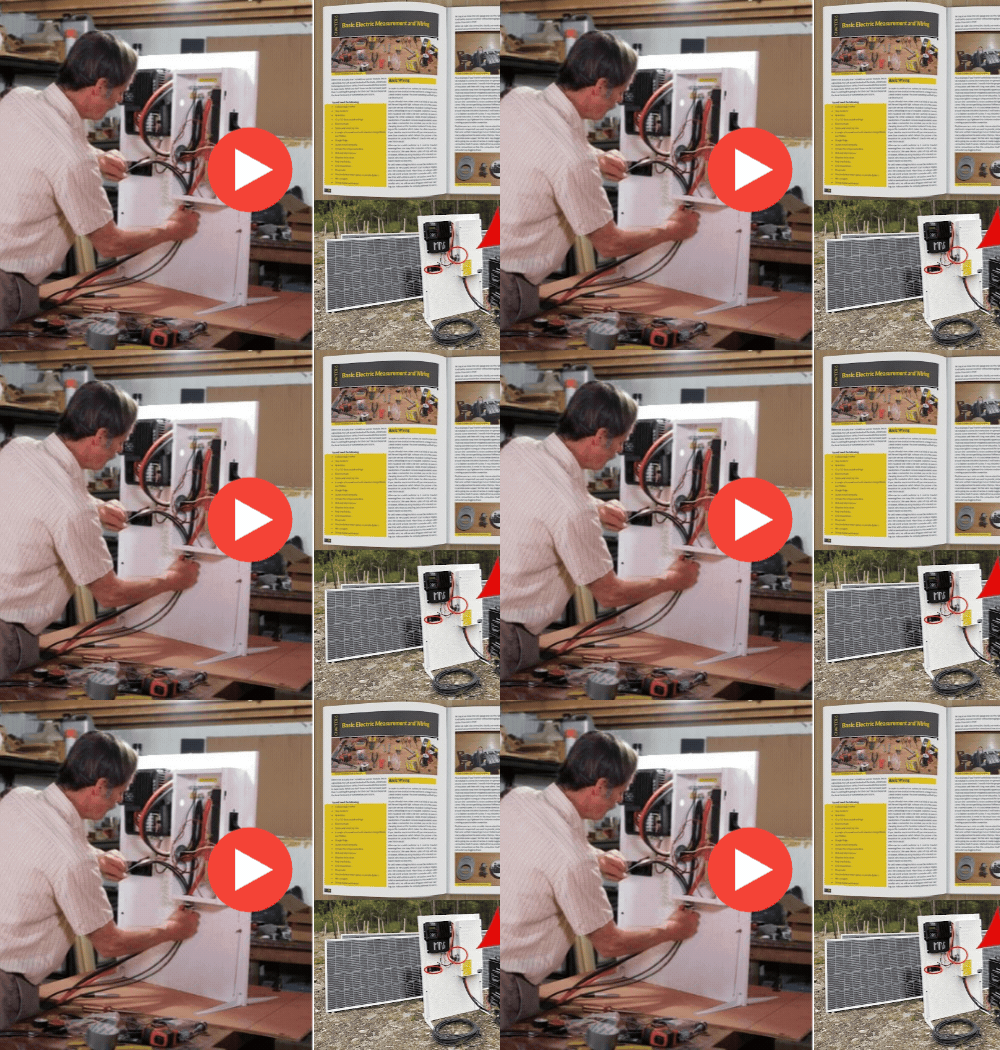
To make this easy to follow, I built the Modular Backyard Power Plant myself and documented the entire process step by step. The instructions are clear, include pictures and material lists, and are designed as a simple weekend project that has been fully tested to show exactly what each module can power, from short outages to long-term blackouts.
You can see exactly how I built the Modular Backyard Power Plant and how it works in this video:
Low-Tech Options That Keep Working
Hand-crank radios and flashlights are not perfect, and some cheap models are junk, but a good one can provide news and weather updates without turning your plan into a battery countdown. A hand-crank radio becomes even more useful when it includes a solar panel and USB charging, because you get multiple ways to keep it running without depending on disposable batteries.
👉These U.S. States Will Be Hit First When the Power Goes Out
Manual tools also reduce your battery needs more than most people realize. A manual can opener, a hand pump, a gravity water filter, and a few simple kitchen tools remove several battery-powered “convenience” gadgets from your life, and every device you remove reduces the amount of battery power you need to store.
How to Make the Switch Without Throwing Money Away
Start by deciding which devices truly matter in an emergency, because not every battery-powered gadget deserves space in your plan. Then, start shifting those key items toward rechargeable and USB-based versions, because those pair well with solar chargers and power banks.
As you do that, keep a smaller reserve of disposable batteries for backup and for devices that do not have good rechargeable options, and rotate those batteries regularly so you do not end up with a pile of expired stock.
Also, it is very important to store batteries properly. A cool, dry place inside the home is better than a garage or shed, and keeping batteries out of devices during long storage reduces the chances of ruining your tools.
Lighting is another place where many people waste batteries without noticing it. Battery lanterns are fine for short outages, but for longer situations, oil lamps, candles, and fuel-based lanterns can provide steady light without draining a limited supply of AA batteries.
These Amish lighting methods can make a real difference in a crisis situation – we tested them ourselves:

Final Thoughts
Battery companies do not benefit when people build a simple, reusable system that covers lighting, radio, and small device power for years. Those companies benefit when people keep buying disposable packs, keep replacing dead stock, and keep believing that a higher price equals long-term reliability.
That is why the marketing focuses on convenience and confidence, because convenience makes you buy again, and confidence keeps you from questioning the system until it fails at the worst time.
A prepper who wants to stop wasting money looks at the pattern, notices what fails over time, and shifts toward tools and systems that can be used daily and replenished naturally, especially when the goal is to remain steady and calm during a stressful situation.
Most people think they’re prepared for a blackout because they bought batteries.
That belief usually lasts right up until the power is actually gone. And suddenly the cold, the silence, and the uncertainty set in, along with the realization that everything you paid for was only designed for short interruptions, not real outages.
That’s the mistake the article exposes: soon, blackouts will not be brief inconveniences, but extended events. And most battery-based solutions were never built for that reality.
That’s exactly why the Easy DIY Power Plan was created.
Instead of depending on expensive batteries that degrade, fuel that runs out, or solar setups that stall when conditions are bad, this plan teaches a different approach – one that doesn’t rely on constant recharging, refueling, or fragile components.
For roughly $100 in basic materials, you can build a compact power system that works without fuel, fire, fumes, or complicated machinery. Once assembled, it keeps generating usable power with minimal upkeep – even during long winters, storms, or heat waves when traditional backups fail.
It’s intentionally designed for everyday people. No engineering background. No special tools. Most builders finish it in a single afternoon.
And when you get Easy DIY Power Plan, you don’t just receive the main instructions. You also unlock five bonus guides that show how to expand the system and reduce dependence on fragile, expensive battery solutions altogether.
You may also like:
 Rescuing And Restoring Almost Dead Lead-Acid Batteries
The Silent Death Wave That Could Send Us Back to the Dark Ages (VIDEO)
Why The Suburbs Are No Longer Safe



















i quit buying batteries from walmart because too many times they’re dead when i get them. they are too expensive to have a good turnover rate. i get all my batteries from the dollar and a quarter store (dollar tree). at halloween we go through alot of batteries for decorations. when we take them down we put the batteries in a ziplock bag and use them throughout the year. alot of times we use the same batteries the next year for halloween again. batteries and reading glasses are dollar tree goto items for this family. we have reading glasses laying around like empty brass in a machine nest.
$13 for a smart charger will solve the problem and save you money on batteries you throw away – just switch to rechargeable batteries
There are alkaline battery chargers sold on Amazon that will charge different sizes of batteries and they work. Check out the one branded Popular Mechanics. I bought three.
RB , thanks for the tip, I will try – hope it charges to a full 1.5 V
I hate rechargeable batteries ! First off, they start at about 1.3 V , Alk, start at 1.6
MANY items like Dig cameras, shut down at 1.2 V so you take 20 photo’s and time for new batteries ! – NO THANK YOU !
Whats better, a 110 V -AC variable power source., hook into the device and power from 110 volt, OR power from a 12 V DC car Battery, which you recharge from a Gen, a running Alt. Solar panel, etc etc
AFTER SHTF, you wont care if your cordless now has a cord, you will care that it Turns.
SAme for radio etc.
PS I buy name brand AA AAA C D etc from WM and have NO Problems with them.
MY dollar tree, the off brand go dead REAL fast, tried them in my radio headphones, mow lawn 2- 3 times, DEAD Batt.
use members mark (SAMS) or copper top, and I Mow more than 10 times ( 1 Acre of lawn on big JD zero turn) SO, the better value is the more expensive battery
Howdy from an undisclosed location high in the desert swamp,
It has been said a flashlight is a tubular device to store dead batteries.
True
I did a couple things just to see how it went. I didn’t stock up on batteries. I got 2 am/fm radio-weather-flashlight crank to charge devices. I have replaced battery flashlight with solar. I also have shake to charge lights. These worked great. In addition I made my own candles from the scraps in used candles. I melted whole candles and ended up making 6 in pint jars. I had no problems. I have several pocket or pack size solar charging blocks, one notebook size solar panel. My wife was happy not to go digging for batteries. We went through the four day outage and light was not an issue. Neither was news from our county. After it came back on we didn’t have to go to the store for anything. I will buy batteries for toys but not for flashlights. This was in the storm tested and it passed.
I also brought in a solar sidewalk light. That was great but overkill. I took it back outside. I have four of those which are rechargeable.
Remember the Alamo
Remember Pearl Harbor
Remember 9/11
Remember North Carolina
Remember to have your soul prepared
Remember the USS Liberty
The crank radios- you are cranking a battery. THOSE batteries also go bad and have limited life. There is no good answer for the very long term. But, if it’s that bad, light and gadgets will be the least of anyone’s concerns.
Howdy again,
Crank radios last years. I got them for my wife and another person. I am deaf so radio means nothing to me. It just gave her a sense of peace being talked through the storm. It also gave her a way to work off nervous energy so win win win.
I have a small thin solar calculator thats probably over 20 years old and a watch that works just fine…my parents had these 6 inch long icicle Christmas tree decorations that would glow in the dark….florescent…..could read with them at night …..
When I click on your links, I get “site can’t be reached,” which really means that if you can’t track me (I can’t get to your links with my VPN turned on), you’re not going to let me see your information. Look–I don’t question anyone’s need or right to make a living, but your articles, long ago, transitioned from helpful information with minimal advertising to superficial covers for covert marketing, and that’s just disingenuous dishonesty not matter how common it has become. You’ve lost me as a customer, and while I generally wish no one harm, I hope you lose everyone else or that you grow some balls and dare to be transparent, genuine, honest, and up front with your readers instead of scamming them for every dime you can squeeze out of ’em. The current system’s days are numbered, and you should be leading the way by demonstrating the new system to come instead of hypocritcally claiming to help people prepare for the difficult part of the transition with manipulative marketing designed to squeeze every last drop out of us in demonstration of the *old*, corrupt ways. Drop that BS and dare to demonstrate the new world where such the corrupt nonsense of today’s status quo won’t exist.
Another satisfied lefty wingnut. Why don’t you just delete instead of the insults. It took far longer to insult and leave than to just leave. Goodbye I want everything free because I am an entitled lefty wingding.
Good job aska prepper staff for exposing a lefty who has nothing to say and nothing to contribute. YAWN and goodbye.