

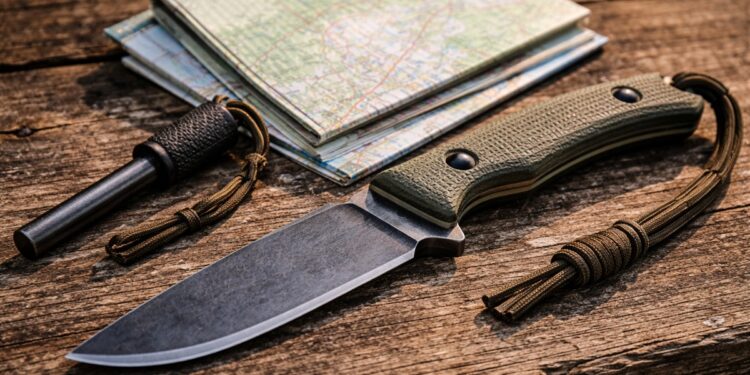


Your survival knife is the single most important tool in your kit. Not the most expensive, not the heaviest, not the most tactical-looking. The most important. A quality fixed blade knife can process food, build shelter, start fire, signal for help, fabricate tools, and defend your life. A poor choice can fail you at any one of those tasks when the stakes are highest.
The problem is not a shortage of options. Walk into any outdoor retailer or open any blade catalog and you will find hundreds of knives marketed as survival tools. Most of them are not. This guide cuts through the noise and tells you exactly what to look for, what to avoid, and which specific knives earn a place in a serious prepper’s loadout in 2026.
Understanding blade metallurgy, geometry, and handle ergonomics is not just for gear nerds. It is the foundation of making a decision you can trust under pressure. The American Bladesmith Society has documented extensively how blade geometry and steel composition directly determine real-world performance under stress. Let’s go through every variable that matters.
Related: Tools You Will Need When SHTF
Fixed Blade vs. Folding Blade: Why This Choice Matters
The first decision is fixed versus folding, and for a dedicated survival knife the answer is not complicated. A fixed blade wins every time. It is stronger, more reliable, and eliminates the mechanical failure point that every folding knife carries by design. A lock that fails under lateral pressure or a pivot that loosens after extended use are not problems fixed blades have.
Fixed blades handle batoning wood, prying, digging, and heavy cutting tasks without complaint. A folder simply cannot absorb those loads safely. For a bug-out bag, vehicle kit, or any loadout built around genuine emergency use, fixed blade is the baseline requirement.
That said, nobody is telling you to carry only one knife. A folding knife or multi-tool alongside your fixed blade gives you a lighter option for fine tasks where deploying a seven-inch blade is unnecessarily cumbersome. Many experienced preppers carry a fixed blade on the hip and a quality folder in the pocket. The two complement each other rather than compete.
The U.S. Army Survival Manual FM 21-76 lists a fixed blade knife as the primary recommended cutting tool for survival scenarios, specifically citing reliability under heavy use as the determining factor over folding designs.
Related: US Official Procedures Before SHTF. How to Know Before It Hits
Blade Style: Point Geometry and Edge Configuration
The Point
The point design tells you a lot about what a knife was built to do. For survival, the drop point is the gold standard. A drop point features a gradual, convex curve from spine to tip that keeps the tip strong and low. The long belly of a drop point is ideal for skinning game, processing cordage, and general camp work. The tip can take abuse without snapping because there is substantial metal behind it.
The clip point is a reasonable second choice. It offers more tip control and is easier to use in detailed work, but the tip is thinner and more vulnerable to lateral stress. Fine for most tasks, but it will show wear faster in demanding use.
Avoid tanto points for a primary survival knife. The tanto is engineered for piercing hard materials and looks aggressive, but the lack of a belly makes skinning animals and performing curved cuts awkward and slow. It is a fighting knife geometry dressed up as a survival tool in most cases.
Avoid spear point double-edge designs entirely for field utility. The dual edge prevents safe batoning, makes striking a ferro rod off the spine impossible, and creates unnecessary injury risk when the knife slips or is grabbed by another person.
The Edge
Plain edge versus serrated is one of the most debated topics in the knife community, and the honest answer is that a plain edge wins for most survival applications. Plain edges are far easier to sharpen in the field using improvised methods like ceramic mug bottoms, river stones, and concrete surfaces. They produce cleaner cuts in rope, wood, and food. They are better for batoning because the edge geometry does not catch and bind in wood fiber the way serrations do.
Serrations excel at cutting through webbing, seatbelts, and synthetic rope under load. If those scenarios are high on your threat assessment, a partially serrated blade puts serrations at the heel where they are most useful and leaves a plain belly for general work. A fully serrated blade is a specialty tool, not a general survival knife.
Research published in the Journal of Materials Processing Technology confirms that plain edge geometry maintains cutting performance longer under repeated stress compared to serrated designs when field sharpening methods are the only maintenance available.
Blade Length: Why Bigger Is Not Better
The bigger-is-better mentality around survival knives is one of the most persistent mistakes in the prepper community. An eight-inch blade is not more useful than a five-inch blade in most survival scenarios. It is heavier, more fatiguing to use during extended tasks, harder to control in detail work, and more difficult to carry comfortably.
The practical sweet spot for a survival knife is four to six inches of blade length. This range gives you enough steel to baton modest-diameter wood, process game, and handle heavy cutting tasks, while remaining controllable enough for precision work. A four-and-a-half-inch blade handles ninety percent of what a survival knife will ever be asked to do.
If you need extended reach for chopping or clearing brush, that is what a machete or hatchet is for. Do not try to solve that problem with an oversized knife. A specialized tool does the job better, and your knife stays the right size for everything else.
Tang Construction: The Most Critical Structural Feature
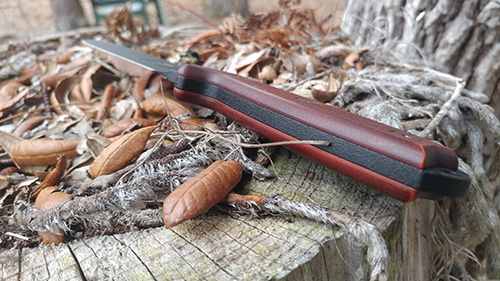
The tang is the extension of the blade steel that runs into or through the handle. It is the most important structural feature of a survival knife, and it is also the most commonly compromised feature in budget knives marketed to preppers.
A full tang design runs the blade steel the full length and width of the handle. The handle scales are attached on both sides of this steel plate. You can often see the tang outline along the top and bottom edges of the handle. Full tang construction is the only acceptable configuration for a hard-use survival knife. It is nearly impossible to break at the handle junction because there is no junction. The blade and handle are one continuous piece of steel.
Partial tang and push tang designs narrow the steel dramatically inside the handle. They are cheaper to manufacture and feel fine in the store, but under lateral stress, heavy batoning, or prying, they fail at the narrow point. This is not a hypothetical risk. It is a documented failure mode across dozens of budget knife designs.
Hollow handle knives deserve special mention because they remain popular in prepper marketing despite being structurally compromised by design. The concept of storing supplies inside the handle is appealing, but to create that hollow space, the tang must be minimal or absent. The handle attachment point becomes the weakest link in the knife. In a genuine survival scenario requiring hard use, these knives fail. Keep your survival supplies in your kit where they belong and put a real tang in your knife.
Rat tail tangs are a deceptive variant. These are sometimes marketed as full tang but the steel tapers to a thin rod inside the handle. They are stronger than a push tang but will bend under serious load. If you cannot see the full outline of the tang along the handle edge, assume it is not a true full tang.
Blade Length: Why Bigger Is Not Better
Spine Thickness and Profile

The spine is the unsharpened back edge of the blade. It does more work than most people expect. A squared spine with a crisp ninety-degree edge is one of the most valuable features on a survival knife because it turns your blade into a fire-starting tool. Drawing a ferro rod against a squared spine produces a strong, consistent shower of sparks. A rounded or polished spine skates over the rod and produces little to nothing.
A squared spine also gives you a controlled surface for thumb pressure during detail work, a hammering surface for driving tent stakes or splitting kindling, and a useful scraper for processing hides, debarking wood, or scraping tinder.
Spine thickness between three-sixteenths and one-quarter inch is the useful range for a survival knife. Thinner than that and the knife flexes under heavy batoning loads. Thicker and the blade becomes heavy and sluggish for fine cutting tasks. Some manufacturers offer a distal taper, where the spine gradually thins toward the tip, which gives you a stiffer base and a more nimble tip. This is a useful feature when you find it.
Steel Composition: Stainless vs. Carbon and What Actually Matters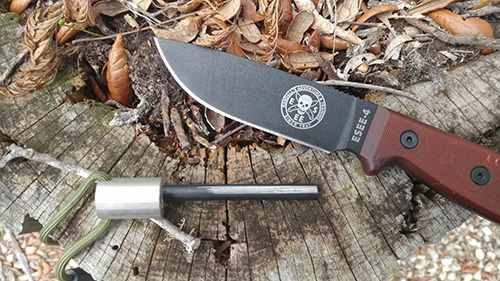
Steel selection is a topic that fills entire books, and most of the debate happens at a level of refinement that does not matter in the field. What you need to understand is the practical tradeoff between the two main categories.
Stainless Steel
Stainless steel alloys contain chromium at sufficient levels to resist oxidation. They are low-maintenance, forgiving in wet or humid environments, and widely available at every price point. High-quality stainless alloys like 154CM, S30V, and CPM-3V offer excellent edge retention and toughness.
The traditional criticism of stainless, that it loses its edge faster than carbon steel, applies mostly to low-grade stainless. Modern premium stainless alloys hold an edge very well. For a survival knife that will be exposed to rain, sweat, blood, and humid storage conditions, stainless is a practical choice that requires less discipline to maintain.
Carbon Steel
High-carbon steel alloys like 1095, O1, and 52100 sharpen more easily than most stainless grades and hold a keener edge for longer under field conditions. Carbon steel also responds well to improvised sharpening methods, meaning you can restore a sharp edge with a flat stone or ceramic mug bottom more efficiently than you can with most stainless grades.
The tradeoff is corrosion susceptibility. Carbon steel will rust if you neglect it. In a humid climate, coastal environment, or prolonged wet survival scenario, an unprotected carbon steel blade will develop surface rust quickly. Many carbon steel survival knives come with a powder coat or parkerized finish that slows this process significantly. With basic maintenance, wipe dry and apply a thin coat of oil, a carbon steel blade is entirely manageable.
The ASM International Handbook on Tool Steels documents the hardness, toughness, and corrosion resistance tradeoffs across major knife steel alloys. For most survival applications, a 1095 carbon steel or 154CM stainless blade in the 57 to 60 HRC hardness range hits the ideal balance of sharpening ease and edge retention.
Handle Materials and Ergonomics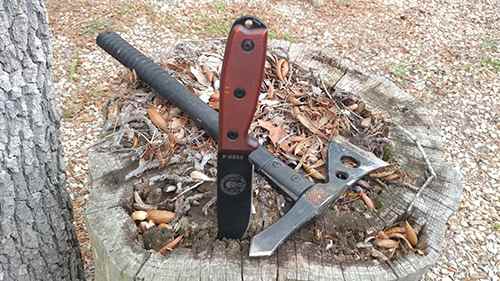
The handle is your interface with the knife under stress. A handle that feels comfortable in a store becomes a liability when your hands are wet, cold, bleeding, or gloved. Test every candidate knife with a firm grip while imagining those conditions.
Handle thickness matters more than most buyers realize. A thin grip concentrates pressure on fewer contact points during heavy work and causes hand fatigue faster. A handle that fills the hand distributes force across the palm and fingers and allows sustained use without discomfort.
Texture is non-negotiable. A smooth handle is dangerous. The grip needs aggressive enough texture to prevent slipping under wet or bloody conditions but not so aggressive that it tears up your hand during extended use. Jimping, which is a series of small notches cut into the spine or handle, adds index finger and thumb traction at critical control points.
Handle Material Options
- G10. Fiberglass laminate that is extremely tough, impervious to moisture, and available in a wide range of textures. Excellent choice for survival use. Does not swell, crack, or absorb moisture.
- Micarta. Linen or canvas phenolic laminate that develops character with use and provides excellent grip even when wet. Slightly warmer in the hand than G10. A premium choice used on many high-end production and custom knives.
- Rubber and Kraton. Provides outstanding wet-hand grip and cushions vibration during chopping. Can degrade with prolonged solvent or chemical exposure. A solid practical choice for most users.
- Wood. Classic appearance but absorbs moisture, can crack with seasonal humidity changes, and requires more maintenance. Not ideal for a survival knife that may spend time in wet environments.
- Bone, antler, and natural materials. Beautiful on a display knife. Not appropriate for a hard-use survival tool.
The Sheath: An Underrated Part of the System
The sheath is not an aftermarket accessory. It is part of the tool system. A poor sheath makes an excellent knife harder to deploy, less safe to carry, and more likely to be left behind because it rides poorly on the body.
- Kydex is the modern standard for hard-use survival sheaths. It is injection-molded thermoplastic that holds its shape under load, retains the knife securely with an audible click, and is completely impervious to moisture. Kydex sheaths are also easily modified for different carry positions. The primary drawback is that repeated daily drawing can eventually abrade a blade’s finish.
- Leather sheaths look traditional and feel premium but absorb moisture, can mold to the blade and make drawing difficult after prolonged wet exposure, and require ongoing conditioning to stay supple. High-quality leather with proper maintenance is a legitimate choice, but it demands more attention than Kydex.
- Nylon and Cordura sheaths are lightweight and often include extra storage pouches, but most do not retain the knife as positively as Kydex or quality leather. Acceptable for moderate use, less appropriate for active field carry where the knife needs to stay put during movement.
Whatever sheath your knife comes with, verify that it holds the blade securely when the knife is inverted and shaken. If the knife falls out without active retention, that sheath will cost you the knife at the worst possible moment.
What to Expect at Every Price Point
- Under $50: This range includes a lot of marketing and very little performance. Most knives here use low-grade stainless, partial tangs, and handle materials that degrade quickly. There are a small number of budget exceptions worth considering, but approach this tier with skepticism and verify the tang construction before buying anything.
- $50 to $100: The entry point for genuinely capable survival knives. Brands like Morakniv and ESEE operate in this range and produce knives with full tangs, quality steel, and field-proven performance. At this price you make some compromises on handle materials and finish quality but not on structural integrity.
- $100 to $200: This is the sweet spot for most preppers. You get premium steel grades, superior handle materials like G10 and Micarta, quality Kydex sheaths, and the fit-and-finish of knives built to last decades. Most of the recommended knives in this guide live in this range.
- Above $200: Custom and semi-custom territory. The performance gains over a well-chosen knife in the $100 to $200 range are marginal for field use. You are paying for craftsmanship, custom steel, and aesthetics at this tier. A great investment if that matters to you. Not required for a survival knife that works.
6 Survival Knives Worth Carrying in 2026
ESEE 4 (Best Overall Value)
The ESEE 4 has been a prepper and military community staple for years for good reason. It uses 1095 carbon steel with a powder coat finish, full tang construction, and a blade length that sits at four and a half inches, right in the ideal range. The handle comes in Micarta or G10. ESEE backs every knife with a no-questions warranty that covers breakage regardless of cause. The aftermarket sheath and accessory ecosystem is extensive. At around $130, it delivers performance that competes with knives twice the price.
Morakniv Garberg (Best Budget Pick)
The Garberg is the only full-tang knife in the Morakniv lineup, and it punches far above its price point. It runs around $80 and uses Sandvik 14C28N stainless steel, which holds an edge well and is easy to maintain. The handle is a comfortable rubber grip that performs well in wet conditions. The Garberg is not flashy but it is a legitimate hard-use knife at a price that allows you to equip multiple bags without breaking the budget.
Benchmade Puukko (Best Premium Choice)
The Puukko is Benchmade’s take on the traditional Scandinavian puukko knife form. It uses CPM-3V tool steel, one of the toughest blade steels available in production knives, with a stabilized wood handle and a full convex grind that makes it an exceptional slicer. The four-and-a-half-inch drop point is versatile across survival tasks. At around $200 it is a serious investment, but the CPM-3V steel in particular is difficult to beat for a knife that will see hard use in demanding conditions.
Ka-Bar Becker BK2 (Best for Heavy Duty Tasks)
If your threat assessment puts heavy batoning, prying, and demanding field work at the top of the list, the BK2 is worth serious consideration. It runs 1095 Cro-Van steel, comes in at five and a half inches of blade, and is thick enough to handle abuse that would damage a lighter knife. The Grivory handle is comfortable and functional. The tradeoff is weight. The BK2 is a substantial knife that you feel in the pack over long carries. For a vehicle kit or base camp loadout, that is not a problem. For ultralight backpacking, it is.
Ontario RAT-5 (Best Versatile Mid-Range)
The RAT-5 from Ontario Knife Company hits the full-tang fixed blade requirements with 1095 carbon steel and a nylon handle at around $80. It is a workhorse design with no pretensions. The five-inch drop point handles most survival tasks cleanly, and the flat grind makes it straightforward to sharpen in the field. Ontario has been supplying the U.S. military with blades since the 1940s. The institutional track record matters.
Fallkniven A1 (Best for Extreme Environments)
The A1 is a Swedish-made survival knife used by Swedish Air Force pilots as their issued survival blade. It uses 3G laminated steel with a VG10 core that delivers exceptional toughness and corrosion resistance. The six-inch blade and convex grind give it impressive slicing performance across wood, game, and rope. The Thermorun handle performs reliably in extreme cold. At around $250 it is the most expensive knife on this list, but if you are equipping a kit for extended wilderness survival in demanding conditions, it is a legitimate investment.
Knife Maintenance in the Field
A survival knife is only as good as the edge you keep on it. Buying a quality knife and neglecting the edge is a waste of money and a liability in the field. Basic maintenance habits extend your edge and reduce how often you need to sharpen.
- Wipe the blade dry after every use. Moisture is the enemy of carbon steel and contributes to accelerated wear on any steel type.
- Apply a thin film of oil before storage. A small bottle of food-safe mineral oil covers this need in a kit and is safe for blades that contact food.
- Strop on leather before putting the knife away after any heavy use session. Stropping realigns the edge teeth that fold over during cutting and adds measurable sharpness without removing metal.
- Carry a sharpening solution. A pocket ceramic rod, a folded sheet of wet-dry sandpaper in multiple grits, or an unglazed ceramic mug in camp all give you a sharpening capability without dedicated tool weight.
- Store in the sheath with the knife clean and dry. Moisture trapped between blade and sheath accelerates corrosion faster than open air exposure.
The University of Georgia Cooperative Extension food preservation guides note that properly maintained knives reduce processing time and injury risk substantially during high-volume tasks. In a grid-down food processing scenario, a sharp knife is not a comfort item. It is an efficiency and safety requirement.
Know Your Local Laws
Blade length laws, carry restrictions, and fixed blade regulations vary significantly by state and municipality. Several states restrict fixed blade carry in public spaces regardless of blade length. Some jurisdictions set length limits between two and four inches for carry purposes. This is not an area to be casual about.
Before you build your carry system around a specific knife, verify the relevant laws for your state and the states you travel through. The Knife Rights Foundation maintains a state-by-state knife law guide that is worth bookmarking. A survivalist who gets charged with an illegal weapons violation before a disaster even occurs has made a preventable mistake.
The Right Knife Is the One You Have When You Need It
All of the technical guidance in this article points toward one practical conclusion: buy the best knife you can reasonably afford, buy it from the full tang fixed blade category, and then learn to use it and maintain it until it becomes an extension of your hand. A $90 Morakniv Garberg carried daily and maintained faithfully will serve you better in a survival scenario than a $400 custom blade sitting in a display case.
The knife you carry is the knife you have. Choose it based on the criteria in this guide, not based on how it looks on a shelf. Test it in your hand under realistic conditions. Learn to sharpen it with whatever materials are around you. And make sure it rides in a sheath that keeps it exactly where you put it, every single time.
That is the standard. Everything else is gear collection.
Frequently Asked Questions
What is the best overall survival knife for most preppers?
The ESEE 4 remains the most consistently recommended survival knife across the prepper and military community for good reason. It combines 1095 carbon steel, full tang construction, a field-proven blade geometry, and an unconditional warranty at a price point around $130. It is not the flashiest option, but it is the most reliable across the widest range of survival tasks.
Is a serrated blade better for survival?
For most survival applications, a plain edge outperforms a serrated edge. Plain edges are easier to sharpen in the field, perform better in wood and food processing, and handle batoning without binding. A partially serrated blade is a reasonable compromise if cutting webbing or synthetic rope under load is a genuine scenario in your threat assessment. A fully serrated blade is a specialty tool, not a general survival knife.
How long should a survival knife blade be?
Four to six inches is the practical range for most users. A four-and-a-half to five-inch blade handles the vast majority of survival cutting tasks while remaining controllable for precision work. Blades longer than seven inches become unwieldy for fine tasks and heavier to carry without providing proportional performance gains. If you need extended reach for chopping, carry a machete or hatchet for that specific task.
Can I use a folding knife as my primary survival knife?
A folding knife can supplement your kit but should not serve as your primary survival knife. The mechanical lock is a failure point under lateral stress and heavy use. Fixed blade knives are stronger, more reliable, and capable of tasks like batoning and prying that are unsafe with most folding designs. If your situation forces you to choose only one knife, choose a fixed blade.
What steel is best for a survival knife?
For most users, 1095 carbon steel or a high-quality stainless like 154CM or CPM-3V represents the best field performance. Carbon steel in the 1095 grade is tough, easy to sharpen with improvised methods, and holds a keen edge. The tradeoff is rust susceptibility that requires basic maintenance discipline. If you are in a wet or coastal environment and prefer lower maintenance, a premium stainless like S30V or CPM-3V delivers excellent performance with better corrosion resistance.
How much should I spend on a survival knife?
The $100 to $200 range delivers the best combination of performance, materials, and durability for most preppers. You can get a genuinely capable, full-tang fixed blade with quality steel and a proper sheath for around $80 to $100 from brands like Morakniv and ESEE. Spending above $200 buys you craftsmanship and premium steel grades that improve marginal performance characteristics most users will not notice in the field.
You may also like:
Innovative Tools Pioneers Used to Survive (video)























Battle Horse Knives. Great knives for a whole lot of reasons
One question I have about tangs and have not been able to answer is: Japanese swords do not have a full tang, not the daito, the long sword, the wakizashi, the short sword nor the tanto, the long knife. Yet each of those is battle tested, more so than any single western sword or knife. Paintings of battles in Japan will depict swords broken mid-blade but none depict any sword broken at the handle. Yet U.S. dictum is that in order to be strong a knife must have a full tang. Practical evidence from battlefields that stretched from what were medieval times to as late as the 1860s in Japan when the last battle between sword wielding samurai and firearm equipped governmental forces took place made famous in the west in the motion picture “The Last Samurai” with Watanabe Ken and Tom Cruise indicate that a less than full tang works quite satisfactorily.
Maybe it didnt need a longer tang because it was so sharp and intended for one thing. To quickly slice through muscle and bone. but I’m no expert. ☺
Not only did you not ask a question, but you referenced a ridiculous movie as proof of your personal opinion. This is the reason aliens don’t come to visit. The song “Shiroyama” by Sabaton has more history than a thousand Tom Cruise movies. Back to topic: A full tang is not required for a strong knife but is certainly a boon for balance and peace of mind.
Perhaps you misunderstood my reference to the motion picture. I referenced it only to provide a reference for those readers who would not understand if I used the Satsuma Rebellion as a reference. The point I was trying to make which apparently wasn’t clear to all was that the shortened tang has long history of battle testing stretching all the way from around the 1100s to 1877 when the Satsuma Rebellion against the Meiji Restoration took place. That’s almost 700 years of battle proofing, reinforcing my point that a partial tang can indeed be strong and I wonder why in the U.S. we insist that the only quality knives have a full tang.
I think Nicholas, perhaps, provided at least a partial answer. With all sorts of makers making knives and without doing massive research, a full tang in a knife means that the maker at least thought enough of his product to include enough metal to make a full tang.
While that isn’t the complete answer by any means, it certainly does reveal what I suggested in the above paragraph.
And perhaps a full tang offers better balance although tanto may have dispatched more people in their 700 or more year history than any other single style of knife known.
The full tang is a way to be certain of at least half decent blade construction when you do not personally know the maker. An extremely well made half tang that can compete with a good full tang blade is completely possible, as you have proven.
In a world of cheap, mass produced blades, a full tang is preferred because you can visually verify the build’s quality.
Just because a fixed blade has a full tang doesn’t necessarily equal a quality build and I would not judge a blades quality on that.
The mid blade failures are just the most common for light weight thinner blade weapons like those you mentioned. Striking these thin blades on the weak side results in common mid blade failures. However, I think you are misinformed about the construction of these swords. The tang is almost exclusively full length, however not necessarily full width of the handle, making it not “full tang.” The argument in favor of the full tang is based on the overall strength of the blade. Take any blades of similar blade thickness and metallurgy and the full tang will be stronger and hold up better. Look into torture tests that include prying and twisting and you will see why full tang is overwhelmingly recommended in survival knives.
A partial tang knife or sword is generally not able to leverage as much force against the resistance of material being cut as a full tang design would allow. This limits the amount of force which a user should apply to the handle of such a weapon. Such designs may be optimal in light-weight knives or swords designed to be kept extremely sharp and used to cut less-resistant materials. Scalpels and Japanese samurai swords are perhaps the most well-known examples of such tools.
The Samurai sword is a hidden tang design. The tang usually is the same length as the handle but is slightly narrower than the blade. The handle then covers the entire tang. When discussing tangs there is a lot more than just full or half tang blades. There are almost as many tang designs as there are knives.
The blades will mostly break in the blade becuase like most knives and swords the tang is not hardened like the blade, keeping it more flexible and soft. Same reason for the hamon line. The clay put on the spine during heat treat keeps the spine softer and more flexible than the edge.
As a side note, much of what is believed about the Samurai sword is myth. There were many quality blade makers but the vast majority of the swords were junk. They were made mostly from unknown small bits of scrap metal, forge welded together. One of the ways to tell if you have a true battle tested Samurai sword is to look down the spine of the blade. While slicing they a very strong blade, they are very prone to bending side ways and will eventually pick up an “S” shape in the blade.
True information. Thanks. Those “experts” selling knives are expressive. Other examples of a rat tail knife is the Marine combat knife and most bayonets used by the military. While I’m no expert but avid collector. I want a knife I can rely on. Fixed blade, full tang (not for strength but damage to the handle, easily sharpened, long enough to penetrate grave winter clothing and leather, full belly for skinning and sharp point that can penetrate bodies or C Rations. Many knife makers from Randall to Schrade, , cold Steel, Buck and others. Get one that you want, but check the quality too
The selection of a knife should be based upon what you intend to use it for; general outdoor survival/ hunting, SHTF survival, E&E survival, etc. Not just for it’s features or design.
This is one of the biggest mistakes in knife selection.
These generic articles do little to help anyone, but just confuse novice survivalists.
Regarding the promotion of ESEE knives.
I do not see what “ESEE backs the knives with an outstanding warranty.” Really has to do with making it a good survival knife.
If it is SHTF or if you do not survive some other event, what good is the Warranty?
My personal favorite is the 11-inch M-1 bayonet from WWII. It was designed as a hard use knife and was battle tested in WWII and especially in hand to hand fighting in Korea. I had one during most of my tour in my 8 years except for one brief period with the 3rd MAW where we got the new shorter version with the skinny blade. Didn’t have the utility of the older WWII bayonet. I have cut locks off of wall lockers with two of those working on the lock and didn’t wreck the blades. I’ve opened C-rats with it. I dug holes with it. It always came back with a stone and a little oil on the stone. You can baton with it and while I never had to use it in self-defense, lots of the Old Breed with whom I had the honor to serve verified that it did the job when it came to to the nitty-gritty.
Good choice. I also believe that that in my own personal mental dictionary “survival” means something different from “bushcraft” A survival knife must first meet the standards of a combat knife and must have a blade at least 7″ to reach deep into an enemy. I’d like a drop point and full belly to aid in skinning animals. Preparing meals, butchering and providing a striking surface for a ferro rod are also chores my knife is required to do. I don’t use my knife as an ax to baton wood, but I could, I guess. The other two issues are a true hand guard to prevent slipping on to the blade and a handle that is both comfortable and secure when hands are in gloves or wet. Carrying additional smaller or general purpose knives are always a good idea in my estimation.
I have a WWII Camulis with a fiberglass sheath w a cotton webbing belt loop, Marine issue I believe. What are you thoughts about this (besides weight) for a survival knife
Are you talking about a Camulis made WWII bayonet?
No it’s not a bayonet, my dad traded his K- bar for it on a beach in Japan. He was in the occupation forces. It’s a hell of a knife. The tip turns up a bit and is sharpened on the back side @1/3 of the length, like a Bowie knife. It’s Cardin steel and full tang and has leather disks as the handle. I’m probably not using the correct terms for this knife. Sharpens week and holds an edge well too. It’s about 11”.
Personally, I would do some on-line research to determine the value of that knife. I am certainly no expert in value of older knives, but sometimes you are better off not using something that is very valuable. For instance, you might have an almost new Luger with Nazi markings that shoots like a champ, however, every round you put down the barrel reduces the value a little. So in that case, you are better off making it a safe queen than you are taking it to the range or making it your everyday carry gun. Also, be sure not to polish the knife or take extra steps to clean it up. If a relic weapon has extra value, that value is in part based on the wear pattern and the patina of age. Too many gun owners have ruined the value of an collectors’ item by “cleaning it up.”
COLD STEEL SRK, or an original.Outdoorsman. The more knives I use, the more I keep.coming back to certain Cold Steel products.
I love COLD STEEL knives. Especially the ones made with carbon 5 blades. Unfortunately I’m told they no longer use the carbon 5. I like the SRK and the Bowie. The Bowie is great for heavy use and the SRK is a great all around survival knife.
My Favorite Survival Knife which also performs a lot of workhorse bushcraft skills in the field is the “Mora Garberg.” Tried and tested in my hardcore outdoors excursions.
I totally agree, that’s what I carry
My favorite is the Mora Companion. It’s a good size knife that will do just about anything I need a knife to do.
My second favorite Mora Knife is the “Mora Robust” – very durable & indestructible which is unlike the Garberg where it is only a partial tang, but amazingly it is so indestructible when it was tested by one of my favorite Youtube Channels “Dutch Bushcraft Knives” which they could never destroy this Mora Robust coz it is a beast & also for rugged use. Check the video out from YT – Dutch Bushcraft Knives Mora Robust Indestructible test – very entertaining.
I find that the PKS mountain lion fits the bill for my favorite survival knife to date.
First, “the knife you have on you in an emergency just became your survival knife.” A quote from my late husband. Second having more than one knife can vastly improve your chances. My second knife wold be a fish filet knife. here is why, first deer I ever took had a full bladder. Bust the bag and you just tainted your meat! The filet knife removed the bladder between the pelvis bone intact. And held it’s edge. Good knife.
The Esse is okay, but there are a lot of good budget priced knives from Schrade, Gerber, and so on. I’d suggest the SCHF9 or the shorter stainless SCHF10 or SCHF26. The SCHF3 or SCHF3N are also good and more classicaly designed like a KaBar. If you prefer lighter and shorter blades, SOG sells their SEAL Pup for under $50. A good carbon steel (1095, 1070, etc.) or the commonly used 8Cr13Mov or 9Cr18Mov stainless steels are all good. And don’t ignore the old standard 440a, 440b, 440c as the Gerber Strongarm, Prodigy and LMF2 are made of this steel and they’re proven to be tough and durable. Whichever knives you buy,you have to keep them sharp. There are a lot of choices, but I tend to favor stainless steels to resist the tendency to rust in the Florida humidity and are good for food preparation. Carbon leaves a taste on foods,but for dirty work it’s great. The handle should be
comfortable. Bigger and heavier means better chopping, but lighter means less fatigue in handling and easier manipulation like when prepping food. As mentioned in the article, many people carry 2-3 blades in different sizes,steels,and weights.
I carry a Schrade schf54M, in a custom kydex sheath. Excellent knife, good balance, and the micarta scales seem to get ” grippier ” when wet.
I also carry an Opinel no.8, for lighter camp chores, such as meal prep.
My personal SHTF knife is the Cutco Kabar….I have found it to be an excellent knife for my daily carry on my property here in San Angelo Tx…..whether it is used for cutting limbs or skinning a deer….I don’t think it can be beat!!!
I use a knife from a company called “TOPS”.
https://www.topsknives.com/steel-eagle-111a-hunters-point
This thing is a beast, it is razor sharp and more durable than I thought possible. This company is fairly small. Their knives are all high carbon steel.
There are truly hundreds if not thousands of acceptable knives that fit most of the uses one would put a knife to. It is my opinion that there is no single “best” knife for every circumstance. While I could hack up a deer with my WWII 11″ bladed bayonet, that’s what it would be, hacked up. You wouldn’t want me to remove a bullet from you with it. I could, but it wouldn’t be the neatest job you ever saw. On the other hand, a Havalon replaceable blade knife might just be the tool to have for such work. I sure wouldn’t get much wood batoned with the Havalon.
Cold Steel SRK in my get home bag
Like most internet info, the discussion of steels is wholly inaccurate, misleading, and serves to only perpetuate confusion for most.
MTKnifemaker, it would be more helpful if you pointed out the errors in the discussion, the basis of your opinion and the correct information. To just say that the discussion of steels is inaccurate and misleading does nothing to dispel the incorrect information if, indeed, it is incorrect.
Randall made knives make some really nice ones but they are not cheap
I have my tops knives XL alert fixed blade always in my go bag and a sog traction folding knife in my pocket. Both quality blades for my work and hold their edges beautifully. I choose tops because if the high carbon steel and the sog because aus 6 steel just holds up to abuse of daily tasks. In my emergency pack is my sog seal pup and my Spyderco dragonfly. Not all knives do every task but they sure can get you out of emergencies with the right sized blade.
I have a Knives of Alaska Bush Camp. I has a 6″ drop point blade made of D-2 carbon tool steel. It has a full tang and nicely slip-resistant handle. The blade is quite robust with a thick spine. I have looked at many and decided that this was what I could best used to get home with! It’s also made in America.
My personal survival knife is a Randal Survival knife using Solingen high carbon steel. It is very strong and easy to sharpen. It is subject to rust but a bit of oil or grease seems to control that. The blade will penetrate a 55 gallon drum easily while maintaining its edge. I first carried it in Laos and vietnam in the 60s and still use it today.It does have a hollow handle but the handle is welded to the full tang and has held up through some rather tough use over the years.
My “do it all” knife (in my bug out bag) is the specwar knife by Emerson, with the thigh rig. It is ATS-34, chisel ground, very thick and sharp. I think this one was designed for Special Forces or something… But I find it to be extremely effective for most outdoor use. It’s a very expensive knife as it has been discontinued for quite some time… But I would like to have it with me if it was the only knife I had. I also have an SRK but Cold Steel.
A very cost effective knife is the Schrade drop point sharp finger. I have one in every car or truck i own. I had a larger knife custom made for survial use.
I’m partial to my Buckmaster . I’ve also got knives of Alaska cleaver set that stays in my ruck sack and has come in handy a time or two.
my survival knife is a TOPS BOB that is the best one for me does everything I want. having more than one kind of knife is smart too for other jobs like food prep and small work.
Knives are such a part of being human they might as well be woven into our DNA. Have to add, though, after a long life of working and playing outdoors, I get as much use out of a good pair of scissors as one of my knives.
For folder, check out the Benchmade Adamas 275 and 2750 auto knifes!
I am fond of the Tahoma Field Knife, by TOPS Knives, designed by Andy Tran. I made 3 different types of kydex sheaths for it. An under the arm concealed carry (I spent an entire year doing an EDC experiment I’m very satisfied with). Another sheath for sleeping and just generally carrying it, and a knock off of a TIE tactical that hangs from my belt and lashes to my thigh.
EDC the TFK !
I have a K-Bar. I think its the 2000 or something like that .Any way its stainless and extremely sharp as my wife will tell you.Just had surgery to have my tendon re attached (upper left thumb).
Mine is a 5 inch fixed blade KBar. Steel blade is the hardest I’ve had, been using knives 50+ years. Worked long and hard to get a razor edge but now it holds that edge and sharpens with a few minutes on the oil stone. Light weight, comfortable grip, skins, filets, batons and sparks flint rods with ease.
Chuck Norris Dont need no knife!
Once upon a time, there was a man on YouTube that performed knife destruction tests. He had a long procedure, with several steps that increased the destructive pressures. When he tested the Busse Battle Mistress; he had to add more steps. This knife was the most unbreakable, still functional blade of all of his testings. Busse’s sibling company; Scrap Yard Dog Co. (SYCO) had another top performer, using a different one of the Busse’s proprietary steels.
The top of the line Busse steel is called INFI, but there are also different levels of INFI steel, between the “economy” models and something like the Nuclear Fusion Battle Mistress. Besides his own three proprietary steels, he also began using commercial steels, like Elmax, and now others of the ever- evolving new “super steels”. He also experiments with heat treatments, etc… to arrive at very high Rockwell Hardness levels.
I have Busse, SYCO, Spyderco, Cold Steel,
and Shrade in fixed knives. And Zero Tolerance, Cold Steel, Spyderco, Boker, Victorinox in my top folders. Did I mention the high quality clone of the Microtech D.O.C.?
With all of the new, and increasingly pricier super steels out there like Elmax, M390, CPM 10, CPM 90, INFI, etc…; the old-timer D2 tool steel remains a darn good choice. And you have those Esse’s, and TOPS’ knives with the old-timer 1095 high carbon steels for durability. Busse knives are quite expensive; but they are top of the line for long term durability under hard and demanding use.
I have about two dozen knives for different purposes.
My main knife is made of 1095 high carbon steel, fixed blade drop point. About 10.5 inches long.
I carry a buck 110 because I like the strength of a lock back
I have owned a Buck 110 for 44 years. I used it to “jump start” a fork lift when I worked for Bell Helicopter in Iran , when moving main rotor blades for AH1J COBRAS ,
( LATE 1970’s). Hollow ground holds an edge like its right . OOOrahh !!!!
I carry a pocket knife everday. It is a Kershaw no idea the model. I bought it from the MAC tool truck about 10 years ago for around $30. Hands down the best pocket knife i have ever owned. 3″ locking, assisted opening. I am an auto tech by trade so an overly expensive knife was out of the question, but this little guy stands all the abuse i can give it.
My favorite fixed blade i have is a hand forged 10″ Bowie made from the axle bearing race of a 3500 Dodge truck. The thing will almost cut a diamond.
I own two smith-signed real (practical) katana; they have full tangs inside the haft. One is a converted-to-military configuration, the other is a youth’s or woman’s weight blade. Both ere made before WW2; probably before the Meiji confiscations. For close work I’ve a modern stainless steel tanto with a full tang.
For camp work I recommend either a modern-steel full-tang Kukri or Bolo blade. The haft should be either ‘bastard’ or two-handed.
I also habitually carry a folding-locking Buck sailor’s knife. Any blade without a real guard isn’t a fighting one, but a tool.
you can never go wrong with a Grohmann…I have a Grohman 4″ Canadian belt knife and a Grohmann 5″ survival knife…both will skin an elk without sharpening.
bigger than 5″ blade…might as well use an axe…will do the job better.
My $.02
swede
My favorite is a Puma White Hunter that I bought in 1973.
A set of ole Hickory knives does everything from chopping to surgery.imo.
“Other types like the tanto are good for stabbing and piercing, but poor for skinning game”. Boy do I ever disagree with that statement. I can skin a deer or sheep in 1/2 the time with a Tanto blade. I have never cut a hide with that point.
This was very informative, thank you for the article.
Mora or MoraKniv are good Swiss knives that can be picked up for as little as $15 right on up to $100+ for the survival knife.
I have a knife my father made in the late 1960’s he was in charge of entire machine floor of a Jig and Tool company in England. The knife he made was what he thought was the same as a Bowie knife it is a rather large knife and the hilt is a good size it has brass and wood in it with a blade guard top and bottom and is riveted to the blade is 2 1/2″ wide at its widest point and was made using machine tool steel hardened and tempered as it should be. To test the knife for ability to cut he hacked at the apple trees in the back yard pruning them for the first time in 20 years, it cut really well and the knife was about as sharp when he finished as when he started its only problem is it has got slight rust damage
I prefer telescopic blades
Thanks. Interesting post
have been using a kabar since 1968 it has clean up a lot of moose and other game i find no fault with it as a hunting knife i would recommended to anyone its a good knife.
Can you please tell me what specific type of Kabar Knife this is? Coz after your comment – I am so yearning to order from Amazon. Thanks!
I don’t think you can go wrong with a k bar knife with a helper in a buck 110 folder.
First, i try to read most every comment on each email i get. Hubby & i are both retired. Hes carried a pocket knife since we met 52 yrs ago. He had a hunting knife. All this info on ‘ best survival knife’ is great. What about those of us that are prepping for the SHTF scenario and are not ex military. I, as a 70+ yo woukd like to add one to my carry bag. I have a Swiss army knife…but thats not what i need. How do I choose something for my arthritic hands ?? Not all preppers are ex military or middle aged.
i prefer a full tang knife , 1095 high carbon steel, 4-5 in. blade, sharp spine, with a broom handle design. my favorite is the Kephart from Pathfinder Knife Shop. it has a scandi grind, but i put a micro edge on it. i have batoned wood but would rather use a hatchet or ax for that. my back up knife is a puukko made by Pathfinder Knife Shop. same steel, full tang, sharp spine, broom handle. i also carry a Victorinox Camper. great knife. all three knives are very affordable and great quality. i’ve had them for 6-7 years and no complaints.
I prefer knives to have the two sided finger and hand guard projections. In self defense work, the safest use of a knife is for slashing, not poking. Poking requires “getting close” that increases danger you you. Slashing keeps a person at a distance. But slash work can involve turning your hand offensively, or defensively, and knife striking knife can, in a sense, throw the arm off balance. It is just too easy for a blade to slash not just the edge of the knife, but also the hand. And what purpose does that serve? At least with the finger guard and back of hand (or wrist guard), one is less likely to get one’s hand or forearm slashed. But I find that knife manufacturers prefer a fast draw to finger and wrist protection. And I despise that. If I were aware of my surroundings I would already “make ready” for a fast draw; and at that point I want finger, hand and wrist protection. Who wouldn’t? So, as it is now, anyone who wants protection has to be wearing a thick leather glove that would provide some slash protection for hand and forearm? Is there anyone out there who wears a glove every time they use their knife? I expect some, but not most. Many ancient swords had a full “cup” (so to speak) as a finger, hand and wrist guard. Why aren’t they on more knives, even if they could be attached?