
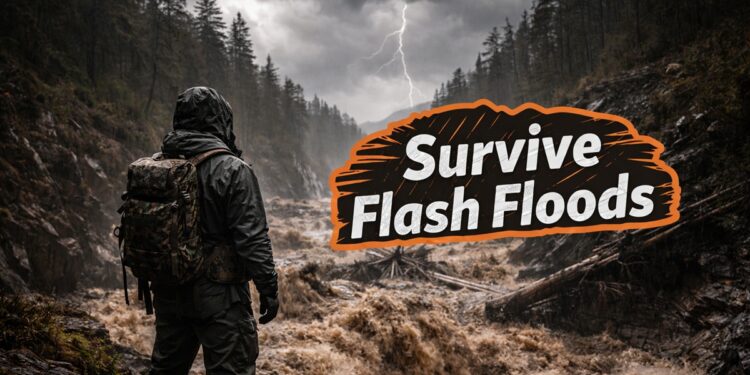


Most people who die in flash floods made one of two mistakes: they underestimated the water, or they had no plan when it hit.
Flash floods are the deadliest weather-related killers in the United States. According to the National Weather Service, they claim more lives each year than tornadoes, hurricanes, or lightning. What makes them so dangerous is the combination of speed and deception. A flood can be triggered by a storm miles upstream, with no rain falling where you are standing. By the time you hear the roar, you have seconds to act.
The Centers for Disease Control and Prevention (CDC) reports that over half of all flood-related drownings occur when a vehicle is driven into floodwater. That single statistic should reshape how you think about driving in heavy rain. This guide will walk you through what to do before a flash flood, how to survive one in progress, and what dangers to watch for after the water recedes.
Understanding Flash Floods
A flash flood is a rapid, sudden rise in water that occurs within six hours of the rain event that causes it, and often within three hours or less. Unlike a river flood that builds slowly over days, a flash flood is a wall of water that moves fast enough to roll boulders, uproot trees, and sweep away cars.
Flash floods happen most often in areas with heavy rainfall over short periods, in mountainous terrain where water drains quickly into narrow canyons and valleys, in desert regions where hard ground cannot absorb rain fast enough, and in urban areas where pavement and concrete prevent natural drainage.
The National Oceanic and Atmospheric Administration (NOAA) notes that just two feet of moving water can carry away most vehicles, including SUVs and pickup trucks. Six inches of fast-moving water is enough to knock an adult off their feet. Understanding these physics is the first step toward making smart decisions when conditions deteriorate.
Warning Signs You Cannot Ignore
Environmental Cues
You do not need a weather alert to recognize a flash flood threat. Nature gives warning signs that a trained eye can read:
- A sudden increase in water speed or turbulence in any stream or creek
- Water that changes from clear to muddy or brown, indicating heavy upstream runoff
- A deep rumbling or roaring sound coming from upstream
- A sharp, sudden rise in water level even with no local rain
- Debris such as logs, foam, and trash floating downstream at high speed
- A drop in air temperature accompanied by a surge of cool, moist wind from upstream
If you notice any of these signs while camping, hiking, or driving near a waterway, move to high ground immediately. Do not wait for confirmation.
Official Alerts
Know the difference between a Flash Flood Watch and a Flash Flood Warning. A Watch means conditions are favorable for flash flooding and you should prepare to act. A Warning means flooding is imminent or already occurring and you must take action immediately. Sign up for your local emergency alerts through the FEMA Wireless Emergency Alerts system and keep a weather radio in your home and bug-out bag.
What to Do Before a Flash Flood
Preparation is what separates a close call from a fatality. If you live in a flood-prone area or spend time outdoors near water, the following steps need to be done in advance, not when the storm is already overhead.
Know Your Terrain
Study the watershed around your home, campsite, or regular routes. Identify where water drains, where low points exist, and what routes to high ground look like. A topographic map or a satellite map app like Google Earth can show you this clearly. Know which roads in your area flood first during heavy rain.
Prepare Your Home
- Stock at least 72 hours of food, water, and medications
- Store important documents in a waterproof container or safe
- Keep a battery-powered or hand-crank weather radio
- Know how to shut off your utilities quickly
- Keep your vehicle fuel tank at least half full at all times
- Have a pre-planned evacuation route that avoids low-lying roads
The Federal Emergency Management Agency (FEMA) recommends having a family communication plan in place before a disaster, including a designated meeting point outside your neighborhood if roads are blocked.
Build a Go-Bag for Flood Scenarios
A standard bug-out bag needs a few flood-specific additions:
- Waterproof dry bags to protect electronics and documents
- A compact emergency whistle and signal mirror
- A rescue knife with a seatbelt cutter and window breaker
- Paracord and a small grappling hook for crossing obstacles
- A personal flotation device or inflatable life vest
- Water purification tablets in case your water source becomes contaminated
Surviving a Flash Flood in Progress
If You Are on Foot
Get to high ground immediately and do not stop moving until you are well above the flood zone. Never attempt to walk through moving water. The force of moving water is deceptive. Six inches of fast-moving floodwater can knock an adult down. A foot of water can sweep you off your feet completely.
If you are caught by rising water and cannot move to higher ground, climb to the highest point available, such as a rooftop, large tree, or rock outcropping. Stay there and signal for help. Do not attempt to swim through floodwater. Submerged debris, currents, and obstacles make flood swimming extremely dangerous even for strong swimmers.
If You Are in a Vehicle
This is where most flash flood fatalities happen. The rule is simple and non-negotiable: turn around, do not drown.
If you encounter water on a road, treat it as impassable unless you can see the road surface clearly and the water is moving slowly. Never attempt to cross a flooded road at night when depth is impossible to judge. Even if another car just crossed successfully, the situation can change in seconds.
According to the American Red Cross, just 12 inches of rushing water can carry away a small vehicle, and 24 inches will carry away most vehicles, including pickups and SUVs.
If your vehicle stalls in floodwater, leave it immediately and move to higher ground. If water is rising rapidly around your vehicle and you cannot open the door due to water pressure, use your window as an exit. Roll it down before water reaches the window level. If it is already submerged, use a rescue knife or window breaker to shatter a side window. Do not use the windshield as it is laminated and very difficult to break.
Once the window is open, wait for the interior pressure to equalize with the outside water, take a deep breath, and push out. This is why every vehicle in a flood-prone area should have a rescue tool within arm’s reach of the driver.
If You Are Camping or in a Canyon
Slot canyons and narrow gorges are some of the most dangerous places to be during a flash flood. Water can rise 30 feet or more in minutes with little warning. If you are hiking in a canyon and the sky darkens upstream or you hear thunder anywhere in the watershed, begin climbing out immediately.
Never camp in a dry riverbed or at the bottom of a canyon. Even on a clear night, a distant storm can send a wall of water toward you. Always camp above the high-water mark indicated by debris lines on canyon walls. When in doubt, camp higher than you think you need to.
After the Flash Flood
Once water levels begin to recede, the danger is not over. In some ways, the aftermath introduces new and less obvious hazards.
Do Not Return Too Soon
Flood conditions can return suddenly as water from upstream continues flowing through. Do not re-enter your home or campsite until officials declare the area safe. Even shallow standing water can hide deep holes, washed-out roads, downed power lines, and contaminated materials.
Watch for These Post-Flood Hazards
- Structural damage to your home including cracked foundations and compromised walls
- Contaminated water in wells, municipal supplies, and standing puddles
- Carbon monoxide risk from generators placed indoors or near windows
- Mold growth beginning within 24 to 48 hours in wet structures
- Gas leaks from damaged lines
- Washed-out roads and bridges that look intact from above but are structurally compromised
The U.S. Geological Survey (USGS) warns that post-flood landslides are also a serious hazard in hilly areas where saturated soil becomes unstable. Do not assume that a hillside above your property is safe just because it did not fail during the flood itself.
Decontamination and Water Safety
Assume any water that has come in contact with floodwater is contaminated. Floodwater commonly carries sewage, agricultural runoff, industrial chemicals, and debris. Do not drink tap water until authorities confirm it is safe. Do not allow children or pets to play in standing floodwater or mud.
Discard any food that has come into contact with floodwater, including canned goods with dented seals or exposed labels. Refrigerators and freezers that have been flooded should be cleaned and sanitized before use. When in doubt, throw it out.
Document Everything
Before removing any flood damage, photograph and video every affected area for insurance purposes. Contact your insurance company as soon as possible and keep a detailed log of all losses and recovery expenses. FEMA disaster assistance may be available if your county has received a federal disaster declaration.
Key Takeaways
Flash floods are fast, unpredictable, and deadly. The actions you take in the minutes before and during a flash flood are what determine whether you survive. Here is the short version of what you need to remember:
- Never drive through floodwater. Turn around, do not drown.
- If you are on foot, get to high ground immediately and stay there.
- Know the warning signs before you need them, not after.
- Prepare your home, vehicle, and go-bag with flood-specific gear.
- After the flood, treat all water, structures, and food as potentially contaminated until confirmed safe.
Surviving a flash flood is not about luck. It is about preparation, awareness, and the discipline to act fast when every instinct might tell you to wait and see. That is what preppers train for.
Prepare for the Moment When Leaving Isn’t an Option
Flash floods don’t give you time to improvise. They don’t give second chances to people who assume they can “figure it out when it happens.” When roads are underwater, bridges are compromised, and evacuation routes are cut off, survival depends on one thing: how well prepared you are to stay put safely.
That is exactly where A Navy SEAL’s Bug-In Guide becomes invaluable.
Written from the perspective of elite survival training, this guide focuses on what most preparedness resources overlook: how to maintain control, security, and sustainability when you must shelter in place during a crisis. Flash floods often make bugging out impossible or extremely dangerous. Knowing how to bug in effectively can mean the difference between stability and chaos when your environment suddenly becomes hostile.
Inside the guide, you will learn how to:
- Secure your home so it remains a safe stronghold even when disaster strikes suddenly
- Protect your food, water, and critical supplies from contamination and loss
- Create layered preparedness systems that continue working when infrastructure fails
- Maintain communication, situational awareness, and decision-making clarity under stress
- Reduce reliance on outside help when emergency services are overwhelmed
- Build redundancy into your preparedness plan so a single failure does not cascade into multiple problems
Flood scenarios highlight a hard truth: mobility is not always possible. Roads become rivers. Vehicles become hazards. Entire neighborhoods can be isolated within minutes. When evacuation is not viable, the ability to shelter safely and effectively becomes a primary survival skill.
A Navy SEAL’s Bug-In Guide teaches practical methods for strengthening your home as a resilient base of operations. It shows how to think strategically about supplies, defensive positioning, resource management, and contingency planning so you are not forced into risky last-minute decisions.
Preparedness is not just about reacting quickly. It is about removing panic from the equation entirely. When you already know what to do, you act with purpose instead of hesitation.
Flash floods are only one example of situations where bugging in becomes the safest option. Severe storms, grid failures, civil disruptions, and infrastructure breakdowns can all make travel unsafe or impossible. Having a structured plan allows you to maintain control when others are scrambling for options.
If you want to strengthen your readiness and build the confidence that comes from knowing your home can support you during emergencies, A Navy SEAL’s Bug-In Guide is a powerful addition to your preparedness library.
Because when the water rises and the roads disappear, the safest place may already be the one you prepared in advance.
You may also like:
 2026 Natural Disaster Map. Is Your Area on the List?
The Pocket Soup that Saved the Lewis and Clark Expedition (VIDEO)
Why “Normalcy Bias” Gets People Killed
The Best EDC Flashlight For All Uses