

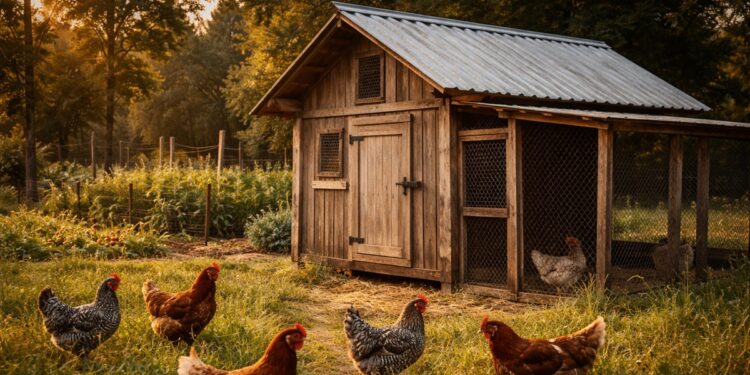


When the grid goes down, the supply chain breaks, or inflation makes grocery store eggs a luxury, the people eating well are the ones who built their food production into their property. Amish chicken coops are not a trend. They are not a lifestyle aesthetic imported from a farmhouse magazine. They are a centuries-old engineering solution to a real and permanent problem: how do you keep chickens alive, productive, and secure without electricity, synthetic materials, or factory infrastructure?
This guide covers everything a prepper or homesteader needs to know about Amish chicken coops, from their design philosophy and structural advantages to sourcing, building from scratch, managing a flock, and integrating your coop into a broader food security plan. If you are serious about self-sufficiency, this is where you start.
What Makes a Chicken Coop “Amish”?
The term “Amish chicken coop” gets used loosely in the market, but there is a specific meaning behind it that matters to preppers. Amish communities, particularly in Ohio, Pennsylvania, Indiana, and Missouri, have been building functional livestock structures for generations without relying on power tools, synthetic fasteners, or imported engineered lumber. Their coops reflect a construction philosophy built around three core principles: durability, repairability, and function over form.
An authentic Amish-built coop typically features solid wood framing, often using rough-sawn lumber or dimensional hardwood rather than treated pine. Hardware is minimal and practical. Joints are designed to be maintained with basic tools. Ventilation is passive, using ridge vents, gable openings, or louvered panels rather than powered fans. Doors and latches operate manually, with no electrical components. Roofing is metal or wood shingles, not asphalt composite.
What this means in practice is that an Amish coop can still be standing and fully functional in 40 years, even if it never receives a single modern hardware store part. That is the standard you want for a preparedness-grade structure.
Why Preppers Should Prioritize the Amish Model Over Modern Coops
Walk into any farm supply store or browse any online retailer and you will find dozens of mass-produced chicken coops at every price point. Most of them are inadequate for serious food production. Here is why the Amish model outperforms them in every category that matters to someone building long-term resilience.
Structural Longevity
Manufactured coops are built for retail margins, not decades of use. Thin plywood, staple-gun assembly, and cheap hardware mean most commercial coops deteriorate within three to five years. Amish-built coops use thicker stock lumber, proper mortise-and-tenon or lap-joint framing, and galvanized or hand-forged hardware. A well-maintained Amish coop easily lasts 20 to 50 years.
The USDA’s National Institute of Food and Agriculture notes that structural quality is one of the most significant factors in long-term poultry flock success on small farms, directly affecting biosecurity, predator protection, and flock productivity.
Off-Grid Compatibility
Modern coops often assume electricity. Heated waterers, powered ventilation fans, thermostat-controlled heat lamps, and automatic doors all require grid power. When that power disappears, the entire system fails. An Amish coop is designed from the ground up to operate without any electrical inputs. Ventilation is passive. Water systems are gravity-fed or manual. Lighting comes from positioning, not wiring. In a grid-down scenario, your Amish coop continues functioning exactly as designed.
Repairability With Basic Tools
If a wall panel on a commercial coop fails, you often need to replace a proprietary part or an entire section. If a board on an Amish coop rots or breaks, you cut a new board and nail it in. The materials are standard. The techniques are documented in generations of carpentry knowledge. You do not need a manual, a warranty, or a parts supplier. This is critical in a scenario where supply chains are disrupted.
Predator Security
Predator pressure is a constant reality of backyard and homestead chicken keeping. Foxes, raccoons, weasels, hawks, dogs, and coyotes all pose serious threats. Amish coops are typically built with hardware cloth (welded wire mesh with small openings) rather than chicken wire, which predators can tear through. Floors are either solid wood with apron framing, concrete, or buried wire to prevent digging. Latches are manual and secure. The overall construction is heavier and harder to breach than anything manufactured at a retail price point.
According to the Penn State Extension service, predator pressure accounts for a significant portion of backyard flock losses, and structural security is the first line of defense.
Capacity for Real Food Production
A decorative backyard coop sold at a home improvement store might claim to hold 4 to 6 chickens while realistically fitting 2 comfortably. Amish coops are built with working flock sizes in mind. A family of four needs a minimum of 8 to 12 laying hens to meet most of their egg requirements, and more if they want a meat bird rotation. Amish coops are routinely sized for 10, 20, or 30 birds with appropriate space allotments, nesting boxes, roosting bars, and run dimensions to support genuine production.
Amish Coop Design Principles You Need to Understand
Whether you are buying an Amish-built coop or constructing your own using Amish design principles, the following elements define what makes these structures work at a fundamental level.
Orientation and Passive Solar Positioning
Amish builders typically orient coops with the main window and door facing south (in the Northern Hemisphere). This maximizes passive solar gain in winter, reducing or eliminating the need for supplemental heat in all but the coldest climates. South-facing windows also maximize natural light, which is critical for maintaining egg production during shorter winter days. The back and north-facing walls are kept solid and heavily insulated or banked against earthen berms in some traditional designs.
Ventilation Without Drafts
Chickens are susceptible to respiratory disease when forced to breathe stale, ammonia-laden air. But they are also vulnerable to direct cold drafts. Amish coop design resolves this tension by placing ventilation high in the structure, near the roofline, where fresh air exchanges without blowing directly on roosting birds. Ridge vents, gable vents, and adjustable louvered panels allow the keeper to tune airflow seasonally without introducing drafts at bird level.
The University of Minnesota Extension service identifies proper ventilation as the single most important environmental factor in flock health, ahead of temperature management.
Nesting Box Ratios
The standard recommendation is one nesting box per four to five hens, though in practice hens often prefer fewer boxes and will share. Amish coops incorporate external access nesting boxes, meaning you collect eggs from outside the coop without entering and disturbing the flock. This is a practical detail with significant implications for daily management efficiency.
Roosting Bar Design
Roosting bars should be wide enough that chickens can flatten their toes over them, which protects the birds from frostbite in cold climates. The traditional Amish standard uses 2×4 lumber laid flat, giving birds a broad, stable surface. Bars are set at staggered heights and positioned so birds roosting on upper bars do not defecate on birds below. Droppings boards beneath the bars, which can be scraped clean daily, dramatically reduce ammonia buildup and simplify coop maintenance.
Flooring Options and the Deep Litter Method
Amish coops commonly use one of three flooring approaches: packed earth, wood planking, or concrete. Each has trade-offs. Packed earth is the simplest and lowest cost but creates predator vulnerability and drainage issues. Wood planking raises the floor off the ground, improving drainage and reducing moisture, but requires periodic replacement. Concrete is the most durable and predator-proof, though it requires more upfront work.
The deep litter method, widely used in traditional Amish keeping, involves building up several inches of wood shavings, straw, or leaf material on the floor and turning it periodically rather than fully cleaning the coop. Over time this creates a composting layer that generates mild heat and significantly reduces pathogens through beneficial microbial activity. Research published in the journal Poultry Science has documented the pathogen-suppressing effects of properly managed deep litter systems. This technique requires no technology, no chemicals, and produces high-quality compost for your garden as a byproduct.
Attached Runs and Free-Range Management
A secure attached run extends your coop’s usable space and allows chickens to forage and access sunlight without full free-range exposure. Amish run construction uses sturdy posts set at least two feet into the ground, heavy gauge wire fencing, and a covered top or roof to prevent hawk predation. For homesteads with sufficient land, a rotational free-range system is often used alongside the run: birds are released to graze in paddocks that rotate to prevent overgrazing and interrupt parasite cycles.
Buying a Pre-Built Amish Coop: What to Look For and What to Avoid
A significant market exists for Amish-built coops shipped or delivered from traditional Amish communities. If you have the budget and want a ready-to-use structure, this is a legitimate option. But the label “Amish-built” is not regulated, and the market includes both genuine high-quality craftsmanship and lower-quality products using the name as a marketing term. Here is how to evaluate what you are buying.
Verify the Wood Species and Thickness
Ask explicitly what species and dimension of lumber is used for framing and siding. Genuine Amish construction typically uses white oak, eastern white pine, or locally available hardwoods in 1-inch or thicker stock for siding and 2×4 or larger framing. Be cautious of anything described as “composite wood,” “engineered wood panels,” or thin plywood under 3/4 inch for structural elements.
Examine the Hardware
Latches, hinges, and fasteners should be hot-dipped galvanized or stainless steel. Zinc-plated hardware will rust within a few seasons. Check that hinges are heavy-duty and screwed into solid material, not stapled. Door and nesting box hardware should open and close smoothly without binding.
Inspect the Wire Mesh
Any reputable Amish coop should use welded wire hardware cloth with openings no larger than half an inch for any portion accessible to predators. Chicken wire (hexagonal wire netting) is not an acceptable predator barrier and should be treated as a disqualifying detail on any coop you are considering for serious use. A raccoon can tear through standard chicken wire with its hands. A weasel can pass through openings larger than one inch.
Check the Roofing Material
Metal roofing, particularly corrugated galvanized steel or standing seam, is the most durable and low-maintenance option. It handles heavy snow loads, resists rot, and will outlast the rest of the structure with minimal care. Asphalt shingles are acceptable but require replacement every 15 to 20 years. Wood shingles are traditional but need regular maintenance. Avoid coops with thin plastic or composite roofing panels, which degrade rapidly under UV and temperature cycling.
Understand Delivery and Assembly Requirements
Many Amish coops are delivered assembled or in large pre-built sections. Check your access points, road widths, and site conditions before ordering. Some suppliers will deliver and set the coop on site for an additional fee, which is worth considering for large structures. Ask about the foundation requirements: most quality coops need a level surface, typically gravel, treated wood skids, or a concrete slab to prevent moisture damage and settling.
Established Sources for Amish-Built Coops
Several established Amish and Mennonite communities in Ohio (particularly Holmes and Wayne counties), Lancaster County Pennsylvania, and LaGrange County Indiana are known for quality agricultural buildings. Many of these operations ship nationally. Looking for builders with verifiable community ties, customer reviews that go beyond aesthetics to discuss structural performance, and transparent material specifications will help you separate quality products from marketing.
Building Your Own Amish-Style Coop: A Prepper’s Construction Approach
If your budget is limited, your site has unusual dimensions, or you simply want the skills and knowledge that come with building your own structure, constructing an Amish-style coop yourself is a realistic project for anyone with basic carpentry skills. The following covers the principles and process, not a single prescriptive plan, because every site and situation is different.
Sizing Your Coop for Real Food Production
The absolute minimum indoor space for a healthy laying hen is 4 square feet of floor space inside the coop. In practice, plan for 6 to 8 square feet per bird for a flock that will be in the coop regularly. Add 8 to 10 square feet per bird in the attached run. For a productive family flock of 12 hens, this means a minimum interior of 72 to 96 square feet with a run of at least 120 square feet.
Do not build small. The most common mistake first-time coop builders make is undersizing. A larger coop is easier to manage, easier to clean, allows more airflow, and gives you room to expand your flock. Build for the flock you want in three to five years, not just for the chickens you have today.
Foundation Options for the Homesteader
For a permanent coop, four options cover most situations. Concrete piers, set below the frost line, provide stable long-term support and allow airflow under the floor, which reduces moisture and discourages rodents. A continuous concrete perimeter wall or slab is the most predator-proof option and the most labor-intensive. Pressure-treated wood skids, typically 4×6 or 6×6 timbers, allow the structure to sit on the ground and can be moved if necessary but require a level site and good drainage. Gravel pad foundations, used under a coop with a solid floor, improve drainage significantly compared to bare earth.
Framing With Available Materials
Traditional Amish framing uses post-and-beam construction, but for a standard homestead coop, conventional stud framing with 2x4s works well and is faster to execute. Frame walls at 16-inch on-center spacing for standard lumber sheathing. Set door frames and window openings with proper headers. If you want to stay closer to the Amish tradition, use rough-sawn local lumber where available: it is typically thicker than standard dimensional lumber and significantly more durable for agricultural applications.
The Forest Service’s Forest Products Laboratory provides documented data on the comparative durability of different wood species for agricultural construction, a useful resource when selecting your lumber species.
Roofing for Longevity
A metal roof is the default recommendation for any prepper-grade coop. Corrugated galvanized steel roofing panels are inexpensive, easy to install, and will outlast the structure below them. A simple gable roof with a 4/12 or steeper pitch sheds snow, handles rain, and allows for ceiling height inside the coop that improves ventilation. The ridge can be left open with a covered cap for passive airflow, or closed and fitted with a ridge vent.
Windows, Vents, and the Cold-Climate Balance
In temperate and cold climates, plan for south-facing windows with a combined area of approximately 1 square foot of glass per 10 square feet of floor space. Use double-pane glass or cover window openings with storm windows in winter. Ventilation openings near the roofline should total 1 square foot per 10 square feet of floor space and be operable so you can reduce ventilation during extremely cold weather while maintaining some airflow. Hardware cloth should cover all vent openings to exclude predators.
Predator-Proofing Your Build
Predator-proofing is not optional; it is the most important security function your coop performs. Use half-inch hardware cloth for all openings, including vent covers, window guards, and the run enclosure. Bury an apron of hardware cloth or use a concrete perimeter skirt extending 12 to 18 inches horizontally from the base of the run to prevent digging predators from gaining access. All doors should close securely with latches that require two steps to open, since raccoons can figure out simple single-action latches. If the door can be opened with one motion, it is not secure.
Predator pressure studies conducted through the University of Georgia Extension service document that most flock losses occur through structural vulnerabilities in the coop itself rather than active predator cunning, reinforcing that building quality is your primary protection.
Integrating Your Coop Into a Prepper Food Security System
A coop is not a standalone investment. It is a node in a broader food security network. The following covers how chickens and your coop fit into a larger self-sufficiency strategy.
Choosing Breeds for Resilience and Dual Purpose
Modern commercial egg breeds like the Leghorn are highly efficient layers but are lightweight, less cold-hardy, and have limited meat value. For a preparedness context, dual-purpose heritage breeds offer a much better trade-off. Rhode Island Reds, Plymouth Rocks, Dominiques, Sussex, and Orpingtons all lay well, handle cold, forage effectively, and produce a worthwhile meat carcass when culled. Dominiques are particularly notable as the oldest American chicken breed, developed specifically for homestead conditions.
Heritage breeds also breed true, meaning if you maintain a rooster, you can hatch your own replacements without purchasing stock. This is a critical distinction in a long-term grid-down scenario. Commercial hybrids are developed to be purchased, not bred. A true-breeding heritage flock gives you biological independence.
Feed Independence Strategies
Commercial chicken feed is a dependency. Disruptions to grain supply chains or simply a period without income can threaten your flock’s survival if they depend entirely on purchased feed. The Amish approach addresses this through several integrated strategies that work with your coop design.
Managed free-ranging allows chickens to harvest insects, seeds, green plants, and other forage that significantly supplement or partially replace purchased feed. Rotational grazing paddocks prevent overgrazing and maximize forage productivity. Grain growing, even on a small scale, allows you to produce scratch grains or fermented feed from your own land. Kitchen and garden scraps redirect calories that would otherwise be wasted. Black soldier fly larvae composting systems, which can be built adjacent to the coop, produce high-protein larvae from food waste and dramatically reduce purchased protein supplement needs.
The National Sustainable Agriculture Information Service documents that well-managed pasture-based poultry systems can reduce purchased feed inputs by 20 to 30 percent in optimal conditions, with integration of additional systems pushing that reduction further.
Water Independence for Your Flock
A laying hen drinks roughly one pint of water per day in normal conditions, more in heat. For a flock of 12, that is a minimum of 1.5 gallons daily, with significant increases in summer. In a grid-down situation, pressurized water supply may not be available.
Rainwater harvesting integrated with your coop roof is the most practical off-grid water solution. A metal-roofed coop sheds water cleanly into gutters and downspouts connected to food-grade storage tanks or barrels. A 500-gallon tank fills quickly in most North American climates and provides substantial buffer for dry periods. Position your waterers on gravity-feed lines from elevated tanks to eliminate the need to haul water daily.
Closing the Nutrient Loop: Manure and the Garden
Chicken manure is high in nitrogen, phosphorus, and potassium, making it one of the most valuable organic fertilizers available. In a self-sufficient system, the coop does not generate waste: it generates fertility. The deep litter from your coop is hot-composted before application to kill pathogens and burn off excess nitrogen, then applied to your garden beds.
Some Amish farms practice a “chicken tractor” rotation that moves portable coops over fallow garden beds in winter, allowing the flock to scratch, fertilize, and decompact the soil simultaneously. Even with a stationary coop, positioning it adjacent to compost areas and garden zones creates a nutrient flow that reduces or eliminates dependence on purchased fertilizer inputs.
Maintenance, Seasonal Management, and Coop Health
A well-built Amish coop requires modest but consistent maintenance. The following schedule and practices reflect the Amish tradition of keeping structures functional for generations through regular attention rather than deferred repairs.
Daily Tasks
- Collect eggs morning and evening to prevent brooding, breakage, and egg eating behavior.
- Check water supply and refill or clear ice as needed.
- Visual inspection of flock for signs of injury, illness, or predator activity.
- Scatter scratch grain or supplemental feed if not on managed pasture.
Weekly Tasks
- Scrape droppings boards under roosting bars into compost.
- Add fresh bedding material to maintain deep litter depth.
- Check nesting box bedding and replace if soiled.
- Inspect structural elements for signs of damage, moisture, or predator attempts.
Seasonal Preparations
In spring, deep clean the coop by removing all litter, washing surfaces with a dilute bleach solution or apple cider vinegar, and inspecting the structure after winter for frost heave damage, moisture intrusion, or hardware failures. In fall, check and tighten all fasteners, re-caulk any gaps in siding or roofing, confirm ventilation settings are appropriate for winter, and ensure waterers and plumbing elements are insulated against freezing.
Address repairs immediately. A small gap in siding that seems minor in summer is a predator entry point or a moisture intrusion problem by winter. The Amish principle here is clear and worth internalizing: fix it now or pay more later.
Common Health Issues and Low-Tech Management
Respiratory disease, external parasites (mites and lice), internal parasites (worms), and crop impaction are the most common health challenges in a backyard flock. All of them can be managed or prevented without veterinary intervention in most cases, using techniques the Amish have employed for generations.
Diatomaceous earth, applied as a dust bath supplement or in bedding, provides significant control of external parasites without chemicals. Wood ash added to a designated dust bath area serves a similar function and is a byproduct of any homestead with a wood stove. Fermented feed reduces pathogen load and improves gut health. Rotational grazing breaks internal parasite cycles. Proper ventilation is the single most effective respiratory disease prevention measure available.
Peer-reviewed research from poultry science departments at multiple land-grant universities has documented the efficacy of these traditional management approaches, confirming that well-managed small flocks maintained in clean, well-ventilated coops have significantly lower disease incidence than industrially managed birds.
The Economics of Amish Chicken Coops: Investment, Payback, and Long-Term Value
A preparedness investment needs to make economic sense, both in normal times and in crisis scenarios. Here is how to think about the cost and value of an Amish-style coop and laying flock.
What to Expect to Pay for a Quality Pre-Built Coop
A genuinely Amish-built coop sized for 12 to 20 birds typically runs between $2,500 and $6,000 depending on region, size, and options, with larger structures for 30 or more birds ranging from $5,000 to $12,000 or more. These prices are significantly higher than mass-produced coops but reflect materials and construction that will last 30 or more years with basic maintenance. The cheapest option over a 20-year horizon is almost never the cheapest initial purchase.
What to Expect to Spend Building Your Own
A self-built 10×12 foot coop with an attached 10×20 foot run, using primarily new dimensional lumber, hardware cloth, and metal roofing, typically runs $800 to $1,800 in materials depending on local lumber prices and choices. Using salvaged or locally milled rough-sawn lumber, reclaimed metal roofing, or other found materials can bring this significantly lower. The primary investment in a self-build is time, typically 40 to 80 hours for a capable builder working on a structure of this size.
The Egg Equation
A healthy laying hen produces 200 to 280 eggs per year in her peak production years. A flock of 12 hens produces roughly 2,400 to 3,360 eggs annually, or 200 to 280 dozen. At current grocery prices for standard eggs, that is $600 to $900 in annual egg value at conventional prices, and significantly more at free-range or organic pricing. The flock pays for a modest coop in two to four years, and continues producing value for the life of the structure.
In an economic disruption or food supply crisis, this calculation shifts dramatically. Eggs are a complete protein source, storable for weeks without refrigeration when unwashed, and tradeable. A reliable laying flock is a genuine economic asset in ways that most financial investments are not.
Legal Considerations: Zoning, HOAs, and Local Ordinances
Before building or ordering a coop, verify your local regulations. Chicken keeping is governed at the local level, and rules vary enormously between jurisdictions.
Most rural and agricultural zones allow poultry without restriction. Suburban and urban jurisdictions vary widely: some allow a limited number of hens with permit requirements, others prohibit chickens entirely. Setback requirements from property lines, neighboring structures, and water sources may affect where you can legally place your coop.
HOA restrictions are a separate layer that may prohibit chickens regardless of municipal zoning. Check your HOA covenants, conditions, and restrictions before any investment.
Roosters are prohibited or restricted in far more jurisdictions than hens. If maintaining a breeding flock for self-sufficiency is a goal, this is an important consideration when selecting your homestead location.
The American Planning Association has documented a significant trend toward more permissive backyard chicken ordinances in municipalities across the country, reflecting growing interest in urban food production, but verification of your specific jurisdiction remains essential before committing to a coop purchase or build.
Final Assessment: Is an Amish Chicken Coop Right for Your Preparedness Plan?
Not every preparedness investment is right for every situation. An Amish chicken coop makes sense if you have or can acquire a site with at least 500 to 1,000 square feet for the coop, run, and associated garden integration. It makes sense if your jurisdiction allows chickens, or if you are planning a homestead property where zoning is not a constraint. It makes sense if you are committed to the daily and seasonal management that a living flock requires.
It is not a passive investment. A chicken flock requires consistent attention. But the return, measured in food security, protein independence, fertilizer production, and the practical skills that go with keeping a flock, is among the highest of any preparedness investment available to a homesteader.
The Amish have maintained this system for generations, not because they lacked access to modern alternatives, but because they evaluated those alternatives against a standard that most preppers would recognize: reliability, repairability, and independence from systems you do not control. Their coop design survives because it works.
Build once. Build right. Build Amish.
Build Skills That Still Work When Everything Else Stops
An Amish chicken coop is more than a structure. It represents a mindset that has kept families fed for generations without relying on fragile supply chains, expensive inputs, or modern infrastructure that can fail overnight.
The same practical philosophy extends far beyond raising chickens.
Food preservation without electricity. Natural remedies using plants you can grow yourself. Handmade household essentials that reduce dependence on stores. Low-tech solutions that keep working no matter what happens to the grid.
These are the kinds of skills that separate inconvenience from true resilience.
The Amish Ways is a collection of time-tested techniques used for generations to maintain independence from modern systems. Inside, you’ll discover practical knowledge that fits perfectly alongside building an Amish-style coop and creating a self-sufficient homestead:
- How to preserve food for long periods without refrigeration
- Simple ways to create powerful natural remedies at home
- Traditional methods for producing essential household items
- Proven techniques for reducing reliance on supermarkets and pharmacies
- Durable, low-tech approaches to everyday needs that still work during disruptions
These methods were not developed for trends or aesthetics. They were developed because they work reliably, year after year, decade after decade.
If you’re serious about building a homestead that can continue producing food even during shortages, inflation spikes, or supply chain disruptions, this is the kind of knowledge that becomes increasingly valuable over time.
The Amish approach is simple:
Use what you can build, repair what you own, and depend on systems you control.
👉 Discover the practical knowledge inside The Amish Ways here!
Build once. Learn once. Use it for life.
You may also like:

The US Army’s Forgotten Food Miracle (Video)
This is Why the Amish Bury Their Food
12 Amish Farming Secrets Every Prepper Should Know
Mennonite vs Amish: What’s the Real Difference?
























What a fine, well thought out article. My wife will read it ,after coffee.. Great job, no profit motive, will follow Claud Davis