

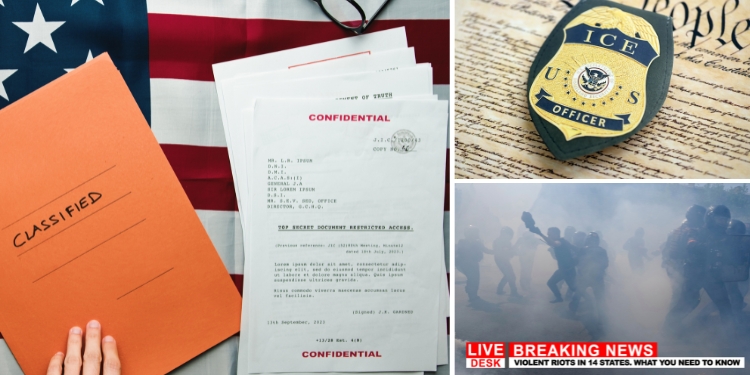


Governments don’t plan for things they believe will never happen. They plan for what they quietly expect, even if they never admit it out loud.
In 2006, while most Americans were focused on gas prices, overseas wars, and everyday life, a small group inside the federal system was planning for something far more uncomfortable: a future where the country itself might become unstable enough to require internal containment.
What is Operation Endgame 2006?
Operation Endgame was created in 2006 by ICE, operating under the Department of Homeland Security. At that time, the federal government was deeply focused on internal security and system failure scenarios. The plan was created internally for administrators and enforcement agencies to prepare for crises in which Constitutional rights may no longer apply.
Understanding Operation Endgame requires stepping away from politics for a moment and looking at how governments think when they believe stability cannot be guaranteed.
The Climate That Produced Operation Endgame
The years following September 11 reshaped how federal agencies viewed risk inside the United States. The concern was no longer limited to foreign threats or isolated incidents. Officials were asked to imagine situations where multiple systems failed at the same time, creating pressure that local authorities could not manage on their own.
During this period, the Department of Homeland Security was still relatively new, and its mission… along with its power, was expanding rapidly. Immigration enforcement, disaster response, infrastructure protection, and internal security were increasingly treated as connected responsibilities rather than separate problems.
👉 3 Warning Signs Civil Unrest Is About to Hit the U.S.
Operation Endgame emerged from this environment. Planners were tasked with answering an uncomfortable question: what happens if immigration enforcement systems are overwhelmed during a national emergency, and the federal government needs to act quickly inside its own borders? The plan was designed as a long-term solution to that question.
Who Created the Plan and Why
 Operation Endgame was developed by Immigration and Customs Enforcement at a time when the agency was still new and trying to define its role inside the Department of Homeland Security.
ICE handled interior enforcement, meaning it dealt with people already living inside the country, not just activity at the border.
That created a problem for planners. Interior enforcement depended on slow systems like courts, local jails, and routine cooperation from state and local authorities.
ICE leadership worried those systems would break down during a major crisis, making large enforcement actions impossible. Operation Endgame was written to solve that problem. Its goal was to give the federal government the ability to act quickly, and at scale inside the country, even if courts were overloaded, local authorities were uncooperative, or normal processes stopped working.
From a planning view, it was about avoiding loss of control during emergencies. From a public view, it raised questions because it implied that federal power could be exercised against individuals without following the proper channels of the justice system or even the Constitution.
What Operation Endgame Was Designed to Do
Operation Endgame was written as a practical enforcement blueprint. Its purpose was to make sure the federal government could carry out very large interior enforcement actions even if normal systems stopped functioning.
According to the document, Operation Endgame was designed to do the following:
- Give federal agencies the ability to find and track large numbers of people inside the country by linking databases and sharing information quickly, instead of relying on local investigations.
- Make sure there are enough places to hold people, by using temporary facilities or rented spaces during emergencies.
- Allow authorities to detain large groups of people at once when courts, local jails, or processing offices could not handle the volume.
- Set up ways to move detainees across state lines quickly, so local areas would not be overwhelmed and operations could continue without interruption.
- Keep cases moving even when immigration courts were buried in backlogs, meaning people could be removed without long delays.
- Enable enforcement actions to continue under emergency rules, where normal timelines and procedures were adjusted to fit crisis conditions.
- Prevent confusion between agencies by making sure federal departments work as one system, instead of arguing over responsibility while operations are underway.
- Keep enforcement running during national emergencies, including events that disrupt staffing, transportation, or local government cooperation.
- Remove steps that normally slow enforcement, so operations could continue at full speed under pressure.
- Allow these actions to move forward without waiting for new laws, public debate, or political approval, once an emergency has been declared.
In short, Operation Endgame was about keeping full federal control over immigration enforcement during emergencies, when normal rules and systems break down.
Detention Was Central to the Strategy
 One of the most significant aspects of Operation Endgame was its focus on detention capacity. The plan acknowledged openly that existing facilities could not handle the numbers envisioned under emergency conditions.
Rather than seeing this as a limitation, the document treated it as a logistical problem that could be solved through expansion and flexibility. Temporary facilities, contracted spaces, and shared use arrangements were all part of the planning.
This approach required confidence that large numbers of people could be housed, guarded, supplied, and managed without overwhelming the system. It also assumed that staffing could be scaled quickly and that supporting services would remain functional during periods of stress.
Transportation and Movement Planning
Endgame devoted considerable attention to transportation. Moving people efficiently was considered essential to maintaining control and preventing bottlenecks that could draw public attention or create unrest.
The plan assumed access to transportation assets that could be mobilized quickly, along with cooperation between federal agencies and private contractors. Routes, schedules, and coordination were expected to adapt rapidly as conditions changed. This emphasis on movement reflected an understanding that delays create problems. When operations slow down, public scrutiny increases and resistance becomes more likely.
Legal Authority Under Emergency Conditions

Operation Endgame was built around the idea that it would be used during a declared emergency rather than normal conditions.
During emergencies, the federal government is allowed to operate under different rules, with fewer delays and less oversight.
This would also mean the government could, in theory, disregard an individual’s Constitutional right… especially if they’re deemed to be a ‘threat’ or better put, a ‘domestic terrorist’.
The plan assumed that immigration courts and legal systems would not be able to handle large numbers of cases in a crisis. Instead of waiting for those systems to catch up, Operation Endgame prepared for enforcement to continue under emergency authority, with faster decisions and centralized control.
Systems created to function under these conditions do not disappear when an emergency ends. They stay in place and can be activated again whenever another crisis is declared.
Why the Public Was Never Involved
Operation Endgame was written as an internal planning document, not as a policy meant to be explained or defended in public. It was treated as a technical solution to a problem that officials believed might arise during a national emergency.
👉 The First US States that Will Go Down when SHTF. Is Your State on the List?
From the planners’ point of view, public debate would have made the plan harder to use. Open discussion invites legal challenges, political resistance, and public pressure long before any crisis actually occurs. Those reactions can limit how much authority agencies have when they are trying to prepare for worst-case scenarios.
By keeping Operation Endgame inside the federal system, agencies were able to plan freely, test assumptions, and build enforcement capacity without outside interference. The goal was to make sure that, if a crisis occurred, the tools were already in place and did not need approval or explanation at the moment they were needed.
Was Operation Endgame Ever Implemented Under President Trump?
 During Donald Trump’s first presidency, immigration enforcement became more visible and more assertive inside the United States.
Interior arrests increased, detention was used more consistently, and federal agencies played a stronger role when local cooperation was limited.
These changes led many observers to wonder whether older emergency-style plans, including Operation Endgame, were being put into practice.
Some signs looked similar on the surface. Immigration courts faced heavy backlogs while removals continued. Federal authority was emphasized over local discretion in several areas – all of this matched situations that Operation Endgame had been written to anticipate.
However, it is important to be clear about what did and did not happen.
Trump’s administration did not formally implement Operation Endgame. There was no declaration activating it, no official reference to it, and no use of its emergency enforcement framework as a standalone plan. What happened instead was that the administration made active use of existing enforcement systems that had been built over many years.
Those systems, including detention contracts, transportation networks, and inter-agency coordination, were already part of the federal structure. Operation Endgame had helped shape the thinking behind that structure, but it was not a switch that was turned on.
Moreover, during Trump’s second presidency, immigration enforcement remains a visible priority. ICE arrests and enforcement campaigns are conducted openly, using coordinated operations that involve federal agents rather than relying heavily on local authorities. These actions follow established legal processes and do not involve emergency declarations, but they show how centralized enforcement can function without new laws or crisis-level authority.
However, this does not mean Operation Endgame is active. It means the capabilities envisioned by planners years ago are now part of normal federal operations.
Did the Plan Disappear?

One mistake many people make is assuming that plans like Operation Endgame expire when administrations change. In reality, federal planning does not work that way.
Once a plan is written, it becomes part of the system. The Patriot Act is a great example of this. It can be revised, updated, or folded into other strategies, but it is rarely thrown out.
Staff may change over time, yet the planning itself remains available and continues to shape how agencies prepare for future situations.
Therefore, Operation Endgame did not vanish. Its ideas and assumptions were absorbed into broader internal planning related to domestic stability and large-scale enforcement. Even when the name stops being used, the framework behind it can continue to influence how the government prepares for crises.
Consequences That Rarely Get Discussed
If an operation like Operation Endgame were ever activated, its effects would reach far beyond immigration enforcement. Large-scale internal operations change how everyday life functions, especially at the local level, and those changes tend to happen quickly.
Some of the most likely consequences include:
-
- Workforce disruption in entire regions, especially in agriculture, construction, food processing, and service industries, where sudden removals can leave businesses short-staffed overnight.
- Higher taxes and increased fees, as local and state governments try to offset shrinking tax bases, and cover rising social-service costs. Luckily, there’s a legal way to stop paying your taxes – you can find it here.
- Strain on local services, such as schools, hospitals, and social services deal with sudden population changes, missing workers, and families in crisis.
- Pressure on food supply chains, particularly in areas where food production and distribution depend on seasonal or immigrant labor.
- Housing instability, with rentals abandoned suddenly, mortgages missed, and local housing markets affected by rapid turnover.
- Increased law enforcement presence, including federal agents operating independently of local authorities, can change how communities function on a day-to-day basis.
- Reduced mobility for ordinary people, as checkpoints, enforcement zones, or transportation disruptions make travel less predictable.
- Court backlogs are spilling into other legal areas, as resources are diverted to enforcement-related cases, slowing unrelated civil and criminal proceedings.
- Economic slowdown in affected areas, as businesses close temporarily or permanently due to labor shortages and uncertainty.
- And in the worst-case scenario… American citizens and legal residents could lose their God-given rights to freedom, property, and the right to express themselves or defend themselves.
- Workforce disruption in entire regions, especially in agriculture, construction, food processing, and service industries, where sudden removals can leave businesses short-staffed overnight.
Operation Endgame isn’t about borders. It’s about control.
When ICE is mobilized at scale, when cities brace for unrest, when law enforcement is stretched thin and government priorities shift inward – history shows what comes next: supply disruptions, frozen systems, and neighborhoods left to fend for themselves.
That’s when the silence starts. No help. No answers. No second chances.
Dark Reset: Survival Before the Silence was created for this exact moment – when civil order fractures quietly, and the prepared separate themselves from the desperate.
If Operation Endgame is the trigger… Dark Reset is your insurance policy!

Final Thoughts
Emergency-style operations focus on speed and control. Long-term social and economic effects are usually treated as secondary concerns. That gap is where ordinary people feel the impact most.
For Americans, these consequences are not to be ignored. They affect food availability, job stability, access to healthcare, and the ability to move freely without interruption. These are the kinds of disruptions that ripple outward, even for people who are not directly involved in enforcement actions.
You may also like:
 Self-Defense Moves That Might Save Your Life Soon
NASA Warns: A 100-Year Drought Is Coming (VIDEO)
Worst States to Be in When the Economy Collapses























another ad for some books, imagine that.
Hello. The article itself is high-quality and independent of the ads. If the ads are distracting, please focus on the content – that’s what we’re here for. We do our best to keep advertising to a minimum, but at this stage the site can’t operate without it. Thanks for being here, and I hope you understand.
A military truth that is considered inviolable is that “No plan survives first contact with the enemy.”
That truism is being proven daily in the resistance to current ICE enforcement activities, financed, recruited, trained, propagandized and controlled by avowed enemies of America, foreign and domestic. Most especially vexing is the outright sedition and treason of “local authorities” in Minnesota and elsewhere. We are a huge, sprawling nation now broken in unifying spirit and common ethos by decades of marxist cultural destruction and the invasion of 200 mil foreigners who do not share our basic civic and moral values. Anything short of drastic extra legal and unconstitutional measures is doomed to ail and guaranteed to produce second and third order consequences which will increase the misery and resistance of and by the very folks who should the beneficiaries of any plan to save the nation. Until and unless the main perpetrators and financiers behind the current intentional disruption and chaos are severely and terminally dealt with. Remove the sources of funding and the “mostly peaceful” “protests” will subside.
I couldn’t have said it better myself!
My fellow Americans I CAN
WE ARE MANY
The infamous THEY
Fight for
The master of the LIE
THE POOR ASS TURD !!!!
DONKEY/RINO
ARE FOOL IN FOR TREASON
WE THE PEOPLE
ONLY FEAR GOD
Just a comment about the intro. The government doesn’t just make plans about what they think is going to happen, they also plan for what MIGHT happen. If there’s an emergency that MIGHT happen, it’s a good idea to have a plan even if you don’t think you’ll have to put it into action. (Some preppers would probably be counted in this group.) My military father once told me he was sure they had plans on file to bomb Washington, DC. If an enemy force had managed to get control of the government and that area, we would be planning to get it back. He added that it wasn’t expected that they would ever need that plan, but he was sure it was there.
This is the job of the War College, to sand table any contingency that can literally be thought up. Rest assured that there are plans to fight domestically (North American Defense Command).
This is true, but planning only matters if there’s a real reason to want the outcome. A lot of government planning feels like it exists just so they can say they’re prepared, which makes you wonder if the threat or goal is sometimes exaggerated to justify the plan itself. Having contingency plans makes sense, like in the military or prepping, but when plans pile up without clear intent or follow-through, the sense of control can turn into an illusion that looks serious on paper while nothing meaningful changes in real life.
I see one major issue with all this. Of free mental capacity, I only served / worked a government job, as a sailor in the US Navy … for four years. But I learned one valuable lesson, that from what I have seen, pretty much is a constant regarding our government.
First … if they want more money, they will tax the pants off you and or print it. They will get what they want. Second … Plans are a dime a dozen … while writing this I am making plans for dinner … is that what I will actually have for dinner? Perhaps, or maybe not. Everybody makes plans, to be effective, you need to follow through with those plans. Not everyone or entity does that. Third … the government entity is inept. Thinking of something, actually doing it, and being successful at it, will take many many many attempts … and even then may fail.
There are bright spots in our government machine, but no one person, yet controls it .. at most they guide it. Many minds involved, make it impractical at best. The government demanding control, using ICE, homeland security, etc … is like demanding a child stop crying by spanking it. It cries louder. The government has little to no control over it’s citizens or illegal immigrants. We merely lazily sit back, and allow them to think they have control. It has always been that way, and will remain.
Here’s the truth: the government doesn’t have to do things well. When it fails, nothing really happens to the people who made the decisions, so there’s no pressure to improve. That’s why the same bad plans and half-results keep repeating.
This is exactly what the founding fathers warned us about. They referred to it as tyranny. They gave us the bill of rights to fight against it. The first amendment gives us the right to free speech and press. The second amendment gives us the right to bear arms. The fourth amendment protects us from unreasonable search and seizure. ICE is clearly violating all three. They arrest citizens for protesting and journalists for reporting it. They have shot and killed a man for legally possessing a gun even though they disarmed him first. They break into houses without warrants. The current President and administration is approving and excusing these violations. President Trump has gone as far as saying “you can’t have guns”.
It doesn’t mater whether you call yourself Republican, Democrat, Libertarian, independent, or something else. We all have to realize that this is Federal government overreach at best and outright tyranny at worst. We cannot allow any President of any political party to ignore the Constitution for his own political power grab or we are all doomed.
You are full of c*ap. All of your so-called points have been disproved. Pay attention.
“The Party told you to reject the evidence of your eyes and ears. It was their final, most essential command.”
– George Orwell, 1984
Everything I cited can be easily verified by video and written evidence. If you choose to reject the evidence of your eyes and ears then you are part of the problem. When they come to take YOUR rights, it may already be too late.
https://fb.watch/F0UCmwnYmq/?mibextid=wwXIfr&fs=e
Radioguy, I respect that people have strong opinions on this, but simply dismissing someone’s view without explaining why doesn’t really move the discussion forward. If you believe the points are wrong, it would help everyone to explain which ones and share your reasoning or sources so we can actually have a useful conversation.
Right on dnm!! Thank you . SUBVERT THE DOMINANT PARADIGM !!
Well Hold on : More to come and when it arrives , you will Own Nothing
famous quote from the biggest thief, looser , demon who ever occuppied the office .
NOT our President or anyones for that fact
Just another usefull IDIOT , puppit
Goal : take all you have , thru taxes, laws, or liars ops
End will come and slavery will be instituted , and you will choose whom you will follow
Marked for life and food, clothing and neccesities according to how you obey
or Eternal Life , with Jesus Christ Never taking any ID , or mark of loyalty to the system of MONEY and Control .
End Game : anti God , Anti Christ , Total World Domination
if you live , you will loose everything on your way out , Goal
Facts dont lie , but news , media, internet Does People Lie
This will be the sign , forced form of religeon to serve the Mass, all , good of mankind
you will still own nothing
From my current perspective…if..the U.S.A. loses its middle class …like Venezuela….we will be in big trouble….like Venezuela. Hopefully the U.S.A. citizens have enough foresight to vote in the best person capable of providing the middle class a good , healthy working ,environment. to become upper class if one so choose .And a positive working environment for the lowest class to choose to be middle class.if they so choose. Hopefully …Operation Endgame will be used for good and not evil…..depends who’s in power….right ? I watch a video yesterday about the living conditions in the slums of Venezuela…..very sad….terrifying actually……I’ll probably forget….but i don’t think so .
Outer Spice, I hear you. The middle class plays a huge role in keeping a country stable by keeping supply chains moving, supporting the tax base, and holding institutions together. When it erodes, as Venezuela showed, shortages grow, crime rises, and people become dependent fast, and recovery becomes incredibly difficult. What matters most is whether people can stay productive and adapt as conditions change. Seeing how many preppers no longer believe in a strong U.S. middle class actually inspired me to write an article on this (coming soon)- how we got here and whether there’s still any real hope left.
its like this
What is a Gun ? it is a tool.
What is a plan ? it is a tool.
What is an Army ? it is a tool.
are tools Evil ?
Depends on who owns the hand that holds them.
Remember THIS. ANYTHING, ANYTHING that gives “your man” more power, you need to ask, What happens when the other guys get in office, and it is their turn to use the new tools . . .
A new thought. How will the new world collapse ? the one where everyone is using AI to replace people. First off, IDIOTS think AI can think, it cant ( yet). its only mimics what it thinks you think. It can find what others did in what it feels are similar circumstances, and suggest that as an answer. Your about to see idiots follow what AI suggests, because they dont know the answer. How many businesses will go under because IDIOTS follow AI ?
That will bring MUCH instability, that will harm everything else.
Wont happen over night, but its coming.
Someday, they will make a “plan” that doesnt include you having less rights. . . Someday
Till then, wish in one hand and Plop in the other, see which gets filled first.
Luckily the human body is much more advanced than any robot could ever be .
If you don’t believe there are all kinds of plans for the powerful to eat your lunch, then you are naive. If you think such plans are only recent developments, then the same issue again. Dr. Strangelove wasn’t a new idea when it was written. Also, in the end people will find that their rights are only lightly protected by law. Rights that people cannot or will not protect through strength and determination, they ultimately will not have.
Does Operation Endgame exist?
Real, documented uses of the name
ICE “Operation Endgame” (2003–2010)
This was a real U.S. Immigration and Customs Enforcement program.
Goal: arrest and remove fugitive immigrants (people with final deportation orders)
Result: hundreds of thousands of arrests
It officially ended around 2010
Widely criticized for:
Sweeps that caught non-fugitives
Heavy local law-enforcement cooperation
Civil liberties concerns
So yes — this was absolutely real, public, and well documented.
I would seriously love to obtain a copy of the Dollar Apocalypse Survival Guide book by David Bates. It is not available to any customers outside of the USA. I know that when these catastrophic changes take place in the US it will also affect us here in New Zealand, so I too want to be prepared.
Hello Rosalie, Dollar Apocalypse is available in New Zealand through Amazon. Link here: https://amzn.to/4kileHh
troubleshoot— my cursor is defaulted to the delete trash can on your articles and if I tap on an additional story to read, it deletes it. Cure?