

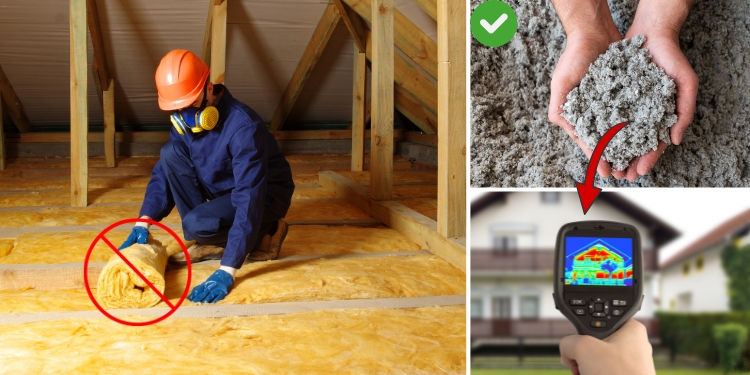


You’ve probably installed foam insulation because every building supply store pushes it first. I did the same thing on my barn renovation five years ago.
The R-value charts convinced me, and the installation went fast. Then problems started showing up. The foam separated from my rafters during temperature swings, creating air gaps that killed its insulating value.
When I needed to add ventilation fans, carving through that rigid foam took four times longer than expected. I pulled samples out and noticed they’d absorbed moisture despite being “closed-cell.”
That failure sent me looking for materials that actually work in real winter conditions, not just laboratory tests.
Sheep’s Wool Insulation
For a material that genuinely regulates temperature and manages moisture, you should look at sheep’s wool insulation. Unlike foam, whose performance can dip in severe cold, wool maintains a consistent thermal resistance, or R-value, because its insulating power comes from its natural fiber structure, not from gases that can change state.
👉 This Common Metal Will Hold Up Better Than Gold and Silver
Each wool fiber contains keratin, the same protein found in your hair, which creates a coating that repels liquid water while still allowing vapor to pass. This means wool can absorb up to 35% of its own weight in atmospheric moisture without feeling wet or losing its ability to trap heat, a critical advantage during winter’s wet freeze-thaw cycles when indoor humidity seeks escape.
If you’re disappointed by foam insulation and want natural alternatives to insulate and heat your home, then this one is for you. It was written for our readers who want to cut energy costs while still keeping their homes warm and comfortable all winter long.
Cellulose Insulation
 When you need to stop icy drafts dead in their tracks, dense-packed cellulose insulation delivers a practical, effective defense.
This material, primarily made from recycled newspaper treated with simple mineral salts like borax and boric acid, fills wall cavities and attic spaces with a dense, fibrous mat that leaves minimal room for air movement.
It is the density that gives cellulose its superior performance as a winter insulator.
By packing it tightly at about 3.5 pounds per cubic foot, you create a barrier that dramatically reduces convective heat loss – the process where cold air infiltrates and warm air escapes through tiny gaps and seams.
In an old homestead house with irregular stud bays and countless penetrations, this dense-packing method seals those legacy leaks that rigid foam boards can never fully address.
Cork Panels
If you seek a rigid panel insulation that behaves nothing like foam, cork provides a remarkable natural alternative. Harvested from the renewable bark of the cork oak tree, this material contains a closed-cell structure filled with air, but it achieves this through suberin, a waxy, complex substance naturally present in the bark, rather than petroleum-based chemicals.
This natural composition grants cork a consistent R-value and a unique resilience to moisture you won’t find in foam. Because of suberin, cork is inherently resistant to rot, mold, and mildew, meaning it can interface with damp foundation walls or a humid crawlspace without deteriorating or losing its insulating capacity.
For it to be effective, I recommend using visqueen, as suggested by Joel Lambert in The Bug-In Guide, one of my personal favorite prepper guides. Visqueen is a heavy-duty polyethylene sheeting designed to act as a vapor barrier, preventing ground moisture and water vapor from migrating into a structure.
When installed behind cork insulation, directly against soil, masonry, or foundation walls, this material stops moisture at the source, allowing the cork to do what it does best: regulate temperature without being forced to act as a moisture barrier. This pairing mirrors traditional building logic: stop water first, then insulate.
Straw Bale Walls
A wall built from straw bales, typically 18 to 24 inches thick, creates a fortress of still air that this weather cannot penetrate. The insulation principle here is simple volume: thousands of hollow straw tubes, each trapping air, are compressed into a massive, monolithic block.
When sealed with a breathable lime or earthen plaster, this assembly achieves exceptional thermal performance, often reaching an R-value between R-30 and R-50. But the real winter advantage is thermal mass.
The thick plaster skin absorbs heat from the sun or your wood stove, stores it, and radiates it back inward over hours as temperatures fall, smoothing out the day-night temperature swing far more effectively than a thin, lightweight foam wall ever could.
Straw bale construction remains one of the most underestimated insulation methods today, dismissed as outdated by people who have never endured a real winter without modern conveniences. Yet the Amish are living proof that few systems perform better.
While they preserve many building secrets we’ve forgotten, every Amish home shares one critical feature when winter sets in, something so simple and effective it’s never discussed in modern construction.
And it’s in every single Amish home during winter:
Hempcrete
Hempcrete, a mix of the woody core of the industrial hemp plant (hurd) with a lime-based binder, works as an insulator in a way that fundamentally differs from both foam and fluffy batts. Instead of just having high resistance to heat flow (R-value), it provides significant thermal mass, which is its key advantage for winter stability.
👉 How To Cool Your House Without Power
This means it absorbs heat slowly and releases it even more slowly, creating a thermal lag that can last 8 to 12 hours. When the sun hits a south-facing hempcrete wall or your wood stove heats the interior, the wall absorbs that energy.
Then, as night falls and temperatures plunge, the wall radiates the stored warmth back into your home, naturally balancing extremes and reducing your active heating load. You can learn how to use hempcrete with this book.
Wood Fiber Board Insulation
If you want a rigid board insulation that doesn’t trap moisture in your walls, wood fiber board is worth a look. It’s made from compressed wood waste instead of chemicals, and it goes on the outside of your wall sheathing to help keep heat in without sealing everything up like foam does.
If you’ve ever followed a set of decent woodworking plans, this stuff will feel familiar. It measures easy, cuts clean, and goes where you expect it to go.
I got the idea for using wood fiber board from Ted’s Woodworking. His plans are built around materials that cut clean, fit right, and don’t fight you and that’s exactly how this insulation behaves. You measure it, cut it, fasten it, and move on without mess or guesswork.
But what really matters in winter is stopping cold air. Once installed, wood fiber board blocks wind from pushing through the walls while still letting moisture escape. That keeps the wall dry and helps the house stay warmer when temperatures swing back and forth.
Clay–Sawdust Composite
For an insulator you can source almost entirely from your own land and workshop, the clay–sawdust composite stands as a testament to practical, low-cost ingenuity. This mix relies on three simple components: the subsoil beneath your feet, sawdust from milling or woodworking, and a natural fiber such as chopped straw to add tensile strength.
Its real strength in winter is not raw R-value, but thermal buffering. While the insulation value per inch is moderate, the mass of the material absorbs heat during the day, or from a nearby stove or shared interior wall, and releases it slowly throughout the long, cold night. This moderates indoor temperatures, preventing the sharp drops that stress heating systems and quietly damage stored food and supplies.
That is precisely why this composite is best suited for root cellars (such as this one) rather than living spaces. Clay naturally regulates humidity, absorbing excess moisture when the air is damp and releasing it when conditions dry out. The result is a stable, cool environment that preserved food requires. When properly mixed and allowed to breathe, the clay’s natural alkalinity discourages mold growth while locking organic material safely inside the mineral structure.
In the video below, you will learn how these insulation principles are applied specifically to a winter stockpile – what materials go where, and why certain walls are left uninsulated on purpose:
Recycled Denim Insulation
Imagine cutting and fitting insulation with nothing more than a utility knife and your bare hands, without any need for gloves, a mask, or special clothing. This is the practical reality of working with recycled denim insulation, a material made from post-consumer blue jeans processed back into a dense, fibrous batt.
👉 The New Money: The Most Sought-After Items You Can Barter for Anything You Need
Its winter performance stems from this density; the tightly packed cotton fibers create an effective barrier against convective heat loss and wind infiltration, similar to high-quality cellulose but in a pre-formed batt that is easy to handle. The inherent structure of the fabric fibers gives it a consistent R-value that isn’t diminished by cold, providing reliable thermal resistance throughout the season.
Living Roof Soil Layers
You might not think of a roof as an active insulating system, but a properly designed living roof in a cold climate uses the earth itself, along with a blanket of snow, to create a highly effective thermal buffer.
The principle is one of mass and added insulation: a layer of growing medium, soil specifically engineered to be lightweight yet moisture-retentive, acts as a thermal mass on top of your roof deck. In winter, this soil layer, especially when dry, provides a steady R-value (roughly R-20 per foot for dry soil).
Then, a layer of fresh, dry snow atop the soil adds a superb natural insulator, with an R-value of about R-1 per inch. Together, they create a dynamic, seasonally-enhanced insulating system that stabilizes the temperature inside the structure below.
The real advantage of this insulation method is that it works year-round. In winter, it slows heat loss and buffers temperature swings; in summer, the same mass and moisture limit heat gain, preventing interior spaces from overheating.
And the best part? Come spring, it can double as a garden where you grow your own medicinal kit. If you wonder how to do that, read more about Dr. Nicole’s Medicinal Kit and how easy it is to do it.

My Two Cents
After working with all these materials and living through real winters with them, I’ve learned one simple lesson: insulation isn’t about chasing the highest R-value on a chart. It’s about how a material behaves when temperatures swing, moisture moves, and the building has to breathe.
Foam looks good on paper, but winter doesn’t happen on paper. Cold finds gaps. Moisture finds traps. And materials that can’t adapt eventually fail. The alternatives I’ve covered here share one common trait – they work with natural forces instead of trying to seal them out.
If you’re building or retrofitting for long-term resilience, especially in harsh climates, choose materials that stay stable, stay dry, and stay predictable. Those are the ones that keep you warm when it actually matters, not just during a quick install, but years down the road when winter shows up uninvited.
Note: This article was originally published on selfsufficientprojects.com.
You may also like:
 How to Soundproof Your Home For Under $50
DIY Backyard Looter Traps for Instant Revenge (VIDEO)
The Silent Threat Hiding in 39 U.S. States. Are You Living on a Ticking Time Bomb?





















so true
figure s on paper dont always translate to reality
The Where , Extremes , out of norms always have to be factored in
dirt , terrain, rocks, heat zone , temp climate , area in the cold, tropics, or lateral position
Bottom Line is : Do your homework
There is no one size fits all
Farmers almanac , Planters Guides , many more
Research , research, research
Everything is optional depending on your area , zone, climate
excellant article
ICF construction. Amazing. R52 and cat 6 rated. Also good in cold
I was a mechanic for 45 years. a dealership I worked for converted an airplane hangar into a shop. the entire building was covered in foam, walls and ceiling. sometimes some of that foam would fall, big chunks of it. at least 6″ thick and sometimes several feet across. anything it hit got damaged, cars would have several huge dents on the body. if you got hit , it hurt like heck, and several people went to the ER with pretty serious injuries. not to mention scarring the crap out of everybody.
A couple of features of cellulose insulation is the effect that boric acid has to prevent mold and mildew. Also ti will eliminate and prevent infestation from powderpost beetles, carpenter ants, and termites.
NOTHING is perfect, never forget.
Straw bales, if you cover them with a cement type sealer , lime, earthen plaster, – big problem, it WILL soak up moisture over time, and it will ROT !
They kind of forgot to tell you that part.
I noticed that cat tail fluff wasn’t mentioned. I have heard that it is a good insulator and it’s cheap (free except for the labor) and plentiful. My concern is that, like the cellulose, straw and wood fiber, it would be flammable. Maybe there is a way to make it less flammable? In the meantime, fiberglass is my first choice and it wasn’t mentioned either except that it was shown in the photo with a red X without explanation. Did I miss something?