

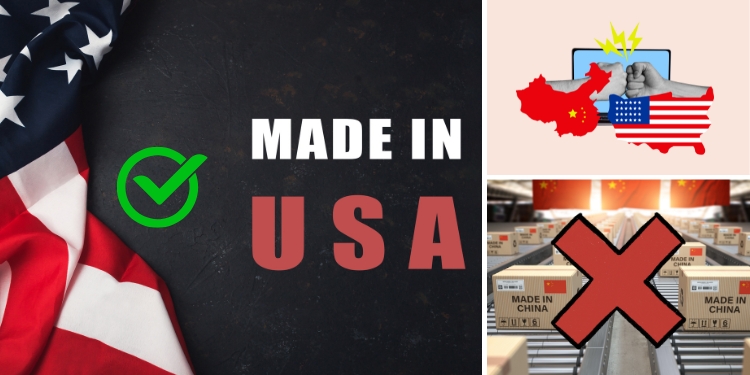


For decades, the economic relationship between China and the United States has been one of deep interdependence. China has served as the world’s manufacturing hub, while the U.S. has been one of its largest consumers. From smartphones and medical supplies to industrial components and rare earth materials, Chinese goods are woven into the fabric of American daily life.
But what would happen if China suddenly stopped supplying the United States?
Donald Trump was the first modern U.S. president to openly challenge this consensus.
Rather than treating China as a benign trading partner, Trump framed the relationship as a strategic risk. He argued, often against fierce political and media opposition, that America had become dangerously dependent on a geopolitical rival for its essential goods.
America’s Dangerous Dependence on China
 China is not simply another trading partner. It is the central node of global manufacturing, controlling production or processing in industries that underpin modern life. The United States relies heavily on China for:
- Consumer electronics and components.
- Pharmaceuticals and active drug ingredients.
- Medical supplies and personal protective equipment.
- Rare earth minerals used in defense systems.
- Lithium-ion batteries and electric vehicle components.
- Solar panels and renewable energy hardware.
- Industrial machinery and electrical equipment.
During the COVID-19 pandemic, Americans saw firsthand what happens when Chinese factories shut down and their exports slow down. Hospitals scrambled for protective gear, supply chains collapsed and inflation surged. But that crisis was accidental, so a deliberate cutoff would be far more severe.
President Trump consistently argued that no serious nation should outsource its industrial backbone to a strategic competitor. Most of his supporters understood this and the Republican Party is fully on his side in this endeavor.
The Immediate Shock
If China were to significantly reduce or halt exports to the US, whether through sanctions, or export controls, the effects would be swift and would mainly affect the day-to-day consumer.
Actually, American factories would not suddenly switch suppliers. Even many products labeled “Made in America” rely on Chinese subcomponents at some stage of production. If those products were suddenly unavailable, manufacturing would slow across multiple sectors, with assembly lines forced to reduce output or shut down altogether.
Moreover, automotive production would likely stall, while electronics manufacturers could struggle to meet delivery schedules as key components disappear from supply chains. Defense contractors, particularly those dependent on specialized materials, may face growing shortages that raise serious national security concerns.
Retailers would also begin to feel the impact within weeks, as store shelves thin, backorders grow, and shipping delays extend from days into months.
The assumption that the United States could simply “buy elsewhere” overlooks a basic reality of modern manufacturing: China’s dominance in scale, speed, and production capacity across multiple industries cannot be replaced quickly or without significant cost.
When this happens, there will be a transition period until our country gets back on track. In such a scenario, the most important thing you can do is learn to be self-reliant, no matter your age. You can learn new skills, return to traditional methods or learn the Amish lifestyle, or take advantage of today’s technology to make life easier.
This is one way to do it:

Inflation and the Cost to American Families
The most immediate consequence for ordinary Americans would be a surge in inflation, driven by a familiar but unforgiving dynamic: when supply collapses while demand remains, prices rise.
The aftermath would be that electronics, appliances, vehicles, clothing, and everyday household goods would become more expensive in a matter of weeks. At the same time, pharmaceutical shortages could push healthcare costs higher and energy prices may climb as batteries and grid components grow harder to obtain.
👉 The First People That Will End Up in the Poorhouse (And How Not to Become One of Them)
Inflation, however, functions as a hidden tax on groups with the fewest options to shield themselves from rising costs: working families, retirees, and small businesses. Republicans have long warned that inflation hits hardest at the bottom and middle of the income ladder, a reality that becomes impossible to ignore during a supply shock.
For years, Trump’s critics argued that tariffs and trade pressure would raise prices, but they ignored the much bigger risk of depending so heavily on a geopolitical rival. Paying a little more today to rely on domestic or allied production is far less costly than being forced to absorb sharp price increases later, when alternatives are limited and control is lost.
Manufacturing Decline and Economic Contraction
As shortages spread through the supply chain, the broader economy would begin to slow down. Manufacturing output would fall, but not because Americans stop spending, but because companies could no longer produce what consumers were trying to buy. This kind of slowdown, called a supply-driven contraction, is especially difficult to reverse, since it cannot be fixed simply by stimulating demand.
Industries most exposed would include:
- Automotive and aerospace.
- Defense and national security manufacturing.
- Healthcare equipment and pharmaceuticals.
- Energy and infrastructure.
- Advanced electronics and semiconductors.
When production declines, financial markets would likely react with sharp selloffs, driven by uncertainty and weaker corporate earnings. The damage may also extend into areas you wouldn’t expect. Retirement accounts and pension funds would take hits, while smaller manufacturers dependent on imported components could be pushed to the brink of bankruptcy.
But the consequences may hit much closer to home than you expect and you could feel them as soon as 2026:

President Trump’s Strategy
Unlike previous administrations that treated economic dependence as an acceptable tradeoff, President Trump confronted the issue directly. His approach rested mainly on preparation and leverage.
Trade Pressure as Strategic Leverage
Trump’s 2025 tariff strategy was aimed at correcting a long-standing imbalance in the U.S. – China trade and reducing concentrated supply-chain risk.
The tariffs increased the cost of importing certain Chinese goods, particularly in sectors where China held overwhelming dominance. This did not stop trade, but it changed the cost calculations companies used when deciding where to manufacture and source components.
👉How a Possible Civil Conflict Can Change Our Lives in the Months to Come
For many firms, higher tariffs made it less attractive to keep all production in China and encouraged them to explore alternatives, including moving parts of their supply chain to Mexico, Southeast Asia, or back to the US. In some industries, companies began splitting production across multiple countries to avoid over-reliance on a single supplier, even if that meant slightly higher short-term costs.
Although Trump’s tariff strategy faced strong criticism when it was introduced, many of the tariffs on Chinese imports remain a central part of US trade policy. Our country has maintained historically high tariff rates on Chinese goods throughout 2025, even after periods of negotiation and temporary truce agreements.
Supply Chain Diversification and Reshoring
Trump openly encouraged American companies to leave China. He promoted manufacturing shifts to Mexico, Southeast Asia, and back to the United States. His main goal was to reduce single-point failure. This “friend-shoring” concept is now widely accepted, but was ridiculed when Trump first proposed it.
But the consequences may hit much closer to home than you expect and you could feel them as soon as 2026:
Securing Critical Materials
 Another major focus of the President’s approach was to make sure the USA is not dependent on foreign rivals for materials it cannot function without.
Government reviews during his administration showed clear weaknesses in areas such as medical care, military equipment, energy systems, and everyday technology.
To address this, the administration used executive orders and federal reviews to push for more production at home and to reduce reliance on suppliers tied to adversarial countries.
This included steps to support rare earth mining and processing in the US, encourage domestic drug manufacturing, and secure supply chains that directly affect military readiness. The goal was not to shut down global trade, but to make sure the country would not be left exposed during a crisis.
The thinking behind this was simple: cheaper sourcing may work in normal times, but it becomes a liability when access is disrupted. Trump’s strategy treated these materials as strategic necessities, not just another line item in a corporate supply chain.
Market-Driven Industrial Revival
Instead of heavy government control, Trump focused on tax cuts, deregulation, and incentives to bring investment back to the United States. The idea was straightforward: once companies understood that rebuilding supply chains was a national priority, the market would respond.
With more time and consistency, this approach would have left the U.S. in a much stronger position to handle a major supply disruption from China.
How Likely Is a Supply Cutoff?
A complete and immediate cutoff is unlikely without a major conflict, such as a war over Taiwan. However, partial and targeted restrictions are highly plausible.
China could restrict exports of:
- Rare earth minerals, such as neodymium and dysprosium, used in missile guidance systems, fighter jets, radar, and advanced electronics.
- Battery components, most importantly lithium compounds and graphite, are essential for electric vehicle batteries, drones, military equipment, and grid-scale energy storage.
- Medical supplies – including active pharmaceutical ingredients (APIs) for antibiotics and painkillers, as well as PPE like masks, gloves, and syringes, which U.S. hospitals still source heavily from China.
- Defense-related materials – rare-earth magnets, tungsten, and specialty alloys, used in missiles, aircraft, armor-piercing munitions, and military electronics.
These actions would be difficult to counter quickly and would test our country. The most likely scenario is not a single dramatic rupture, but a slow escalation – export controls and strategic pressure. As a matter of fact, this is already happening through export licenses and material controls.
If China were to significantly reduce or stop supplying the U.S., it could directly affect you and your family’s well-being. That’s why, before this happens, it’s important to make sure your stockpile includes these essential products:

Making America Great Again
Even in a worst-case situation with China cutting off supply, the US will not collapse, but daily life may become tougher and more expensive. The adjustment might be uncomfortable at first, but it can also push the country to face a problem that has been ignored for too long.
So, replacing what China supplies today will take time and steady effort. New factories need to be built, domestic production expanded, and supply chains rebuilt step by step. That kind of change does not come from government statements alone. Actually, it comes from people who are willing to work, learn new skills, and produce real goods again.
👉 The Most Dangerous Threat America Could Face in the Near Future
A more independent country can only exist if hard-working Americans step up. Machinists, electricians, welders, engineers, truck drivers, and factory workers will all have a role to play. Rebuilding the industrial base means valuing skilled labor and restoring pride in making essential products at home instead of relying on cheap imports.
For most American folks, this shift may open the door to more stable jobs and real opportunities to earn a living. Instead of shipping work overseas, the country can invest in its own people and skills. Over time, better wages and steady employment may help offset some of the higher costs.
Final Thoughts
The era of ultra-cheap globalization was convenient, but it left the country exposed. What replaces it might cost more, but it offers something far more valuable: control. An economy built on reliability and domestic production will demand effort and discipline, but it can also reward those who are willing to contribute to something lasting.
President Donald Trump argued that a nation stays strong when it works, produces, and stands on its own feet. Relying on rivals may bring short-term comfort, but it weakens a country over time. Therefore, higher costs and harder work are the price of rebuilding American industry and securing our future.
You may also like:
 10 Things You Need to Do When Martial Law Is Enacted
The First US Banks to Fail. Is Your Bank On the List? (VIDEO)
Worst States to Bug In. Do You Live in One of Them?

























i have always been happy to spend more for US made products.
if i spend 25% more for a product that lasts twice or five times longer, i consider that to be a better deal.
BTW, great article.
China is equally as dependent on US consumers. If they don’t have a market to sell to I would argue they would be in a worse position.
Me, My thoughts are that the rest of the world is very much supported by Chinese products, and that is was larger than the US… China might make a small adjustment, but can survive very well without US consumer support… On the other had, there are a few other countries around the world that can produce similar products that could be made available to the US, until the US can ramp up its manufacturing of said products… After Pear Harbor, it didn’t take long for the US to become a very productive war machine, and it could happen again… The key is the US needs to start now, and work to decrease it dependence on foreign made products… if they can make it, so can the US… we’ve done it before and we can do it again… just gotta get that workforce off the front porches and working… China does not need the US to survive… for nearly 75+yrs they didn’t need anybody and survived to become a world domineering force that they are today…
Thank you Kate, for this well written and thought-provoking article (not your everyday “go out and do this”). It makes you dig deeper (use some gray matter) to find some implementable actions for the every-day prepper. What can I do right now, or work into my prepping strategy, to deal with this particular risk? Kate has nailed it: learn to be more self reliant. We got into this situation by relying on cheap alternatives and have become a throw-away society. Tech improvements made life lots easier, allowing more time for relaxation, recreation and the “soft” life (aka retirement). And a large portion of our society is inert or otherwise non-productive. While putting those folks back to work would take turning our entire nation upside down, that’s what other countries have been doing for ages: the elderly do not sit and vegetate, they work. Everybody in the family unit contributes. The non-working don’t drag the economy down, and freeloaders eventually disappear (either work or become worm fodder). A great example of “doing something” is the re-use movement, catching hold in other parts of the world, as things are repaired and not replaced. At 75, I haven’t needed a new microwave in decades, but they are cheaper now, more than ever. Some would say they are better (that’s arguable). And those microwaves being produced and sitting in warehouses are being bought by our growing population: all those kids are aging up and becoming consumers, so I get it — they need stuff. But we need to train the younger generations how to do, rather than throw away and replace. Can I repair the microwave when it breaks? No, but maybe there’s someone around who can. Does every neighborhood have an electronics repair guy/gal? That’s a pretty specialized talent, so I wager not, but if there’s one around, we should seek them out. We’ve got washer/dryer repair shops around, so why not electronics. Granted, since the invention of the IC (integrated chip), some things simply cannot be repaired (think of the master engine computer in your car) That didn’t exist a couple decades ago. But there’s lots of cars still on the road that don’t have that, and run just fine. Or they are designed for obsolescence like that 20 year old fridge that springs a freon leak, and no repair guy wants to touch it because it’s not economically feasible for him to even start (but he’s happy to come out and eyeball it for a diagnostic fee). Yes, some stuff simple cannot be fixed, but there’s lots that can, and many can be fixed very simply, just takes some gray matter and initiative. Like the solenoid on my car starter, … which I gotta get to this week … or that 75 year old mantle clock that I need to clean to get running again … but I digress …
agree TG, it has not been that long ago that we didn’t have integrated chips in our appliances or cars, microwaves or the internet for that mater. and everything worked just fine.
its planned obsolesces to sell more products.
and why anyone would tie our infrastructure to a world wide grid so that some third world country could just press ” enter” and disable our entire country is beyond me. it boggles the mind how stupid people have become, and true, it may not be stupidity but part of the plan.
we live very simply here and don’t need the outside world in our area.
it aint heaven but you can see it from here.
In 1994 I was laid off from working at an aerospace industry that made it’s own integrated chips. So we did it in the rather recent past .. why couldn’t we do it now? We haven’t likely done it recently, because China, took our technology, our capability to build chips, and built them under a communist controlled people … for less cost. And we bought it. But there are still chip manufacturing plants here in the US … that perhaps China has been unable to steal the backward compatible tech, allowing us to keep the manufacturing here. All isn’t lost … it will merely take a mental focus, and regrettably some time … to get back in the swing of the working class actually working.
I would hope that this short article would be and could be a thought provoking one… One could easily take an audit on just exactly what you need on a regular basis, and investigate as to where it is manufactured… and that should be the wake up call… One might spend the time to locate the same product on an American built basis, if possible… there are alot of products we use regularly that is not and maybe can not be manufactured in the US… Hopefully there are folks who are seriously looking into this matter, and possibly, just possibly want to actually make those needed products here, US here… I do believe that we still have all the resources needed to do just that… Issues being that we have a large part of our society that feels that it doesnt need or have to be employed, reason being they are supported by our gov/tax payers… My Dad, I’m 76, once stated, that until there are NO ads for employment needs, there should be NO unemployment support… Put America to work, history shows us that Americans typically want to work… but just like feeding the bears, once they get a taste of getting support without working, it’ll be a tough stance to get them to work again, unless you eliminate the support … Its amazing what a hungry person will do for food, rent, and utilities… given that the only option is employment,/Work and a pay check… An engineer might just wash dishes to feed his family…Build American, Buy American… Oh well, this is my two cents worth… I do remember the Alamo, Pearl Harbor, and 911… and also think that history could very possibly repeat itself… Live long and prosper…
China has no oil.
What happens when CHINA NEEDS OIL?
Maybe silver for oil?
They will do what Japan and Germany did in the 1930’s – conquer oil producing nations and take what they need.
Xi Jinping was in Venezuela the day before Maduro was pickup by the US. I don’t think he was there for coffee or a free meal. He had oil in mind. They have a way to loan countries money and help with upgrades or new construction for projects. I think he wanted to loan Venezuela money for oil and increase China’s source for future oil period.
They will do what Japan and Germany did in the 1930’s – conquer oil producing nations and take what they need.
China would be great if their government was not a communist organization that wants to dominate the world .The U.S. can survive without using their population as slave labor to manufacturer all our goods . China needs to stay in their own borders .I would not want to be ruled by the Chinese government. I’m interested in how the people of China prep. for food , water , shelter…..rats and rice ….The U.S. future survival food .if things don’t change.
The Chinese are probably more worried about surviving from day to day much less prepping for future what if situations
Hopefully we’ll see small business startups that expand into larger manufacturing companies and recover that way.
So I see I have been banned from the site, of course I can post anytime from a VPN because the block is on ISP, pretty low tech.
Good article, good comments.
Chips, we will be building them here SOON.
China dependent on US, yes they do supply lots of the WORLD, be we alone are like 40 % of their economy. Profit margin ? What happens when you loose 40% over night ? its NO PROFIT. MUST un employ % 40 of workers, who are no longer Farm based . Now you must feed them, or they revolt.
Rare earth, orange man has that in his sights, big in roads in S America and MORE.
if you look, Orangeman has all these points in mind and is paving the way for all of them.
TROUBLE, peacefully from them, depends on WHEN. And every day, its less effective for THEM to do so AND more dangerous to them, to do so. THEY CAN NOT AFFORD TO DO SO. Not my idea, but I agree with the bright minds that have studied this and reached that conclusion, I have listened to their logic and follow their reasoning. I sleep better from this.
ANY business, tomorrow remove % 40 of your market, what happens. Its NOT a hose and faucet. you dont turn it off and keep the water in the well, save the electric.
PS Walmart functions on 3 % profit. Pick any country where they have w M, close % 40 of the sales, you just closed every WM in that country.
Some of us can’t work any more. At nearly 70 I haven’t been able to work for about 10 years. My back went out and left me to where I can’t walk without a “rolator” and then not very far. And now need supplemental oxygen. But most of my life I did work and worked hard.
As to some of what we get from China we killed our company’s from making a lot of it with all the regulations on environment and safety. Rare earths are EXTREMLY bad for the environment to mine and make into useable materials. So we let China do it and they don’t give a rats a** about the environment as long as they make a buck. We didn’t care if they poisoned there people as long as we got cheep stuff. And they don’t care much about there workers safety as they have 10 persons waiting on each job. though that number is dropping. And some of it is our companies pure greed. To many CEO’s put profit above patriotism.
Good article, except when it sais covid 19 was accidental, it most certainly was released on purpose!
The problem is that its not just China. Trump’s tariffs are making most of our trading partners look upon China is a better trade partner. The US has an addiction to China. We use their components and we ship goods to them. The US economy is supported by our consumers at approximately 72% of our GDP. The remaining 28% is companies exporting goods. But if China and all of the other countries trading with the US changed to trading with China, they could eliminate that 28%. A 28% loss for our industries would usher in a Great Recession/Mild Depression. For example the Great Depression had a 33% drop in the economy.