
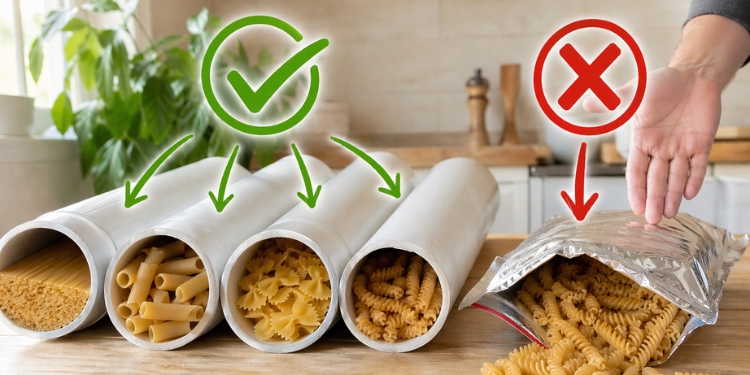


If you’ve been prepping food for long-term storage, you’ve probably seen mylar bags recommended everywhere. They’re the default answer on forums, YouTube channels, and prepper blogs. And for a lot of foods, they work fine. But when it comes to dry pasta specifically, there’s a better option that most people overlook.
This isn’t about being contrarian or doing things differently for the sake of it. PVC pipes solve real problems that mylar bags create when you’re storing pasta shapes long-term. Once you understand why, you’ll probably wonder why more people aren’t talking about it.
The Problem With Mylar Bags and Pasta
Mylar bags are thin. That’s kind of the whole point – they’re lightweight, flexible, and easy to seal with a cheap impulse sealer or even a clothes iron. For rice, beans, flour, and most grains, that thinness isn’t a big deal because those foods are relatively soft or small enough that they settle into the bag without causing trouble.
Dry pasta is different. It has sharp edges and pointed ends, especially shapes like penne, rotini, farfalle, and rigatoni. When you fill a mylar bag with dry pasta and then vacuum out the air or press the bag down to seal it, those hard edges push against the thin mylar material. Sometimes they puncture it right away. Sometimes the puncture happens weeks or months later, after the bag has been moved, stacked, or shifted around in storage.
7 Deadly Stockpiling Mistakes You’re Probably Making Right Now
A tiny puncture in a mylar bag defeats the entire purpose of using it. The whole reason you sealed your pasta in Mylar was to keep out oxygen and moisture. A hole the size of a pin lets both of those back in over time. And you won’t know it happened until you open the bag months or years later and find your pasta absorbed moisture or developed an off taste.
Even if the pasta doesn’t puncture the bag, the pressure of hard pasta shapes against the mylar creates stress points. These weak spots are where the bag is most likely to fail during storage, especially if temperatures fluctuate and cause the air inside to expand and contract slightly.
Most preppers I know try to solve this by double-bagging, which adds cost and bulk. Others wrap the pasta in paper towels or cloth before putting it in the mylar, which sort of works but adds extra steps and materials to something that should be straightforward.
Why PVC Pipes Work Better for Pasta
 The key advantage of using PVC pipes is rigidity. A hard container protects hard food. It sounds obvious when you put it that way, but the prepping community got so focused on mylar bags as the universal solution that this simple logic got lost.
When you store dry pasta inside a PVC pipe, the pasta can’t puncture or stress the container walls.
A piece of penne pressing against the inside of a Schedule 40 PVC pipe isn’t going to do anything to it.
The pipe doesn’t care. It will sit in your basement or closet for twenty years and the structural integrity won’t change at all. PVC pipes are also stackable in a way that mylar bags are not. You can build a simple rack or just stack them in a corner, and they won’t shift, sag, or deform under their own weight.
Another benefit is pest resistance. Mice and insects can chew through mylar bags without much effort. A mouse can get through a standard mylar bag in minutes. PVC pipe? Not a chance. The hard plastic wall is a physical barrier that rodents and pantry moths simply cannot penetrate.
So, if you’re storing food in a garage, shed, or basement where pests might be a concern, this matters a lot.
How to Seal Pasta in PVC Pipes
The process is straightforward and doesn’t require specialized equipment beyond what you’d find at any hardware store. You’ll need PVC pipe in either 2-inch or 4-inch diameter, two end caps per tube, PVC cement (that’s the purple primer and glue), and oxygen absorbers. That’s everything.
Here’s how to do it:
- Cut the pipe to whatever length works for your storage space. Most people go with 12 to 24 inches. Shorter tubes are easier to handle and let you open a reasonable amount of pasta at a time instead of committing to a huge batch.
- Glue one end cap on permanently using the PVC cement. Let it cure for a full 24 hours even if the label says less. You want a complete, airtight bond.
👉 What To Do With ALL Your Frozen Food Once The Power Goes Out
- Fill the pipe with your dry pasta. Shake it gently as you go to settle the pieces and minimize air gaps. You won’t get rid of all the air space between the pasta shapes, but that’s what the oxygen absorbers handle.
- Drop in an oxygen absorber sized to your tube. For a 2-inch by 18-inch pipe, 100cc is usually enough. For a 4-inch pipe, go with 300cc. The absorber will consume the residual oxygen over the next few hours.
- Glue the second end cap on and let it cure completely. Once both caps are cemented, you have a sealed, pest-proof container that will keep your pasta in excellent condition for years.
Some people prefer using a threaded end cap on one side so they can open and reseal the tube. This works if you want reusable containers, but keep in mind that every time you open it, you’re letting fresh oxygen and moisture back in.
If your goal is truly long-term storage measured in years, permanent caps with oxygen absorbers are the way to go. If you plan to rotate through your stock within a year or two, a threaded cap with a rubber O-ring is perfectly fine.
How Much Does It Cost?
 This is where people usually push back. Mylar bags are cheap – you can get them for less than a dollar each in bulk. PVC pipe costs more per unit, no question about it.
But let’s think about this honestly. A 10-foot length of 2-inch Schedule 40 PVC pipe costs somewhere around eight to twelve dollars at most hardware stores.
You can cut that into five 24-inch storage tubes. End caps run about one to three dollars each depending on size and type. So, you’re looking at maybe four to six dollars per finished tube, including the cement and absorbers.
A tube that size holds roughly one to one and a half pounds of most pasta shapes. Compare that to a mylar bag setup where you need the bag, an oxygen absorber, and a sealer, and your cost per pound stored isn’t as far apart as it seems at first. Especially when you factor in that PVC tubes won’t fail from punctures and won’t need to be replaced.
There’s also the cost of failure to consider. If a mylar bag gets punctured and you lose a pound of pasta, you’ve wasted the food, the bag, and the absorber. If you double-bag to prevent that, you’ve just doubled your mylar cost. The PVC pipe doesn’t have this problem.
Labeling and Organization
One advantage of PVC pipes that people don’t think about until they start using them: you can write directly on the pipe with a permanent marker. Date of storage, type of pasta, number of servings – whatever information you want. It won’t smudge, fall off, or become unreadable the way labels on mylar bags sometimes do.
Still Drinking Tap Water? Here’s Why You Should STOP ASAP
You can also color-code your end caps if you want a visual system. White caps for one type, blue for another. It’s a small thing, but when you have fifty tubes of different foods stored in a closet, being able to grab the right one quickly is nice.
Why You Shouldn’t Ditch Mylar Bags
It would be dishonest to pretend PVC pipes are better than Mylar for everything. They’re not. For soft, granular foods like rice, flour, sugar, oats, and powdered milk, mylar bags work great because those foods don’t create puncture risks. Mylar bags are also lighter and take up less space when empty, which matters if you’re storing supplies in a vehicle or bug-out bag where weight and volume are limited.
Mylar bags are also excellent for storing spices, dehydrated vegetables, jerky, and freeze-dried meals – basically anything that benefits from a sealed, oxygen-free environment without sharp edges that could compromise the bag.
They’re especially good for stockpiling seeds. That said, you don’t have to worry about figuring out the perfect setup on your own – the medicinal seeds kit I recently ordered from here came already stored in proper Mylar packaging, and those seeds could stay viable like that for years without any extra effort on my part. If your seeds are still sitting in flimsy packaging or open containers, it’s time to change that and get yourself a proper medicinal seed kit now.
The ideal approach for most people is to use PVC pipes for hard, pointy foods like pasta, and mylar bags for everything else that doesn’t create puncture risk. You don’t have to pick one system and commit to it entirely. Use the right tool for the right food.
Shelf Life Expectations
 Dry pasta stored properly in a sealed PVC pipe with oxygen absorbers can last anywhere from 10 to 30 years.
That’s comparable to what you’d expect from mylar bag storage done perfectly, with one important difference: the PVC pipe storage is much more likely to actually remain sealed for that entire period.
The failure rate is essentially zero if you glued the caps correctly, because there’s nothing that can go wrong short of someone physically breaking the pipe.
With mylar bags, the theoretical shelf life is similar, but the real-world shelf life depends heavily on whether the bag stayed intact. And with pasta specifically, the odds of a bag surviving decades without any puncture or stress failure are not as good as people want to believe.
The Ideal Strategy
PVC pipes and pasta are a natural match. But pasta isn’t the only thing worth sealing in a pipe. Hard candies, nuts in the shell, coffee beans, dried chili peppers, even small tools and fire-starting kits store beautifully in PVC because they all share the same problem: they’re awkward shapes that tear through flexible packaging.
Also, don’t ditch your mylar bags – they still earn their place protecting the softer side of your stockpile. Rice, flour, oats, powdered milk, dehydrated meals, seeds – mylar handles all of it without issue. The two systems aren’t competing. They’re covering each other’s blind spots.
Now, here’s the part you probably don’t want to think about. No matter how many pipes and bags you fill, a stockpile is a countdown. It gets smaller every time you eat from it. Growing food, raising animals, preserving your own harvest – that’s what turns a stockpile from a ticking clock into a safety net.
The Autopilot Homestead course is what got me started on that side of things, and I wish I’d found it sooner. Real homesteaders, real land, real methods – from building a greenhouse and raising chickens to growing medicinal herbs you’d otherwise depend on a pharmacy for.
If you’ve already gone through the trouble of gluing PVC caps and dropping in oxygen absorbers, this is the logical next step. Take a look at it here and decide for yourself.
You may also like:
 50 Ways Mylar Bags Will Save Your Life Post-SHTF
The ONLY 5 Long Lasting Super Foods you need to make to survive when SHTF (VIDEO)
The Biggest Enemies of Long-Term Food Storage (It’s Not Looters)