

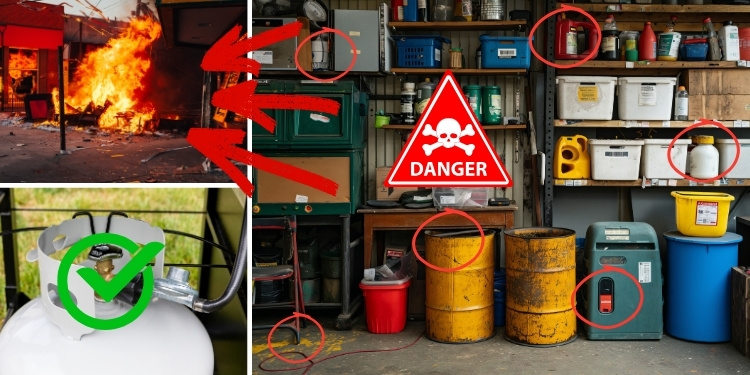


If you’re serious about emergency preparedness, you already know that stockpiling fuel isn’t optional. But before you start filling up tanks or stacking wood, you need to know what you’re working with.
Some fuels store well, some don’t. And while some are safe indoors, others are a disaster waiting to happen if not handled correctly. I’ve spent years prepping and testing different fuel sources, and let me tell you – fuel is one of those things you want to get right the first time. When fuel goes bad, it can ruin your equipment, put you in danger, or leave you without power when you need it most.
Gasoline, the Common Go-to Fuel
 One of the most popular fuels for preppers, gasoline powers so many things, such as vehicles, generators, chainsaws, and other small engines. Also, it offers high energy output and is relatively easy to obtain.
The downside is its volatility and short shelf life. Untreated gasoline can go bad in 3 to 6 months, forming varnish-like residues that clog up fuel systems. Fortunately, fuel stabilizers like STA-BIL can extend the shelf life up to a year or more.
Best used for vehicles, gas-powered generators, mowers, and other tools, gasoline should be stored in red, approved fuel containers. If you decide to store gasoline for your fuel supply, then make sure to keep it in a shaded, well-ventilated area, preferably a detached shed. Always label each container with the date of purchase and treatment. Rotate your supply every 6 to 12 months and never store gasoline indoors.
Diesel, Less Flammable than Gasoline
Diesel is safer to store than gasoline because it’s less flammable, and it has a longer shelf life – up to a year untreated and potentially several years with stabilizers and biocides. It’s the fuel of choice for larger generators, trucks, tractors, and off-grid heaters.
However, diesel can gel in freezing temperatures and is susceptible to microbial growth if exposed to moisture. Adding a fuel stabilizer along with a biocide can dramatically improve its storage life and prevent fuel system damage.
The best way to store diesel is in yellow, approved containers in a shaded, cool area, away from direct sunlight. To keep it as fresh as possible, rotate your supply at least once a year and use anti-gel additives if you live in colder regions.
But, keep in mind that diesel storage can only take you so far. For complete energy independence and protection from rising costs or grid failures, you could learn how to create your own hybrid power setup right in your backyard.
If you don’t know where to start, watch the VIDEO below and find out some of the secrets to reliable, self-sufficient power!

Propane, Ideal for Long-Term Storage
It doesn’t go bad, it’s extremely versatile, and it burns clean. You can use it for cooking, heating, powering generators, refrigeration, and even running some vehicles.
On the flip side, propane requires pressurized tanks, which must be handled with care. Leaks can be deadly if propane accumulates in a closed space. For this reason, propane should always be stored outdoors, upright, and in well-ventilated areas. Never store it indoors!
It’s also wise to keep a wrench, spare regulators, and hoses readily available. More importantly, make sure you teach everyone in your household to safely connect and disconnect propane systems.
Kerosene, the Old-School Fuel With Surprising Advantages
Kerosene became widely used in the mid-19th century for lighting lamps and heating, particularly before electricity was common. By the late 1800s, it was a standard household fuel. During the Great Depression, kerosene was still commonly used in homes for lamps, stoves, and heaters, especially in rural areas. Some Amish communities today also continue to use kerosene for lighting and heating, though it’s less common overall.
One reason it can be a valuable resource is that, when stored properly, it can last up to five years and is less flammable than gasoline, making it somewhat safer to keep on hand. However, it’s becoming less common, so finding both the fuel and compatible equipment may require some effort.

But with the right guidance, kerosene stops being a mystery and becomes a reliable tool for your home. Curious how to use it efficiently, store it safely, and make it a cornerstone of a self‑sufficient lifestyle? The Amish Ways shows you exactly how.
What you’ll discover inside the pages:
-
How Amish homes keep the lights on without grids. For example, one section shows how a single kerosene‑lamp can run for 258 hours on just one gallon of oil.
-
Step‑by‑step projects: from building a root cellar to creating an “Amish fridge” that needs no electricity.
-
In‑depth guidance on food preservation, natural remedies, and storing medicines or supplies, all crafted with the same resourcefulness that some Amish families depend on year‑in, year‑out.
-
Practical solutions for heating, lighting and off‑grid systems: e.g., how to set up kerosene‑lit systems, how the Amish heat & cool their homes without electricity or fossil‑fuel‐intensive setups
👉Click Here to Get Your 76% Discount of The Amish Ways – TODAY ONLY!
Don’t wait, because once modern supply chains falter, knowledge like this becomes far more valuable than gear alone!
Alcohol (Isopropyl, Ethanol, Denatured)
Alcohol-based fuels offer a clean-burning option for emergency stoves and heaters, particularly in portable or mobile situations. Denatured alcohol and ethanol are commonly used in alcohol stoves, while isopropyl alcohol is more often used for sanitation, but can double as a fuel.
The main drawbacks of alcohol-based fuels are their high flammability and their tendency to evaporate if not sealed properly. Because denatured alcohol is poisonous, clear labeling and good ventilation are important. These fuels should be stored in tightly closed, clearly marked containers, kept out of reach of children. For safety, larger amounts should be stored only in a designated fuel cabinet or a well-ventilated outdoor shed.
Firewood and Charcoal: Timeless Backup Options
Being considered a timeless fuel source, firewood has a lot of qualities – it’s renewable, sustainable, and provides excellent heating and cooking capabilities when paired with an efficient wood stove or outdoor fire pit. Moreover, it has an unlimited shelf life if kept dry and properly seasoned.
However, despite its qualities, firewood is bulky and labor-intensive. It must be dried for at least 6 to 12 months depending on the species, and it can attract pests if stored too close to your home. My advice is to use firewood only for wood stoves, fire pits, rocket stoves, and campfire cooking. To store it properly, stack the wood off the ground, cover the top to keep out rain, and leave the sides open for airflow. A lean-to or covered rack is a good setup for this.
👉This One Mistake Can Ruin Your Fuel Stockpile
Charcoal briquettes are another reliable backup fuel for cooking, but the issue with it is moisture. Briquettes will crumble and become unusable if they absorb too much humidity. They also emit carbon monoxide, so indoor use without ventilation is extremely dangerous.
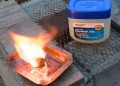
Store charcoal in airtight containers or mylar bags with desiccant packs and keep them in a dry, cool location off the ground. You can also prep DIY fire starters using dryer lint and wax to help ignite charcoal under damp conditions.
When every drop counts, knowing how to store and manage fuel can mean the difference between comfort and crisis. A Navy SEAL’s Bug-In Guide breaks down proven, practical methods for stockpiling fuel safely, rotating supplies, and integrating them into a self-sufficient home setup. From handling different fuel types to protecting your reserves from spoilage or theft, this guide gives preppers clear, actionable strategies to keep your home running when the grid goes down.

Final Thoughts
Stockpiling fuel is a key part of any preparedness plan, but it’s not as simple as stacking cans and calling it good. This is because each type of fuel has its own strengths, limitations, and safety concerns.
Always use approved storage containers, label everything clearly, and keep fuel out of your living areas. Also, make a sustainable plan and remember to add stabilizers when needed, especially for gasoline and diesel, and rotate your supplies regularly.
You may also like:

How to Have 24/7 Free Electricity (VIDEO)
10 Forgotten Fuels You Can Still Use Today























I am experimenting with tri-fuel conversions of several single cylinder gasoline engines (Briggs & Stratton, Tecumseh, Kohler, Kawasaki, etc). Conversion kits are easy to find via online sellers from A to Z (LOL) at reasonable prices. You need both a carburetor conversion kit and a low pressure supply hose with tank fitting assuming you are using 20 gallon or 30 gallon propane (BBQ) tanks. I have succeeded on converting a 3.6K generator auction find so I am expanding to a 2″ water pump, tiller (not sue how the hose and tank will mount on a moving unit yet), and a old lawn tractor (retired by the zero-turn). I have an old electric start lawn mower engine that needs overhauling (junk pile due to the mower deck is worn out) and a couple of old tractor alternators that may all become a “tri-fuel 12VDC battery charging system” in the future. The interesting additional advantage of propane and natural gas beyond their long term storage advantages is the lack or very reduced carbon build up in engines when used. This can greatly extend the lifespan of the engine and the oil change intervals. Lots of potential (and fun fabricating) without a lot of cost investment.
For the very dedicated Preppers vehicles are always a topic to discuss. If a wood gassifier vehicle is too far of a reach for you consider a tri-fuel vehicle conversion. There are several kits and lots of tutorials for converting (think “got propane”) common V6 and V8 engines along with specialty applications for small 4x4s like Suzuki Samurai and Geo trackers (think nash fuel). I imagine there will be tri-fuel kits now or very soon for all the ATVs and UTVs on the market today. Every prepper wants a simple vehicle that can run on multiple fuels in their stocking this year!
Yes I still think about a wood gasifier generator, steam generator 120VAC, and steam battery charger 12VDC projects. Someday!
No mention of butane. I have a butane stove and a butane heater as backups. The fuel is relatively cheap and easy to store. Anyone else have thoughts on this?
We didn’t mention butane in the article because it’s generally better suited for short-term or mild-weather use, and we focused on fuels that perform well in a wider range of conditions. That said, it’s still a great option for compact backup cooking and heating setups.
There was once a time when carbide was used to heat homes and fuel cook stoves. There was a house close to us that was set up to use carbide throughout the whole home. I still use it on occasion to power a lamp. It’s not too hard to find, just costly to ship.
Ozark- you or someone else got me thinking about a month ago, STEAM gen.
I remember that many steam powered excursion trains have electric for the snack car etc.
100 yrs old or brand new ? I didnt ask, but a phone call could get that answer – I just rode the only steam train in NY and they have one. I did some research, company called ems sells them, they also sell wood gasifier generators.
Fuel – 40 years after Vietnam war ended, people were flying high performance airplanes on fuel not produced after the war ended. HIGH Octane Aviation fuel.
Today, you can get 100 LL Aviation fuel, about twice the price of unleaded. BUT it stores long term without additives. Real LONG Term. down side, enough lead to sink your Canoe, and it will burn out many exhaust pipes, and some exhaust valves. CLOG a catalytic converter in one afternoon, or close. BUT, it Might make a perfect fuel for a low RPM stationary engine running electric generation. I would use heavy wall pipe to start the exhaust system, stand extra heat. As well as an oversized muffler, wont care about any lead build up.
Jet fuel – home heating Oil, Diesel, all practically the same fuel. Aviation has a product called Prist, anti fungal. I have seen Russian built jets sit for 2 decades and fire right up on OLD fuel ( American fuel- 10 times cleaner than soviet fuel).
Back on the Farm- visit any good museum with OLD farm tractors, you get into an age when most had 2 fuel tanks, 1 for Gas and 1 for kerosene. “Gas is expensive” its nearly 10 cents and Kerosene in only a Nickle you understand. So, they started on Gas, warmed it up, switched to Kerosene with petcocks. Before shut down, switch back to Gas for 2 minutes so its primed to start next time.
Its lunch time, so I gave you all food for thought, and some just got a source for steam turbines, if the price is ok ( no idea what it is)
Mostly, I think a junk yard trip, buy up the fresh installed alternators, 1000 miles before the car was junked ( especially accident vehicles), have a dozen on the shelf in metal containers, for about the price of two ( make friends and look for sale weekends).
Kre – you are referencing the 110 and 120 octane leaded fuels of past. Those were some very magical potions!
For other comment readers – 100LL (100 octane Low Lead) is the most used piston engine aviation fuel currently available and will do everything Kre mentioned to engines not designed for it. An additional item is fouling the spark plug electrodes in conventional designed spark plugs. The lead is added to the fuel to prevent per-ignition of the fuel in high compression high performance engines.
Just a quick note: Leaded gasoline won’t harm exhaust valves in a piston engine. It’s unleaded gasoline that can erode valves and valve seats over time if the engine isn’t designed with this sort of thing in mind, as with different alloy valves and hardened valve seats etc. This is an ongoing issue with people who own vintage cars… except a few air cooled models which already have hardened valve seats and exhaust valves designed to hold up to very high temperatures after manufacturers’ discovering that standard exhaust valves had issues when running in air cooled engines. That said… a generator that’s small enough to be portable shouldn’t have such issues because its engine is already (being mostly aluminum) going to have steel valve seats and tougher exhaust valves because air cooled engines inherently tend to run hotter and generally have higher combustion temps than liquid cooled engines. Typical running temps for an air cooled engine vary between 250 and 450 degrees f. and under a hard load the exhaust valves in these engines can normally run hot enough to glow red. So, run whatever gasoline you like in most generators etc, no worries. Meanwhile… AVGAS may be a bit difficult to come by in a SHTF situation so such concerns may simply be moot. Use whatever you have.
its not the lead that harms the valves, it the HEAT – from the extra octane.
it doesn’t go bang it goes BABOOM and it happens a little slower, and MORE heat is passing the opening exhaust valve.
SO, run it HARD and pay the price as the engine was NOT made for it. ALSO, some rubber and plastic wont stand up to it. A small 1960’s engine, run at low output, will stand up best. DONT even think about it in a modern unleaded engine.
remember “flight of the intruder” “I’d do it for you Sandy”
well, Sandy was burning 130-145 octane Av Gas. 130-145, depending on variables the octane was between these two values. Those OLD fuels were Purple, Straw, and Green.
As mentioned, 100 LL most common, but there was 100 Octane as well, even MORE Lead ! you can hear Gore CRY, look out for the snow storm Al.
If you have enough money, your private jet does not pollute.
Valves, shall we talk about Hayes Stellite and sodium filled valves ? ? ?
SHTF, where would I find Thousands of gallons of Av Gas. Yup I have that answer too.
Cygnet, cycling 50 Gal from cans thru your car is good. But in week 14 after SHTF, then what ? are you prepping for 16 days or months or years ? we want you prepped for each of those, 16 years, propane, your own gas well, Av gas, Maybe diesel & K 1 maybe.
Ozark, steam right again. “out west” they have “meets” and licenses to run live steam at high pressures. I want to GO ! ! ! near home they run tractors etc but LIMITED pressure, as you know. I did not look far into the gens I mentioned, but you might want to if you haven’t, turn every stone idea. Those out west steam guys MIGHT be some help. maybe, run an almost hobby low steam, turning an alternator ??? away from my area so I dont know if thats smart or stupid, but its my thought. Turn 12 V and then convert to 110 / 220
I have opened a hatch and added 425 Gal of the nice Blue stuff, then moved to the others. I would rather keep a lot of anonymous on the web.
The new crap ( so far) being purple, Hurts me.
ETHANOL
its the plague ! its for a modern engine, NOT for a Prepp. Staff please jump in on that thought ! ! ! !
I have run 2 yr old non ethanol fuel in little engines, with Little effort, little fresh prime and GO, kind of like the old switch to kero. So dont toss old fuel, just be careful in your use.
Dino man, think we can figure out a GOOD appricott flavored fuel, multi use for sure.
Poppy, id like to join you on the porch , but just remember, educate your kids and they can take over.
Like the Man said, live long and prosper
We have a wood stove, and we use diesel as a backup. We use the woodstove when it’s coldest and use the diesel when the temperatures require some heat at night. We have a generator that runs with gasoline and we rotate our stored gasoline through our cars.
Whenever we go to fill up our vehicles, we dump the stored gasoline into the tank and buy more at the fuel station. This way, there’s no need for an additive to keep the fuel fresh, but we always have gasoline on hand when we need it.
Kre – I buy 100LL (blue) by the wing full and shake my head at the price. There is an aviation 94UL (purple) in development but it will cost more than 100LL. I am down in the enthusiast level (not poor but not over flowing with cash) of funding side projects. I have found many plans for small steam engines and many ways to convert other engines to steam operation. Some more complicated than others. Lots of resources for model steam and marine steam. The main difficulty remains building or buying a “boiler” for the system.
For others reading the comments, the boiler (live steam – high pressure) is the part that kills you (boom) if done incorrectly. Internet searches will find lots of heating, cleaning, and cooking steam boiler / generators (dead steam – lower pressures). No one in the USA wants to take the liability risk to offer a wood or coal fired live steam product for sale so that just leaves 100 year old plans and antiques.The term “generator” means different things in the internet searches. When you search for “steam generator” you most often get commercial devices that make dead steam for other uses not devices that make electricity from steam engines or turbines.
Only talk about Stabil as fuel additive, but Pri-G and Pri-D are much better. Use in all my stored fuel. Have started small gas generators with two year fuel in them with Pri-G additive with NO problems. Only use Pri-G or -D.
We mentioned Sta-bil only as an example, but Pri-G and Pri-D are just as good. I use them in all my stored fuel and have started small gas generators with two-year-old fuel treated with Pri-G with no issues.
If you are considering building, think first in terms of energy conservation, then in terms of energy production. A solid insulated concrete form (ICF) home that doesn’t require any fuel because of its conservation is better than a cheaper home that constantly requires making heat or cooling. Add a port for a small rocket stove and even a SHTF scenario is manageable for heating or cooking with a reasonable stockpile of wood.
RE: alcohol – obviously since some drink it, it’s important to recognize the toxicity of the denatured variety, but tbf, ALL the fuels are toxic. One point re: alcohol – you can produce your own if you educate yourself about stills and distillation processes. There’s lots of good sources for mashes even in catastrophic scenarios. And it’s a commodity others will readily buy (denatured and not).
Very good article, obviously stimulating a rash of comments and ideas… In my AO, we have readily available nonethanol gasoline… it is a little more expensive… I store 55+ gals for use in all my small engines, ie; Generators, lawn tractors, mowers and such… I store nearly 50gal of premixed fuel for my smaller engines, ie: weed eaters, chain saws and such…I also store 250 gals of diesel for my tractor, and 55 gal of kerosine, I also keep 100 gal of ethanoled gasoline for my vehicles… both my vehicles also carry 12 to 24 gals of extra fuel on board..As for propane, I have two 250 gal for house and shop use,and a plethora of those 20lb bottles, and several of the 30 & 40lb as well, all kept full . I reside in a very wooded area so wood for fuel I think would not be an issue… Having non ethanol fuel available is a plus for us around here, I see all the time lawn care guys fueling up all their equipment at the station, and there are several stations that offer this type of fuel.. My standby generator is a duel fuel set… I am in the beginning stages of setting up solar and wind charging for a set of batteries to run what I NEED to run on electricity…key word NEED… there are tons of things we don’t need, and electricity can be one of them… I have 90% of my reference books in print form, I don’t download and print references, if it isn’t in a book, I don’t NEED it… As long as there’s power available, I’ll use it till the cow’s come home, and to tell the truth, I’ll be disappointed if the SHTF never happens before I croak… I’ve done all this stuff, and its nearly a full time job just maintaining it all, so if this SHTF is going to happen, lets get it on, hahaha.. I’m not truly fully ready, but who is? its become a wait and see game and the only ones prospering during this waiting game are the guys selling us all this stuff, and there has been a huge growth of those guys since the millennium and the COVID crap… oh well… I do wish us all good luck, and pray.. Live Long and Prosper… PS, If I’ve missed anything, please tell me, as I have a couple of daytime hours that I don’t do anything but sit on my front porch, sip my bourbon, and maybe burn up a good cigar… and wait…