


When the grid goes down and normal communication channels collapse, the ability to transmit information clearly and accurately over a radio could be the difference between life and death. That is not a dramatic overstatement. It is the reason the military alphabet exists.
The military alphabet, officially known as the NATO phonetic alphabet, assigns a specific code word to each letter of the alphabet. Instead of saying the letter C over a crackling radio and hoping it does not get confused with B, D, E, G, P, T, V, or Z, you say Charlie. There is no ambiguity. No room for misinterpretation. The message gets through.
Every serious prepper who plans to use radio communication during a crisis needs to know the military alphabet cold. This guide covers everything: the complete alphabet, how it was developed, how to use it correctly, how it differs from civilian variants, and how to practice it until it becomes second nature.
What Is the Military Alphabet?
The military alphabet is a spelling alphabet, which means it is a standardized set of words used to represent individual letters when spelling out words verbally. Each word was chosen because it sounds distinctly different from every other word in the set, even over low-quality radio transmissions with heavy static, interference, or accents from different languages.
The official name is the NATO phonetic alphabet, also called the International Radiotelephony Spelling Alphabet (IRSA). It was standardized by the International Civil Aviation Organization (ICAO) in 1956 and adopted by NATO, the International Telecommunication Union (ITU), and virtually every military, aviation, and maritime organization worldwide. When you hear pilots, air traffic controllers, military personnel, emergency dispatchers, and ham radio operators spell out words, they are all using the same system.
According to NATO’s official communications doctrine, the phonetic alphabet is a cornerstone of allied communication procedures precisely because it eliminates the ambiguity that costs lives in high-stress, noisy environments.
For preppers, the value is identical. A grid-down communication environment is noisy, stressful, and high-stakes. Knowing the military alphabet is not optional equipment. It is a core skill.
The Complete Military Alphabet (NATO Phonetic Alphabet)
Below is the full NATO phonetic alphabet with the official pronunciation for each code word. The pronunciations follow ICAO standards, which are designed to be understood across language barriers.
- A = Alpha (AL-fah)
- B = Bravo (BRAH-voh)
- C = Charlie (CHAR-lee)
- D = Delta (DELL-tah)
- E = Echo (EK-oh)
- F = Foxtrot (FOKS-trot)
- G = Golf (GOLF)
- H = Hotel (hoh-TEL)
- I = India (IN-dee-ah)
- J = Juliet (JEW-lee-ett)
- K = Kilo (KEY-loh)
- L = Lima (LEE-mah)
- M = Mike (MIKE)
- N = November (no-VEM-ber)
- O = Oscar (OSS-kar)
- P = Papa (PAH-pah)
- Q = Quebec (keh-BECK)
- R = Romeo (ROW-me-oh)
- S = Sierra (see-AIR-rah)
- T = Tango (TANG-go)
- U = Uniform (YOU-nee-form)
- V = Victor (VIK-tah)
- W = Whiskey (WISS-key)
- X = X-ray (ECKS-ray)
- Y = Yankee (YANG-key)
- Z = Zulu (ZOO-loo)
A few notes on pronunciation. Lima is pronounced LEE-mah, not like the city in Ohio (LYE-mah). Alpha is AL-fah, not AHL-fah. Quebec is keh-BECK with a hard K, reflecting its French-Canadian origin. These specific pronunciations exist to minimize confusion across different native languages and accents, so stick to them.
The History of the Military Alphabet
The NATO phonetic alphabet did not appear fully formed. It evolved over decades of military experience, multiple wars, and hard lessons learned about the cost of miscommunication.
World War I and Early Radio Communication
The first widespread military use of radio communication came during World War I. As radio technology expanded, it became clear that spelling out words over static-filled transmissions was error-prone and potentially fatal. Early spelling alphabets were improvised and inconsistent, varying by unit and branch.
The British Army adopted one of the first standardized phonetic alphabets during WWI, using words like Ack for A, Beer for B, and Cork for C. The U.S. military used a different set. The lack of standardization created confusion even among allies.
World War II and the Able Baker Alphabet
By World War II, the U.S. military had standardized its own phonetic alphabet, commonly called the Able Baker alphabet after its first two code words: Able, Baker, Charlie, Dog, Easy, Fox, George, How, Item, Jig, King, Love, Mike, Nan, Oboe, Peter, Queen, Roger, Sugar, Tare, Uncle, Victor, William, X-ray, Yoke, Zebra.
This system worked reasonably well for English-speaking forces but created problems in multinational operations. Words like Able, Baker, and Oboe were difficult or impossible to pronounce correctly for soldiers and airmen whose first language was French, German, Spanish, or any of dozens of other languages involved in the conflict.
The ICAO Process and the Modern Alphabet
After World War II, as international aviation expanded and NATO was established, the need for a truly universal phonetic alphabet became urgent. The International Civil Aviation Organization (ICAO) undertook an extensive research and testing process in the late 1940s and early 1950s.
The ICAO tested candidate words with speakers of 31 different languages to identify which words were most clearly understood across language barriers, even with heavy accents and degraded radio conditions. The result was the current alphabet, formally adopted in 1956.
The word choices reflect this careful testing. Foxtrot replaced Fox because Fox sounded too much like other words in certain languages. Juliet replaced Jig. Lima replaced Love. Each substitution was data-driven, based on real intelligibility testing across multiple languages and radio conditions.
Since 1956, the NATO phonetic alphabet has remained essentially unchanged, a testament to how thoroughly it was designed. Minor pronunciation adjustments have been made over the years but the 26 code words are identical to what was finalized nearly 70 years ago.
Why Preppers Need to Know the Military Alphabet
Preppers who have not yet invested in radio communication skills and equipment are operating with a significant blind spot. When cellular networks go down, which they do during every major natural disaster, power outage, or infrastructure attack, radio communication is what remains. And radio communication done poorly is almost as bad as no communication at all.
Radio Communication in Grid-Down Scenarios
FRS/GMRS radios (the common bubble-pack walkie-talkies), ham radios, CB radios, and satellite communicators all transmit voice. Voice transmission over any radio system is subject to interference, static, distance degradation, and environmental noise. A message like ‘meet at Beacon Street’ sounds like ‘meet at B-something Street’ with even moderate interference. That ambiguity can send your group to the wrong location, delay a critical rendezvous, or result in someone moving into danger.
Using the military alphabet eliminates that ambiguity. ‘Meet at Bravo Echo Alpha Charlie Oscar November Street’ gets through. Every letter is confirmed.
Coordination With Emergency Services
During a major disaster, survivors who have radio capability may need to communicate with FEMA, the National Guard, local emergency management, or volunteer groups like CERT (Community Emergency Response Teams). All of these organizations use the NATO phonetic alphabet. If you cannot communicate in their system, you will struggle to relay information clearly under pressure.
FEMA’s National Incident Management System (NIMS) specifically includes interoperable communications as a core component, and phonetic alphabet use is standard across all partner agencies.
Ham Radio Operations
Ham radio (amateur radio) is the prepper’s most powerful long-range communication tool. Licensed ham operators can communicate across hundreds or thousands of miles using HF bands, relay information through repeater networks, and access emergency communication infrastructure that remains operational when everything else fails. The phonetic alphabet is standard practice in all ham radio operation. Amateur radio licensing exams include phonetic alphabet content, and it is expected knowledge on the airwaves.
The American Radio Relay League (ARRL), the national association for amateur radio, includes phonetic alphabet training in its licensing preparation materials and emergency communication courses.
Group Communication and Security
Within a prepper group or community, using the military alphabet for callsigns, location names, and sensitive information adds a layer of clarity that reduces miscommunication under stress. It also establishes a communication culture that scales if your group needs to interact with other prepared groups or emergency responders.
How to Use the Military Alphabet Correctly
Knowing the alphabet is step one. Using it correctly in actual radio communication is a different skill that requires practice.
When to Spell Phonetically
Not every word in a radio transmission needs to be spelled out phonetically. You spell phonetically when there is potential for confusion. Proper names, street addresses, grid coordinates, callsigns, identification numbers, and any word that sounds like other words all benefit from phonetic spelling. Routine words like ‘confirmed,’ ‘over,’ or ‘copy’ do not need phonetic spelling because they are unambiguous in context.
Correct Transmission Format
When spelling a word phonetically over the radio, announce that you are spelling before you begin, then state each letter clearly with its code word, then repeat the complete word. For example, if you need to transmit the name ‘Cruz,’ you would say: ‘I spell: Charlie Romeo Uniform Zulu. Cruz.’ This format eliminates ambiguity about where the spelling begins and ends and confirms the complete word at the finish.
Numbers in Military Communication
Numbers have their own pronunciation standards in military and aviation communication. These are designed to prevent confusion between numbers that sound alike, especially over a radio.
- Zero is pronounced ZEE-roh (not ‘oh’)
- One is pronounced WUN
- Two is pronounced TOO
- Three is pronounced TREE
- Four is pronounced FOW-er
- Five is pronounced FIFE
- Six is pronounced SIX
- Seven is pronounced SEV-en
- Eight is pronounced AIT
- Nine is pronounced NIN-er (the ‘er’ distinguishes it from the German word ‘nein’ meaning ‘no’)
These pronunciations are not optional affectations. They exist for the same reason the phonetic alphabet exists: to eliminate fatal ambiguity. Saying ‘niner’ instead of ‘nine’ is protocol, not habit.
Standard Radio Procedures That Work With the Phonetic Alphabet
The phonetic alphabet does not operate in isolation. It works alongside a set of standard radio communication procedures that every prepper should know.
- Over – indicates you have finished speaking and are waiting for a response
- Out – indicates the conversation is ended, no response expected
- Copy or Roger – confirms you have received and understood the message
- Say Again – request to repeat the last transmission (never say ‘repeat’ on military or aviation frequencies as it has a specific artillery meaning)
- Wilco – short for ‘will comply,’ confirms you understood and will carry out the instruction
- Standby – indicates you heard the call and will respond shortly
- Break – indicates a pause in a long transmission
These procedures are documented in ARRL’s Emergency Communication Handbook and are taught in FEMA’s Independent Study courses on emergency communication, both of which are worth completing before a crisis, not during one.
Military Alphabet vs Other Phonetic Alphabets
The NATO phonetic alphabet is not the only spelling alphabet in existence. Several others are used in specific contexts, and preppers who communicate with different agencies or in different regions may encounter them.
The Old Able Baker Alphabet (WWII U.S. Military)
The WWII-era U.S. military alphabet is still occasionally encountered in older military reference materials and among veterans of that era. As noted above, it used words like Able, Baker, Charlie, Dog, Easy, Fox, George, How, Item, Jig, King, Love, Mike, Nan, Oboe, Peter, Queen, Roger, Sugar, Tare, Uncle, Victor, William, X-ray, Yoke, Zebra. If you encounter older military documentation or communicate with veterans who learned this system, you may need to recognize these terms. However, all modern military and emergency communication uses the NATO standard.
Law Enforcement Phonetic Alphabets
Some U.S. law enforcement agencies use a different phonetic alphabet, especially in older departments or regions with established local customs. A common law enforcement version uses Adam, Boy, Charles, David, Edward, Frank, George, Henry, Ida, John, King, Lincoln, Mary, Nora, Ocean, Paul, Queen, Robert, Sam, Tom, Union, Victor, William, X-ray, Young, Zebra. This system is less internationally standardized than NATO but remains in active use in many U.S. police departments and county sheriff offices.
The practical implication for preppers: if you are communicating with local law enforcement during an emergency, they may use this alphabet. Recognizing it matters even if you respond in NATO standard.
Aviation Use
Commercial and general aviation uses the NATO phonetic alphabet exclusively and has since 1956. Pilots and air traffic controllers worldwide operate on the same system. If your prepper communication plan involves monitoring aviation frequencies (legal with a basic scanner) or if you hold a pilot’s certificate, you are already in the NATO system.
Marine and Maritime Use
The International Maritime Organization (IMO) adopted the NATO phonetic alphabet for all maritime communication. VHF marine radio, used on boats and monitored by the U.S. Coast Guard, operates under the same phonetic system. Preppers with water-based bug-out plans or coastal locations should know that maritime rescue coordination communication follows NATO standards.
How to Memorize the Military Alphabet Fast
There is no shortcut to genuine fluency with the phonetic alphabet, but there are methods that accelerate memorization and, more importantly, build the automatic recall you need when you are stressed, tired, and operating in a crisis.
Chunking by Groups of Five
The 26-letter alphabet divides naturally into chunks. Memorize in groups: Alpha through Echo (A-E), Foxtrot through Juliet (F-J), Kilo through Oscar (K-O), Papa through Tango (P-T), Uniform through Zulu (U-Z). Learn each group to automatic recall before adding the next. This mirrors how musicians learn scales: mastery of small sections before integrating the whole.
Daily Practice with Real Words
Spell common words phonetically as a daily habit. Your name, your street address, your vehicle license plate, the names of your family members. Do this while driving, cooking, or doing any routine task. The goal is to reach a point where you hear a letter and the code word comes automatically, without conscious retrieval.
Radio Practice
If you have a ham radio license or a GMRS radio, find practice nets. Amateur radio has specifically structured nets for new operators to practice phonetic communication. Spelling under the slight pressure of a real transmission builds the muscle memory that silent practice alone cannot provide.
Reference Cards
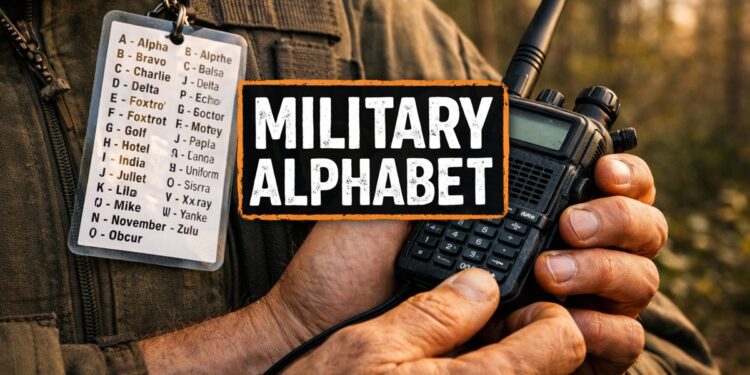
Laminate a reference card with the full phonetic alphabet and attach it to your radio kit, your go-bag, and anywhere you plan to operate communications. Experienced radio operators do not consider it a weakness to use a reference card. Having the card means you do not freeze or guess when under pressure. Keep one in your vehicle, one in your bug-out bag, and one posted near your primary communication station at home.
Mnemonic Anchors for Difficult Letters
Most letters are straightforward but a few trip people up consistently. Quebec (Q) and Yankee (Y) are the most commonly confused or forgotten. For Quebec, associate it with the Canadian province and the sound of a hard K at the start. For Yankee, picture an American baseball cap. For Uniform, think military dress uniform. For Foxtrot, picture ballroom dancing. Visual anchors embedded in a word’s meaning accelerate automatic recall.
Building a Radio Communication Plan Around the Military Alphabet
Knowing the military alphabet is most valuable as part of a broader communication plan. Here is how to build one that actually works when infrastructure fails.
Choose Your Equipment
FRS/GMRS radios are the entry level and work well for short-range group communication within a neighborhood or small community. Range is typically 1 to 3 miles in real-world conditions, less in urban or forested terrain. Ham radio, specifically HF capable radios, extends range to regional and global distances but requires a license. CB radio is unlicensed and offers medium range with a large existing user base. Satellite communicators like the Garmin inReach allow two-way text communication anywhere in the world without any infrastructure.
Establish Callsigns
Every person or station in your communication network should have a callsign that is easy to transmit phonetically. Short callsigns of 2 to 4 letters or a letter-number combination work best. Practice transmitting your callsigns phonetically until everyone in your group can do it without hesitation.
Set Primary and Backup Frequencies
Designate a primary channel or frequency and at least two backup frequencies for your group. Document these in writing and ensure every member of your group has a laminated copy. Frequencies should be recorded in the standard format and be transmissible phonetically.
Schedule Check-Ins
A radio communication plan without scheduled check-ins is not a plan, it is equipment ownership. Set specific times for daily check-ins, especially during a crisis. A missed check-in triggers a response protocol. This structure is only useful if everyone knows it and the phonetic alphabet fluently enough to report status clearly.
FEMA’s Community Emergency Response Team (CERT) program trains civilian volunteers in exactly these communication protocols, and the training is free. Completing CERT training puts your group in direct alignment with how local emergency management communicates.
Practical Scenarios: Military Alphabet in Action
Understanding the alphabet in the abstract is different from knowing how to deploy it under pressure. The following scenarios illustrate practical application.
Scenario 1: Coordinating a Rendezvous Point
Your group is separated after bugging out. You need to communicate a meeting location over a noisy GMRS channel. Instead of saying ‘meet at Miller Road and 5th,’ which could easily be misheard as ‘meet at Milo Road and 9th’ with static, you transmit: ‘Rendezvous location follows. I spell: Mike India Lima Lima Echo Romeo. Miller. Road. Niner. Break. Fife. 5th Street. Say again: Miller Road and 5th. Confirm copy.’ There is no ambiguity.
Scenario 2: Reporting an Incident to Emergency Services
A natural disaster has struck and you are relaying information from your neighborhood to a local emergency operations center via ham radio. You need to report a street address. Transmitting the address phonetically, including the street name spelled letter by letter, ensures the operator at the EOC writes down exactly what you said, not what they thought they heard.
Scenario 3: Identifying Yourself on a Net
You are checking into a local ham radio emergency net during a community crisis. Your callsign is K5ABR. You transmit: ‘This is Kilo Fife Alpha Bravo Romeo, K5ABR, checking in.’ Every operator on the net heard your callsign clearly, including those unfamiliar with your voice and those using equipment with poor audio quality.
Frequently Asked Questions About the Military Alphabet
Is the military alphabet the same as the NATO phonetic alphabet?
Yes. The military alphabet and the NATO phonetic alphabet are the same thing. The full official name is the International Radiotelephony Spelling Alphabet, but it is also called the ICAO phonetic alphabet, the NATO alphabet, or simply the phonetic alphabet. All refer to the same 26 code words from Alpha to Zulu.
Do I need a ham radio license to use the military alphabet?
No license is required to learn and memorize the military alphabet. The alphabet itself is a communication tool, not a regulated activity. However, transmitting on most radio frequencies does require a license. FRS radio channels (channels 1-14 on most bubble-pack radios) are license-free. GMRS requires an FCC license. Ham radio requires an amateur radio license. The phonetic alphabet is appropriate for all of these.
How long does it take to memorize the full military alphabet?
With consistent daily practice, most people can memorize all 26 code words in 1 to 2 weeks. Achieving automatic fluency where you hear a letter and the code word comes instantly without conscious effort typically takes 4 to 8 weeks of regular practice. The goal is not just memorization but genuine automaticity under stress.
Is the military alphabet used in everyday police communication?
Not universally. Many U.S. law enforcement agencies use a different phonetic alphabet (Adam, Boy, Charles, David, etc.) rather than the NATO standard. Federal agencies and agencies with military ties tend to use NATO standard. Local and county agencies often use regional variants. Knowing both systems is an advantage for preppers who may need to communicate with or monitor local law enforcement.
What is the difference between ‘Over’ and ‘Out’ on a radio?
‘Over’ means you have finished your transmission and are waiting for the other party to respond. ‘Out’ means the conversation is finished and you do not expect a response. Using ‘over and out’ together is a Hollywood invention and is incorrect in actual radio procedure. End a transmission expecting a reply with ‘over.’ End a conversation with ‘out.’
Should children in a prepper group learn the military alphabet?
Yes, absolutely. Children as young as 8 to 10 can memorize the phonetic alphabet with practice, and teaching them to do so prepares them to communicate clearly in an emergency. It also gives them a specific, concrete skill that reinforces their sense of capability and preparedness.
Why does the military say ‘niner’ instead of ‘nine’?
The word ‘nine’ sounds very similar to the German word ‘nein,’ meaning ‘no,’ in radio transmissions. Adding the ‘er’ suffix to make it ‘niner’ creates a distinct sound that eliminates that potential confusion in multinational operations. It is one of the many small design decisions in military communication protocol that exist for a specific reason even when they seem unnecessary in a domestic context.
Final Word: Learn It Before You Need It
The military alphabet is one of those prepper skills that costs nothing to learn, takes up no physical space in your kit, and pays dividends in every radio communication you ever make. It is the kind of skill that sits quietly in the background until the moment it matters, at which point it matters enormously.
Do not wait until a crisis to try to learn it under pressure. Start now. Spend five minutes a day spelling words phonetically. Laminate a reference card and put it on your radio kit. Get a ham radio license and check into a local net. Build the muscle memory before you need it.
Clear communication saves lives. The military has known this for a century. Now you know what they know.
If you think clear communication matters, ask yourself this: what happens when the message isn’t just misunderstood… but your money is too?
Right now, you’re learning how to say things clearly over a radio. But in a real collapse, the bigger problem won’t just be how you communicate. It’ll be what your dollars are worth when the system behind them starts to crack.
We’ve seen it before. Currencies don’t fail overnight with a warning label. They erode, quietly at first, then all at once. Prices spike. Supply chains break. What used to cost $10 suddenly costs $50… if you can find it at all. And in that moment, the people who understood what was coming are already positioned. Everyone else is scrambling.
That’s exactly what Dollar Apocalypse exposes.
It breaks down, step by step, how fragile the current financial system really is, what triggers a currency collapse, and what happens in the critical days and weeks after confidence is lost. More importantly, it shows you how to prepare before that tipping point hits.
Because here’s the truth most people ignore:
You can have food, gear, and radios… but if you don’t understand the financial side of collapse, you’re walking into the same trap that has wiped out millions of unprepared people throughout history.
Dollar Apocalypse connects the dots between economic breakdown and real-world survival:
- Why inflation is only the beginning
- What happens to banks, savings, and cash on hand
- How quickly buying power disappears
- What assets actually hold value when currency fails
- And what smart preppers are doing right now to stay ahead of it
You already know that clear communication can save lives.
This is about making sure your resources still exist when you need them.
👉 Check out Dollar Apocalypse here and understand what’s really coming before it’s too late.
You May Also Like
 Join The Official Ask A Prepper WhatsApp Channel
Signs Your Neighbor Will Become a Looter as Soon as SHTF (VIDEO)
HAM Radio Secret Frequencies You Should Know About
Military Items That Might Be Missing From Your Prepping Kit
Food Prepping Skills I Learned in the Military
The Secret U.S. Military Plan for Handling Civil Unrest