
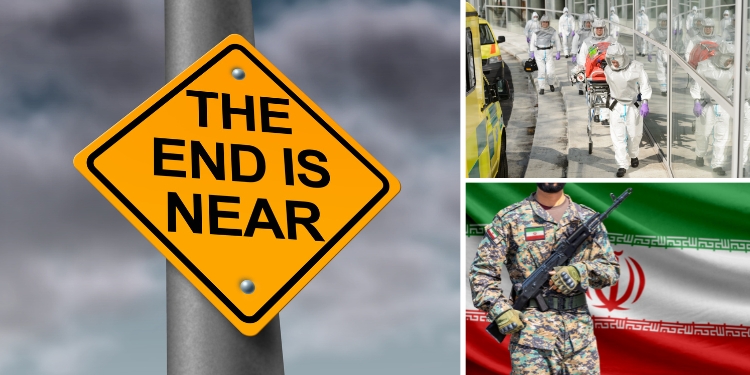


If you are over 50, you most probably remember when people trusted their government enough to believe the system would not fail. In recent years, that sense of stability has begun to fade as more cracks appear in the systems that hold modern life together. That is exactly why so many people have become interested in prepping again, since the world feels less predictable than it did decades ago.
TEOTWAWKI is a survival acronym that means “The End Of The World As We Know It,” and it often describes something far more realistic than a movie-style apocalypse. In most cases, collapse does not arrive in a single dramatic flash, but rather through a series of disruptions that accumulate until daily life becomes unrecognizable.
The uncomfortable truth is that the next few years carry real uncertainty, and several scenarios could push communities into survival conditions faster than most people expect.
6. A Major Long-Term Power Grid Failure
 The American power grid is one of the most fragile foundations of modern society, because nearly everything people rely on depends on electricity working without interruption.
A long-term outage could come from extreme weather, cyberattacks, aging infrastructure, or even a large electromagnetic event.
And once power stays down, the chain reaction begins immediately. Gas stations stop pumping, grocery stores lose refrigeration, and water systems start struggling to deliver a clean supply. This means the crisis grows far beyond darkness in your home.
As communication networks fail and people become isolated, fear spreads quickly through neighborhoods, especially once it becomes clear that help is not arriving overnight. A blackout lasting weeks would create Teotwawki conditions fast, because modern life simply cannot function without energy.
That is why preparing for this scenario means more than owning a flashlight, since real readiness requires stored water, shelf-stable food, backup lighting, and a realistic way to stay warm or cool when the grid is gone.
5. A Severe Economic Collapse That Makes Everyday Life Unstable
Older Americans have lived through inflation before, but the next economic shock could hit harder and spread faster, because the cost of living is already squeezing families and retirees. With debt rising, markets unstable, and supply problems still affecting prices, a serious financial breakdown is not an impossible scenario, especially during a period of global uncertainty.
We Are on the Brink of a New Great Depression. Why You Shouldn’t….
In an economic Teotwawki, the danger is not that food disappears from the planet, but that ordinary people can no longer afford what they need.
Banks may restrict withdrawals, jobs may vanish, and panic grows once people realize their money is losing value faster than they can keep up. When financial trust breaks down, social stability often follows, because desperation pushes people into unpredictable behavior.
4. Civil Unrest That Makes Normal Safety Feel Uncertain
 The country feels more divided now than it has in decades, and that tension is no longer hidden beneath the surface.
Protests, riots, and rising crime have become more common, and another national crisis could spark wider instability in ways that spread quickly from cities into smaller communities.
This kind of disruption does not require total collapse, because even partial disorder can make everyday life unsafe. Travel becomes risky, police and emergency services become overwhelmed, and families realize that personal security depends on their own preparation.
In these situations, the smartest move is often staying home with enough supplies, because being forced into crowds during chaos is where danger increases. But keep in mind that Teotwawki does not always come through the fall of government, since it can also arrive through social breakdown, when trust disappears and fear fills the streets.
3. Global Conflict that Disrupts Supplies and Daily Life at Home
Modern war does not stay overseas, because global conflict affects shipping, fuel prices, and supply chains almost immediately. Just look at Ukraine – when Russia invaded, diesel and gasoline prices spiked around the world, wheat and fertilizer exports were disrupted, and manufacturers rushed to secure alternative suppliers. That conflict did not happen on American soil, but the effects were felt at home through higher prices and delayed goods.
Another flashpoint is the growing risk of confrontation with China over Taiwan, since any conflict in that region could disrupt global trade overnight while also raising the possibility of direct attacks on American satellites, communications, or military assets. These are not distant problems, because modern conflict includes cyber warfare, economic disruption, and strategic strikes that can hit the U.S. homeland through infrastructure collapse rather than traditional invasion.
A major international crisis could devastate the USA, because it will trigger shortages, cyberattacks on infrastructure, rationing, and long-term stress across the country. When trade routes are disrupted and infrastructure becomes a target, stores can empty faster than people expect, energy costs can rise sharply, and basic goods become difficult to replace.
During the Ukraine conflict, for example, fertilizer shortages drove up food costs worldwide, and shipping delays made it harder to get everyday products into port.
2. Iran Using an EMP-Style Strike Against the U.S.
 Iran often comes up in discussions about infrastructure-based attacks, especially when the conversation turns to the possibility of an EMP-style strike aimed at the US power grid.
The reason this scenario matters is that it represents one of the fastest ways a modern country could be pushed into a true Teotwawki situation.
A grid-focused disruption is different from most other threats because it removes the foundation that everything else depends on, and once that foundation is gone, the effects stack immediately.
Fuel becomes inaccessible, supply deliveries stop, clean water systems struggle, hospitals lose full function, and normal law enforcement becomes stretched thin, which means daily life starts breaking down in ways that feel sudden and irreversible.
Analysts have noted that hostile states such as Iran often look for asymmetric ways to hurt stronger opponents, and striking infrastructure has always been viewed as a shortcut to chaos. Even if such an event is not guaranteed, the fact that adversaries study these options is enough to keep it on the Teotwawki radar, because the grid remains a vulnerability that cannot be ignored.
What makes this a true end-of-the-world-as-we-know-it scenario is that most Americans are not prepared to live without electricity for weeks or months. And once the system fails at scale, there is no quick reset button.
That is why this possibility continues to stand out, because in an EMP-driven disruption, the only real protection comes from being ready beforehand with the right essentials already in place, such as:
- An EMP cloth or Faraday shield are critical devices to protect your valuable electronics, such as radios, flashlights, and backups.
- Long-term food supplies, because grocery stores will empty fast and resupply may not happen for weeks
- A modular backyard generator or off-grid power option to keep basic systems running when the grid stays down.
- A medicine kit stocked with essential supplies, including these 12 critical drugs every prepper should have stored.
- Fuel reserves, since transportation, generators, and emergency mobility depend on access to gasoline or propane.
- Clean water storage and filtration, such as the Air Fountain System, because municipal systems can fail quickly once electricity is gone.
1. A Future Pandemic or Biosecurity Crisis Worse Than Anything We’ve Seen
The COVID-19 pandemic taught everyone how fast society can unravel when a novel virus spreads. That experience was a wake-up call, but health experts now warn the next outbreak could be even more threatening, especially if a new pathogen emerges that spreads rapidly and causes more severe illness.
Just recently, China has been dealing with major outbreaks of mosquito-borne and respiratory viruses, and these developments show how unpredictable global health risks have become.
One of the outbreaks drawing attention is a large surge of the chikungunya virus in southern China’s Guangdong province, where more than 7,000 cases have been confirmed and authorities have launched widespread containment efforts.
Although chikungunya is transmitted through mosquitoes rather than respiratory droplets, its rapid spread and the absence of a universal cure or treatment make it a stark reminder that new and expanding pathogens can strain health systems and disrupt daily life in unexpected ways. At the same time, respiratory illnesses such as human metapneumovirus have caused spikes in hospital visits and raised past concerns about the potential for overwhelmed health facilities.
What makes the pandemic scenario truly frightening from a Teotwawki perspective is not just the illness itself, but the secondary effects that cascade through society. Even a low to moderately contagious virus can shut down supply routes, strain food distribution, and force people into isolation.
That’s why medical knowledge is crucial – in this kind of scenario, pharmacies cannot keep up when demand explodes and hospitals get overwhelmed fast. That is why many preppers keep The Home Doctor on hand. Written by experienced doctors who have worked through real medical shortages around the world, this guide explains how to handle common emergencies at home, even without immediate professional help. And it covers situations that, if untreated, could become fatal fast.
Why These Teotwawki Are Relevant for You
Some people still laugh at collapse scenarios, but history shows that societies can change faster than anyone expects. Teotwawki rarely arrives in one dramatic moment – it often comes through failures building over time, until daily life becomes harder, less safe, and less predictable.
The coming years bring uncertainty through economic pressure, infrastructure weakness, global tension, and social instability, which is why preparedness is not paranoia. Self-reliance has always been the difference between panic and survival, and strong households have always handled hardship better than those who depend completely on fragile systems.
But the biggest mistake you can make right now is assuming you have more time.
You don’t. That’s why you should grab a copy of Dark Reset: Survival Before the Silence and find out the truth about what a collapsing society really looks like. The truth is, you cannot even begin to imagine what it feels like to experience such a scenario until you’re living it.
But Dark Reset is accessible to those who are aware of the truth of the world we live in. Be part of the exclusive group of people who think outside the box, and who will be ready to put the pieces back together when everything starts to crumble.
Get your copy NOW and enjoy a special 75% discount. Because real knowledge shouldn’t be kept only for the elites.
Final Thoughts
If you want to be honest with yourself, none of these scenarios requires a meteor, a zombie outbreak, or some Hollywood-level catastrophe. They’re all rooted in things we can already see happening: fragile infrastructure, economic pressure, global tension, and systems that break down faster than people expect.
Therefore, the best time to prepare is now, while resources are still available and choices still exist, because once disruption hits, the people who planned ahead will always have more control over their situation.
The next few years may test communities in uncomfortable ways, so the question becomes simple: if life changes suddenly, will your home be ready, or will you be scrambling too late?
You may also like:
 15 Prepping Trends That Can Get You Killed
Why You Should Never Hide Your Stockpile in the Basement (VIDEO)
Instant Foods You Need to Buy Before They Disappear
10 Ways to Build a Faraday Cage at Home (And What to Store Inside Each One)



















I think today ,the maybe TEOTWAWKI can be a good thing ….long over due …..not by death and tragedy but by life and happiness. I made my first WW2 trench candle yesterday…..just in case…tuna can …cardboard….wax…..I need to fire it up for a test run.
I’ve been preparing for years now. I have forgotten all about that candle system. Thanks for the reminder!
I’ve never heard Iran mentioned in connection with an EMP weapon before, probably since their missiles lack the range to reach the US. Why now?
Iran really only needs to reach Europe.
“Green” power indeed.
More like white above ground flash, and instant cave men.
I do believe that the U.S.A. and Israel took out Iran’s emp device., a few months ago. But that will not stop them from making another .The leader of this country is a psyco lunatic .hell bent on the destruction of western civilization.No more negotiations for the people that want to kill you.Or they will become like rocket man of North Korea. Which the universe does not need more of .
well, you missed it !
big priority for them is long range, which they MAY have.
BUT they do have submarines, and their best friends the N Korea crowd, has ability to launch missiles from their Sub’s
Put them together, motor to our eastern seaboard, and LIGHTS OUT entire eastern half of the USA, cascade effect, maybe good night USA.
This is over 10 yr. OLD news, the question is, DID we use that 10 years to EMP proof our power grid ? ? ?
my guess is NO
Iran’s missile range is mostly regional, but an EMP threat doesn’t depend on hitting the U.S. with a standard long-range strike. EMP scenarios can involve high-altitude detonation, unconventional delivery methods, or attacks aimed at U.S. forces and infrastructure closer to the region. That’s why Iran is being discussed now — especially with tensions rising and Washington openly considering military action.
Iran, nuke program destroyed ? ? ? ?
Maybe
Would you have ONLY 1 site working on such a project, if you were them ? ? ?
its called intelligence, because its THE BEST GUESS
if it was 100 % knowledge, no guessing, we call that just plane FACT
We must have our intelligence, but don’t over or under estimate that . . . Guessing
Much of our intel comes from Israel HUMIT.
Eye in the sky can be limiting.
no third world county needs long range missles to put a nuke on american soil. no-notice launches from a cargo ship, or suitcase dirty devices put close range threats inside our perimeter. our detection gadgets are pretty good, but not infallable.
A TEOTWAWKI scenario would, with a bit of luck, send us back to the pre-revolutionary era, meaning the 18th century. The question is, how prepared are we? Henry Ford had a home workshop that allowed him to develop various tools and machines; how many of us today possess those skills?
You forgot to mention asteroid / comet strike on the planet and super volcano. Alien invasion is another possibility.
I think the point of the matter is, shtf has many ways of severely impacting our lives. All natural events, being large enough could very easily set us back 125+ years. I am not completely prepared for all of it, not sure if anyone can. I try to make sure i have 3 months of food, water, a place to keep be basically covered from the outdoors weather and, protection. Im in the deep woods and that, for me, keeps extra options at hand.
Hello, Randall,
Remember – you’re doing more than most. Three months of supplies and a solid shelter gives you breathing room. Nobody’s prepared for everything, so having time and options is what really matters.