
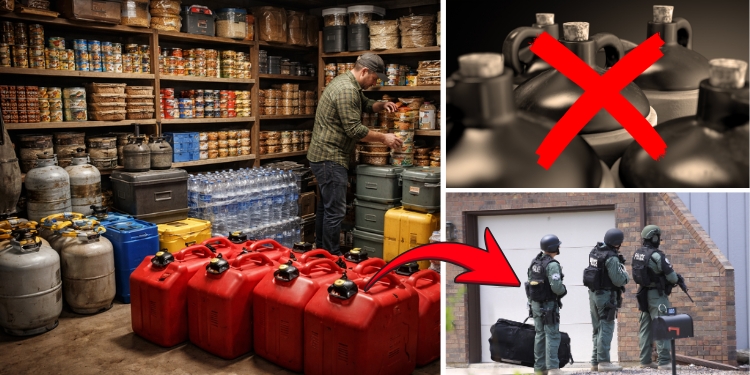


I remember reading a few years ago about this property owner in Pennsylvania who found himself in trouble for something most preppers would consider responsible planning. After a minor electrical fire damaged a detached shed on his land, the local fire marshal conducted a routine inspection of the property. The wiring issue was quickly identified, yet what drew extended attention was the fuel stored neatly along one wall of the shed.
Over time, he had built a reserve large enough to run a generator for several weeks if winter storms knocked out power across the region. The gasoline was stored in approved containers, treated with stabilizer, and rotated regularly. From his perspective, the setup reflected careful preparation.
What he had not factored in was the local fire code. The municipality limited residential gasoline storage to an amount far below what he had accumulated. The situation did not escalate into criminal charges, yet it did result in fines and a formal requirement to reduce the stored volume. His insurance provider reviewed the inspection findings before processing the shed claim, which added another layer of stress to an already frustrating situation.
That story stayed with me because it revealed something most prepping guides never mention (except this one!). In many parts of the country, the amount of fuel required to sustain a household through a prolonged outage exceeds what residential codes technically allow without additional compliance measures.
Where the Legal Line Usually Sits
 Most residential fuel limits are found in municipal fire codes rather than criminal statutes, which is why they rarely show up in everyday conversation.
These rules are usually based on International Fire Code (IFC) standards or state-level adaptations, and they specify maximum quantities of flammable liquids that can be stored in residential occupancies without additional safeguards. For gasoline, the allowed amount is often lower than people expect.
Many jurisdictions cap residential storage at a volume that covers short-term lawn equipment use or minor backup needs, not multi-week generator operation.
Diesel is sometimes treated more leniently due to its lower volatility, yet it still falls under quantity limits. Propane regulations typically focus on tank size, placement distance from structures, and whether installation meets permitting requirements.
What complicates matters is that these limits are written with fire safety assumptions. Code committees think in terms of minimizing explosion risk in dense neighborhoods. Preppers think in terms of maintaining independence during supply disruption. Those two frameworks rarely align.
As a result, someone who methodically calculates fuel consumption for extended outages may exceed local limits without ever intending to ignore the law.
The Math That Changes Everything
Fuel storage tends to expand once real consumption numbers are calculated honestly. A portable gasoline generator running under moderate load can consume roughly half a gallon per hour. If used eight hours a day, that equals four gallons daily. Over a two-week outage, that becomes fifty-six gallons, assuming consistent operation and no waste.
7 Amish Hacks That Will Help You Thrive in a Long-Term Blackout
But Most residential codes do not assume that kind of use. Once heating, water pumping, refrigeration, and battery charging are factored in, the numbers stop looking theoretical. A family that wants true continuity for several weeks may find that their practical storage needs exceed what local regulations allow without additional compliance measures.
How Enforcement Actually Happens
 Contrary to popular assumption, enforcement is rarely proactive. Inspectors do not conduct random fuel audits in quiet neighborhoods. Most cases surface indirectly, often after an unrelated event brings officials onto the property.
A structure fire, storm damage assessment, renovation permit inspection, or insurance investigation can all expose stored fuel. Once visible, storage quantities become part of the report. At that stage, compliance is no longer hypothetical.
In some situations, homeowners are simply instructed to reduce stored amounts. In others, fines are issued, especially if storage conditions violate container standards or placement rules. Insurance complications tend to be more financially significant than municipal penalties, particularly if stored fuel contributed to increased fire risk.
You need to understand this pattern because it changes how you should look at the issue. The real risk is that a routine inspection or insurance review could uncover a technical violation when you least expect it.
Why So Many Preppers Overlook It
People discuss how to rotate gasoline, which stabilizer works best, and what type of container holds up over time, but very few stop to ask how much their local code actually allows them to keep on residential property.
One reason is that the rules are not uniform. Storage limits can change from one county to the next, which makes general advice difficult and encourages people to focus on equipment instead of regulations.
Why You Should Never Store Gas or Water in Blue Barrels
Another reason is cultural. Within preparedness circles, the emphasis tends to stay on capability and efficiency, while legal details feel secondary or overly bureaucratic.
For you, that gap can create a problem you never intended to have. You might spend years improving your setup, tracking consumption rates, and building a reserve that truly supports long-term resilience, only to discover that the final number exceeds what your state allows.
What You Should Check First
 If you are building a serious fuel reserve, take the time to look up your local fire code and read the section that covers residential storage of flammable liquids.
Most cities and counties publish these rules online through their fire prevention or building safety departments.
You are looking for the maximum quantities allowed, the type of containers required, and any rules about where fuel can be stored on the property. Also, you should review your homeowners insurance policy with the same level of attention.
Some policies tie coverage to compliance with local codes, which means a claim could become complicated if stored fuel exceeds permitted limits or is kept in ways that violate placement rules.
If you rely on propane, confirm that your tank size and its distance from structures meet local setback requirements. Even when a primary tank was installed professionally, adding secondary storage can introduce separate regulatory issues.
States With Stricter Fuel Storage Enforcement
While fuel storage limits often depend on local fire codes, some states are known for adopting and enforcing stricter standards. If you live in one of these states, it is especially important to understand how residential storage limits are applied.
- California follows a strict version of the Fire Code, and enforcement is taken seriously, particularly in suburban and wildfire-prone areas. Residential gasoline storage is typically limited to small quantities unless specific safety conditions are met. Inspections tied to property sales, renovations, or wildfire mitigation reviews can expose excessive storage.
- New York enforces detailed fire prevention codes, especially in densely populated counties. Residential limits on flammable liquid storage are often conservative, and violations can surface during routine inspections or insurance reviews. Propane installations are also closely regulated in many municipalities.
- New Jersey. With high population density and strict building oversight, New Jersey municipalities tend to apply fire code provisions carefully. Storage quantities that might be overlooked in rural states can raise compliance issues here, particularly in suburban neighborhoods.
- Massachusetts has a reputation for rigorous fire code enforcement. Residential storage of gasoline and other flammable liquids is clearly defined, and local fire departments are active in inspections connected to renovations, permits, or safety complaints.
- Illinois (especially Cook County and Chicago area). Urban counties often enforce stricter interpretations of fire code limits. In the Chicago area, residential flammable liquid storage is more likely to be scrutinized than in rural parts of the state.
These examples do not mean fuel storage is illegal in those states. They illustrate where enforcement culture and population density make compliance more important to verify. In more rural states, local authorities may apply similar codes with less active oversight, yet the written limits still exist.
So, before expanding your fuel reserves, it makes sense to check how your state and county interpret and enforce residential flammable liquid regulations.
What’s the Next Step You Should Take
 It is perfectly reasonable to keep fuel on hand as part of a prepping plan. A modest reserve gives you flexibility during short-term outages and buys valuable time when supply chains stall.
The key is understanding that stored gasoline or diesel is generally intended to bridge temporary disruptions, not to power a household indefinitely.
Before expanding your supply, take the practical step of reviewing your local fire code to confirm the maximum quantity allowed for residential storage, the approved container types, and any rules about placement, ventilation, or detached structures.
Once you understand the legal limits, build your fuel strategy around diversification instead of volume alone:
- Propane systems. Larger stationary propane tanks installed with permits often fall under a different regulatory framework than portable gasoline cans. Propane stores longer without degradation and supports generators, heaters, and cooking equipment with fewer rotation concerns.
- Solar with battery storage. Even a modest solar device paired with batteries can handle refrigeration, lighting, communications, and device charging. One of the most popular model is the Solar Innovator System.
- Dual-fuel or tri-fuel generators. Equipment that runs on gasoline, propane, or natural gas expands flexibility and reduces dependence on a single stored fuel type.
- Backyard modular power plant. Think in terms of a small, scalable energy system rather than a single generator. For example, we built this modular setup that can combine solar panels, battery banks, an inverter, and a fuel-based generator that automatically supplements power when battery levels drop. This layered approach allows solar to carry daily loads while fuel steps in only when necessary.
- Wood heat and cooking. In colder regions, a wood stove can carry much of the heating load during winter outages, which reduces reliance on fuel-powered systems. Find some helpful insights from the Amish here.
- Energy efficiency upgrades. Insulation improvements, LED lighting, and efficient appliances shrink total consumption, which directly lowers the amount of backup fuel required.
The Takeaway
The prepping method itself is straightforward: build enough fuel reserves to operate independently during extended disruptions. The overlooked detail is that, depending on where you live, the amount required to meet that goal may exceed what residential codes technically allow without additional safeguards.
That is where the strategy needs to evolve. If expanding gasoline storage creates legal exposure, and relying entirely on the grid leaves you vulnerable, then the smarter path is reducing how much fuel you need in the first place. Instead of building resilience around volume, you build it around efficiency and diversification.
That is the idea behind the Moray Generator System.
Positioned as a modular backyard power framework, the Moray Generator integrates multiple energy components into one scalable system, combining a solar array that supplies steady daytime power for lights, refrigeration, and essential circuits, a battery bank and a high-efficiency backup generator that activates only when demand exceeds stored capacity, preserving fuel while extending overall runtime.

The goal is simple: stretch every gallon further while staying within practical and legal limits.
Once this modular system is set, you can:
- Cut generator runtime significantly
- Reduce long-term gasoline storage requirements
- Stay aligned with local fire code limits
- Maintain refrigeration, lighting, communications, and critical appliances
- Expand capacity gradually as your household demands grow
So, don’t let outdated thinking limit your options. The Moray Generator System gives you a smarter path forward, one built on control, flexibility, and long-term stability rather than sheer fuel volume. Build it once, scale it as needed, and create a setup that give you UNLIMITED ENERGY and keeps your home running in a total blackout.
You may also like:
 Read This Before Stockpiling Your Fuel!
This Is How You Will Survive The Next Big Blackout (VIDEO)
15 Prepping Trends That Can Get You Killed
The Only Fuel I Stockpile For Survival (And Why You Should Stockpile It Too)