

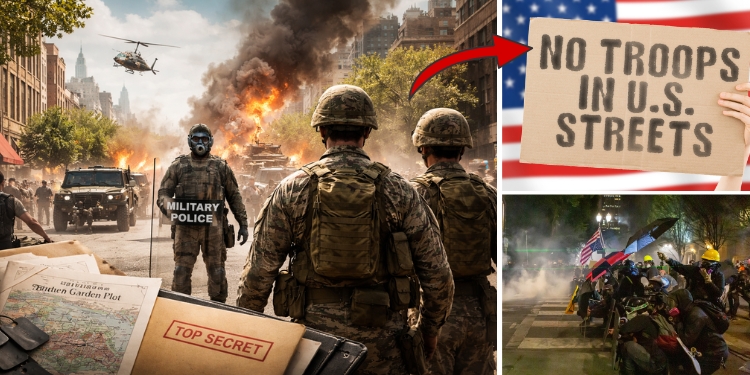


In the late 1960s, riots broke out across several major American cities and pushed local leaders to the edge. Streets burned for days, police struggled to keep control, and the National Guard was called in more than once. Federal officials began asking a hard question: what happens if the violence spreads faster than states can handle it?
Inside Washington, the answer was preparation. Military leaders worked on a plan that explained how federal troops would enter American cities if things went too far. They decided which units would move, how quickly they could arrive, where they would be stationed, and who would give the orders. The idea was as simple as it was and serious at the same time. If local control failed, the federal government would step in with soldiers.
But the biggest problem was that most of us were not aware of this happening behind closed doors. The public saw the riots on television, yet few realized that a long-term response plan was being built behind the scenes. That plan did not disappear when the unrest slowed down, and the legal power behind it still exists today.
The name of that plan was Operation Garden Plot.
What Was Operation Garden Plot?
Operation Garden Plot took shape in the 1960s, a decade marked by riots, large protests, and rising political tension across the country. Major cities faced days of unrest, and in some cases local police and National Guard units struggled to restore order. Federal officials began preparing for situations where state resources might be overwhelmed.
The Department of Defense developed a clear plan that explained how military units would be sent into American cities during severe unrest. The plan covered where troops would gather, how they would coordinate with governors, how communication would function, and what authority they would use once deployed.
The legal foundation came from the Insurrection Act of 1807, which allows a president to send federal troops into a state under certain conditions. While the Posse Comitatus Act generally limits the military’s role in civilian law enforcement, the Insurrection Act gives the federal government the power to step in during serious internal crises.
To support this plan, the Army maintained units trained in riot control and kept equipment such as shields, gas masks, armored vehicles, and other crowd-control gear ready for rapid deployment. Some military bases were prepared to move troops quickly if unrest spread from one city to another.
Why was this plan a problem for day-to-day Americans? Under Garden Plot, a serious wave of unrest could bring active-duty soldiers into city neighborhoods, place streets under curfew, and limit movement through checkpoints and controlled zones.
Daily routines such as commuting to work, running a business, attending school, or simply moving freely through town could change overnight. Military involvement also meant federal authority expanding beyond local control. This raised concerns about how long those powers would last and how they would affect ordinary families who were not even involved in the unrest at all.
The Power Behind the Plan
The Insurrection Act remains one of the strongest emergency powers a president can use. It allows federal troops to enter a state even without the governor’s approval if certain conditions are declared.
The law refers to situations such as rebellion or obstruction of federal authority, and those terms can carry a wide meaning during a serious national crisis.
What was the plan behind Garden Plot? The operation was built to turn that legal authority into action. It mapped out how units would be alerted, how quickly they would move, which cities were considered high risk, and where soldiers would be stationed once they arrived.
Your Rights Under Martial Law: How They Differ From State to State
It detailed how federal commanders would coordinate with state officials, how curfews could be enforced, and how key locations such as government buildings, transportation hubs, and communication centers would be secured.
If the Insurrection Act was the legal key, Garden Plot was the step-by-step playbook. In past deployments under similar authority, troops patrolled streets, guarded infrastructure, and created controlled zones to contain unrest. The structure for domestic deployment was written into law, and Garden Plot showed exactly how that power could be carried out on the ground.
When Federal Troops Entered American Cities
 Garden Plot was not left on a shelf.
In 1968, after the assassination of Martin Luther King Jr., riots broke out in several major cities. Washington, D.C. saw widespread fires, looting, and destruction that stretched over days.
President Lyndon Johnson responded by deploying thousands of federal troops into the capital. Armored vehicles moved through city streets, and soldiers were stationed near government buildings and in residential areas to prevent further violence.
The country witnessed troops standing guard in neighborhoods that were just ordinary blocks filled with families and small businesses. Movement was restricted in certain areas, and the presence of military force changed the city’s atmosphere almost overnight.
In 1992, during the Los Angeles riots following the Rodney King verdict, federal forces were deployed again after local authorities struggled to contain the violence. Marines and Army units supported law enforcement as fires spread and entire sections of the city fell into chaos.
These deployments showed that the authority behind Garden Plot could move from paper to pavement. The plan provided the structure for how federal troops would be organized, where they would operate, and how control would be reestablished once unrest crossed a certain line.
A Reflection of Internal Stability
The Cold War had a strong influence on how federal officials viewed unrest inside the country. Leaders at the time worried that foreign powers could exploit internal tensions and turn protests into something more organized and dangerous. There were concerns about sabotage, coordinated disruption, and the possibility that unrest in one city could trigger problems in others.
Planning documents from that period show a clear focus on worst-case scenarios. Large cities were seen as pressure points where violence could spread quickly. Transportation systems, communication lines, and power grids were treated as critical targets that had to be protected at all costs. If those systems failed, daily life could stall within hours.
Garden Plot brought several pieces together into one organized approach. It connected intelligence monitoring, rapid troop movement, and coordination between federal and state agencies. The plan assumed that instability would not stay contained in one place, and that federal forces might need to respond in more than one region at the same time.
That way of thinking still carries weight today, especially in a country where information moves instantly and unrest can grow faster than ever before.
The Successors to Garden Plot
The name Operation Garden Plot does not appear in headlines anymore, yet the type of planning behind it never disappeared. It evolved. Today, the Department of Defense operates under programs such as Defense Support of Civil Authorities, which outline how military resources can be used during disasters, emergencies, and large-scale unrest inside the country.
On paper, these programs focus on support and coordination. In practice, they maintain the same core ability to move troops, equipment, and command structures quickly if a situation spirals out of control. The Insurrection Act still stands as the legal backbone for domestic deployment, and presidents in recent years have openly discussed using it during times of nationwide tension.
The “Home Defense” LIE – What the Prepping “experts” are hiding from you
What has changed since the 1960s is speed and reach. Troops can deploy faster. Airlift capacity is stronger. Communication between federal agencies happens in real time through secure digital networks. Surveillance tools are more advanced, allowing authorities to monitor developing unrest with far greater precision.
If a serious national crisis unfolded today, the response would likely be quicker and more coordinated than anything seen decades ago. Curfews could be enforced across large areas with centralized oversight. Infrastructure such as highways, ports, and power stations could be secured within hours. Federal control could expand step by step as conditions justified it.
The plain truth? Well, the structure for domestic deployment remains in place, supported by modern technology and updated planning. The tools are sharper now, and the system is built to act without delay if leaders decide the threshold has been crossed.
The Plans You Were Never Meant to See
There is another layer tied quietly to civil unrest planning, and it rarely receives sustained attention. It is called Continuity of Government, often shortened to COG. Its purpose is simple on paper: to ensure federal authority survives during catastrophic events.
Originally designed for nuclear war, these plans expanded over time to include terrorism, cyberattacks, and large-scale domestic instability. After 9/11, portions of Continuity protocols were reportedly activated. Members of Congress were relocated. Emergency command structures operated under classified directives for months. The public was told this was precaution, but the deeper operational details were never disclosed.
Here is where the unease begins. Continuity planning includes relocation sites, hardened facilities, and emergency chains of command that function outside normal visibility. Some executive directives allow federal coordination of transportation systems, energy infrastructure, food production, and industrial resources during declared emergencies. Each authority has legal grounding. Combined during a severe crisis, they centralize control rapidly.
If widespread unrest overlapped with infrastructure failure, multiple emergency powers could activate at once. The Insurrection Act could send federal troops into cities to control unrest and secure key areas. At the same time, emergency continuity plans and resource laws could give the president greater authority and allow the federal government to manage fuel, transportation, and food supplies during the crisis.
The unanswered question is how long temporary powers remain once crisis stabilizes? That uncertainty keeps this discussion alive.
What Domestic Deployment Could Look Like Today
When federal authority expands during a serious internal crisis, the impact does not stay confined to government offices or protest areas. It reaches into neighborhoods, workplaces, and daily routines. Emergency powers are designed to restore order, yet they can also reshape ordinary life in ways most people never expect until they experience them.
If federal deployment were triggered, these are the practical consequences that could follow:
- Communication controls – Emergency management systems could take priority over public networks, and certain areas might even experience no service during operations. But we know a method that will allow you to communicate during any crisis. Find out more here.
- Curfews enforced at city or county level – Residents could be required to remain indoors during set hours, with violations leading to fines or detention. Evening work shifts, travel, and normal routines would be disrupted.
- Supply chain prioritization – Fuel, food shipments, and the most important medical supplies could be redirected first to government-approved locations, delaying restocking for regular stores. Before this happens, make sure you have this first aid guide in your stockpile.
- Military presence in neighborhoods – Armed troops could patrol streets, guard intersections, and secure public buildings, changing the atmosphere of entire communities.
- Roadblocks and identification checks – Entry into certain districts could require proof of residence or purpose, limiting free movement and slowing daily activities.
- Restricted access to infrastructure – Highways, bridges, ports, and transit hubs could operate under controlled access, affecting deliveries and commuting.
- Business interruptions – Retail centers, banks, and offices in high-risk zones could close temporarily under security orders. According to economists, this could trigger a collapse of the dollar, as explained in this recent video.
- Declaration of martial law – In a severe breakdown of civil order where civilian courts cannot function, military authority could take control. The scope and limits of this power depend on your state’s laws regarding martial law – see the full list here.
Surveillance and Information Control
 During the Cold War, federal planners monitored certain domestic groups and tracked individuals they believed could influence unrest.
At the time, this required informants, wiretaps, and physical observation, which meant information moved slowly and often arrived after events had already escalated. Even then, officials believed early awareness gave them an advantage when instability began to spread.
Today, things work very differently. Most communication happens online, and almost everyone carries a phone that sends location data. Because of this, authorities can see where large groups are gathering and how fast messages are spreading. Social media posts can be scanned quickly, and video footage can be reviewed with tools that identify faces in a crowd.
In a declared emergency, the government can expand its monitoring under national security rules. That means more data can be collected, more closely watched, and analyzed much faster than before. If serious unrest broke out, it would not unfold in the dark. It would be observed as it developed, with officials seeing where people are moving and who is organizing events.
So, if you want to reduce your exposure to CCTV in public spaces and limit your phone being tracked, follow these steps now, while you still have the freedom to do so.
Wondering how to prepare like the military? You need to be a step ahead with your prepping game and learn from the most trained people in the country.
Operation Garden Plot was built around one idea: when things turn fast, the people with a plan move first. They already know what matters most, where the weak points are, and how to keep essentials flowing when normal life starts breaking down.
So here’s a quick reality check. Your stockpile might not be as sturdy as you think. And it could fail you when you need it most, meaning all those years you spent preparing might not matter when the pressure actually hits.
You don’t want that, do you?
Then you should take the Amazing Stockpiling Challenge. Think of it as a stress test for your entire prep. It shows you exactly where your stockpile is strong, where it’s weak, and what’s missing before a real crisis exposes those gaps.
You’ll learn how to build a deep reserve of food, water, medicine, and essential gear the same way the military does – step by step, with a system already tested in real life.
If It Happens Again, Are You Ready?
 At this point, the question is no longer if serious unrest will return, but how ready you are when it does. The records show that federal plans for domestic deployment are real, and history shows that large waves of instability come back in cycles.
Those who ignore the signs usually realize what is happening only after movement tightens, supplies thin out, and options shrink.
You can already see the pressure building. Political tension keeps rising, protests organize faster than ever, and supply chains have proven how fragile they are when stressed. Emergency powers have been openly discussed in recent years, and once those powers are activated, they move quickly and with structure.
If escalation unfolds again, you will not have weeks to adjust. You will have days, maybe hours, before restrictions, redirected resources, and controlled access begin to affect daily life. Waiting for confirmation from the news will put you behind the curve.
So, to be ready for when this happens, you must stay ahead and go beyond surface-level stockpiling:
- Install a transfer switch and pre-wire your home for generator or solar input so you can power circuits directly instead of running extension cords through windows. Pair it with this Backyard Power Plant that can run refrigeration, well pumps, and security systems quietly for several weeks.
- Secure a private water source or deep redundancy, such as a tested well with a manual backup pump, a 300–500 gallon concealed storage system (Water Freedom System), and gravity-fed filtration that does not depend on electricity, such as the Aqua Tower.
- Store fuel in rotation with stabilizer and metal containers, and calculate actual burn rates for your generator under load so you know exactly how many days of power you control. Also, make sure you read this before stockpiling any fuel!
- Acquire two-way radios with programmed local frequencies, not just handheld units in a box, and coordinate call signs and check-in times with trusted contacts before you ever need them.
- Keep a percentage of savings outside the banking system, split between secure cash storage and hard assets that hold trade value if digital access slows or freezes temporarily. Also, remember that this common item could become better than gold.
- Create controlled entry planning inside your home, including reinforced strike plates, longer hinge screws, interior lockable zones, and camera systems that record locally. This home defense kit might do the job for you.
Why This Still Matters
Operation Garden Plot shows that federal authorities have long prepared for moments when civil unrest overwhelms local control and military support becomes an option. That kind of planning does not disappear. It evolves with new threats and new technologies.
Today the world feels less stable than it did just a few years ago. Open conflict in the Middle East, direct attacks involving Iran, and growing tension between major powers have raised the risk of spillover effects at home. Modern warfare is no longer limited to battlefields overseas. It includes cyberattacks, infrastructure sabotage, proxy violence, and economic disruption. Any of these could trigger panic, shortages, or unrest inside the United States.
You may also like:
 9 Navy SEAL Secrets All Preppers Need to Know
NASA Confirms: We’re Entering The Worst Drought in 1,200 Years – But This Farmer Found The Solution (VIDEO)
What Happens When China Stops Supplying the United States?












Kate, thank you for another good article. The authorities were dealing with uprisings related to MLK, the Democratic national convention in Chicago, and then the march on the pentagon. It was my first few months in the army and I was stationed in the Washington DC so I got the riot control training under the Garden Plot banner. Our training emphasized tight shoulder to shoulder rank and file formations that would be a barrier to protesters, as opposed to the club swinging actions that had been televised from Chicago. This all seemed reasonable and I could see that it might become necessary at some point. Then 69 moved on to 1970, I am now halfway around the world and I get the news of a wet behind the ears 2nd Lieutenant and Kent State and shootings. That hit me hard and it ranks right near the top of why I feel we have to be very careful of what we allow, tolerate or even condone from our government. Times change, issues change, technologies change, but what doesn’t change is that we (WE THE PEOPLE) have to have the final say on what the government can do.