

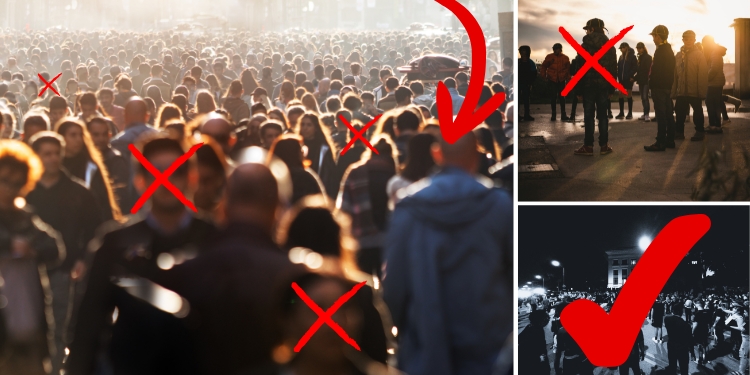


The idea of the “gray man” has become a go-to strategy in the prepping world. Blend in. Stay unnoticed. Do not draw attention to yourself. In theory, it makes sense. If no one knows you have resources, no one will try to take them.
But here is the hard truth: if you rely too heavily on being a gray man, it might cost you your life.
That is right. The very strategy that is supposed to keep you safe could be the one that gets you killed when things go sideways.
Let’s break down why.
The Gray Man Does Not Build Trust
Disasters do not just take out power lines. They take out systems of support: food, water, security, communication. And in a long-term crisis, survival favors groups, not individuals.
If you have spent your whole time trying to blend in, stay invisible, and keep to yourself, you have missed one of the most powerful survival tools available: community.
In a real collapse, people remember who helped them, who shared information, who stepped up. If you have been silent, withdrawn, and distant, no one will have a reason to help you. Worse, they might not trust you at all. In a world where trust is everything, your silence can easily be seen as suspicion.
The Gray Man Is Easy to Overlook Until It Is Too Late
If everyone around you is forming barter groups, organizing security patrols, or trading skills, and you are sitting on the sidelines, guess what happens?
You get left out.
You might have the food. You might have the skills. But if no one knows what you bring to the table, you are not invited. In fact, you might be seen as a threat later on because you are the unknown variable.
Related: Top Tips for Securing Homes: Ensure Safety and Peace of Mind
Being gray might work for the first few days. But as time stretches on, people start taking stock of their surroundings. Suspicion replaces politeness. And if no one knows what side you are on, you are on your own.
That invisibility you relied on to stay safe? It now works against you.
When you’re surrounded by chaos, disappearing isn’t a strategy — it’s surrender. The real survivors aren’t running into the woods; they’re locking down, fortifying, and thriving where they stand.
That’s what The Bug-In Guide is all about — mastering the art of staying right where you are when the world loses its mind. Inside, you’ll uncover how to:
- Turn your home into a fortress of resources and stealth.
- Build airtight defense layers without drawing attention.
- Keep power, water, and food flowing long after the grid dies.
When the panic starts outside, survival starts inside.
👉 See what’s inside The Bug-In Guide before you’re forced to learn the hard way
Silence Does Not Equal Safety
The gray man strategy is built on the idea that staying quiet keeps you safe.
But in many crisis scenarios, silence is what makes you vulnerable. You might miss out on warnings, trade opportunities, or even crucial alliances because you are trying so hard not to be noticed.
If someone is organizing a watch group, distributing food, or warning people of danger nearby, the person hiding in the corner does not get included. Worse, you may be seen as someone who is hoarding, or worse, spying.
Being strategic is smart. Being invisible? Not always. There is a line between discretion and self-isolation, and crossing it can leave you blind, deaf, and alone in an unpredictable world.
Gray Turns to Prey
Here is the part nobody wants to talk about.
If things get violent, being gray does not make you safe. It makes you a target. The people who organized early, who built relationships, who showed strength, are less likely to be messed with.
But someone who is isolated, quiet, and alone? That person looks like an easy mark.
You might think your low profile protects you, but predators do not look for bold. They look for vulnerable. Being gray can make you appear weak, and in a world where strength deters threats, weakness attracts them.
Do not assume that flying under the radar makes you invisible. It might just make you look like prey.
It Is Exhausting to Stay Hidden Forever
Long-term survival requires sustainability. You cannot hide in the shadows forever. Eventually, you will need to trade. You will need to interact. You will need allies.
If your whole plan is to never be seen, what happens when you finally have to step out? Will you know who to trust? Will they trust you?
The longer you stay in hiding, the more relationships you miss. People form bonds quickly under pressure. If you are not there to be part of the group early on, you might not get welcomed later.
It is better to build quiet, smart relationships before things go south than to try to create them when you are desperate.
That trust takes time to build. And time is not something you can afford to waste when everything collapses.
When systems fail, so does money. The quiet ones who think they can hide from inflation and collapse will wake up broke and powerless.
Dollar Apocalypse exposes what’s coming — and how to use it. You’ll learn how to convert dying dollars into hard assets, protect your wealth when banks freeze, and even profit from economic chaos.
Survival isn’t just food and ammo. It’s financial foresight.
👉 Get Dollar Apocalypse now and learn how to beat the system before it eats you
A Reputation of Silence Can Backfire
If people know you never shared, never helped, and never spoke up, your silence becomes part of your reputation. In the early days, being gray can work. But over time, people remember.
They remember who stayed inside while others were sandbagging the flood. Who looked the other way when danger showed up. Who never offered a hand, a tool, or even a word.
And when you finally come looking for help, they will remember that too.
In some communities, your reputation will be your currency. And if your name comes with suspicion or selfishness, you will pay the price.
What to Do Instead
You do not need to broadcast your preps to the world. In fact, being overly vocal can make you a target. But swinging too far in the other direction—total silence and secrecy—can be just as dangerous. The goal is balance: low profile, high usefulness. Here is how to avoid the gray man trap the smart way:
Build Selective Trust:
Start now by identifying one or two people in your neighborhood or community who seem level-headed, self-reliant, and open to collaboration. These should be individuals you could rely on when things go wrong. Schedule coffee chats, run scenarios, or help them with a small project. Give them a bottle of Nicole’s Joint & Movement Salve. It does not matter. Do something. Trust is earned long before it is needed.
Stay Aware, Not Silent:
Being observant is crucial, but do not fall into the trap of total detachment. Attend a few community meetings. Be present at neighborhood events. Listen more than you speak, but make sure others recognize you as a level-headed, dependable person.
Offer Value:
Develop or highlight skills that naturally make you useful—gardening, first aid, mechanical repair, radio communication, food preservation, or even leadership and organization. When the time comes, people do not need to know everything you have, but they should know you bring something to the table.
When the next big strike hits — whether it’s a solar flare or an EMP — silence won’t save you. Every piece of tech you depend on will fry in seconds.
Your radio, your generator, even your backup medical gear — all gone. That’s why true preppers are wrapping their survival systems in EMP Cloth — the same military-grade shielding material used to protect critical gear from electromagnetic pulses.
Here’s what makes it indispensable:
-
Full-spectrum defense: Blocks E1, E2, and E3 EMP waves — the same ones that cripple grids.
-
Covers what matters: One sheet wraps a generator, solar battery, or comms hub completely.
-
Multi-threat protection: Blocks Wi-Fi, GPS, Bluetooth, and RF tracking signals too.
Don’t wait for the lights to go out to wish you had protection.
Practice Discretion, Not Disconnection:
Keep your preps and strategies private, but avoid being the person nobody knows. Disappear too hard, and you might be mistaken for a hoarder, a stranger, or someone hiding something dangerous. You want to be seen as cautious, not suspicious.
Know When to Step Forward:
There is a moment in every crisis when someone needs to lead, give clarity, or take initiative. Be ready to be that person. You do not need to be loud or controlling, just competent and steady. People follow those who keep calm under pressure.
When the lights go out, the looters come out — and they don’t care how “gray” you are.
You can’t reason with desperation, but you can prepare for it. The Anti-Looter Kit gives you the edge when chaos hits your doorstep. Inside, you’ll find gear and defensive tools designed to deter, delay, and disable intruders before they ever breach your line.
When the mob comes, hesitation kills.
👉 Arm yourself with The Anti-Looter Kit now — because mercy won’t stop them.
Develop Local Networks:
Make a list of neighbors or nearby contacts and categorize them based on what they know, what they have, and how you can support each other. Maybe one has chickens. Maybe another has a well. Maybe you are the one with solar power or water filtration. Networks work best when built on mutual benefit.
Train Quietly, Connect Openly:
Keep sharpening your skills—shooting, gardening, field medicine—but do it off the radar. Meanwhile, use public settings to strengthen relationships. Help someone move. Lend tools. Start conversations. These small acts build social capital that lasts when systems fail.
In short, you do not have to choose between being loud and being invisible. The best prepper in a crisis is often the one who is quietly capable, selectively trusted, and always connected to those around them.
Final Thought: When to Be Gray and When to Be Known
The gray man concept is not useless. It has its place in short-term scenarios—escaping a riot, moving through hostile territory, avoiding early looting. In these moments, being invisible can save your life.
But long-term? When days turn to weeks and systems collapse? That is when blending in becomes a liability.
Connection beats camouflage. Trust beats secrecy. And usefulness beats invisibility.
Be smart. Be prepared. Be known by the right people, at the right time.
Because in a world where everyone is scared and desperate, the last thing you want to be is the unknown man in the corner.
Be ready. Be real. Be visible when it matters.
When the grid fails, those still hiding will fade fast. But the ones who built independence — power, water, food, communication — will become untouchable.
No Grid Projects shows you exactly how to build that kind of freedom:
-
Generate off-grid energy and store it safely.
-
Create water systems immune to city shutdowns.
-
Build food and barter systems that last through collapse.
You don’t survive by hiding. You survive by preparing smarter than everyone else.
👉 Get No Grid Projects and take your survival off-grid — for good.
You may also like:

Are Signal Jammers Illegal? The Truth You’re Not Supposed to Know
What’s Coming Is A Global Reset (Video)
7 Life Skills I Wish I Knew Sooner

















Excellent article! One addition is to remember the platoon rule; an effective platoon is 20 to 50 people maximum. The theory is that a group is more powerful than an individual up to a certain size. Once that size is exceed internal conflict, politics, social stratification begins to take hold and you end up with hierarchy and a central elite core. That can be great if your are part of the elite core but not so good if you are one of the masses, then you are just back to being a gray-man within the large group. Be aware of how big any groups your are a part of are becoming, what your status in that groups is, and possibly be active in separate groups as redundancies if a specific group’s dynamics shift away from your best interests.
That’s a great point, and we couldn’t agree more. The “gray man” mindset works best when it’s balanced with smart group awareness because survival doesn’t end with camouflage; it depends on community dynamics too. The platoon-size rule makes sense: small, flexible groups between 20 and 50 people keep cohesion, trust, and accountability without turning into bureaucratic tribes. Once numbers swell, hierarchy creeps in and you get politics, ego, and that elite-versus-the-rest problem. In a crisis, that can be fatal, not from outside threats, but from infighting. So, just like you said, always track how your group evolves, understand your place in it, and never tie your entire survival to one camp. Having a few trusted circles even smaller support clusters within or outside your main group gives you redundancy, perspective, and a lifeline if leadership goes sideways.
In other words, everyone wants to be the boss.Remember that friendly handshake is nothing more than a venomous serpent in disguise, there only needs to be enough money and power involved, and the serpent will strike. 95% of the population will stab you in the back the minute you turn around, so choose your friends very carefully and like mom and dad said never trust strangers.
My mother use to say that when you leave the house you have to be dressed appropriately because you represent the family. Neat, clean, and presentable!
Here in the city, those words have a different meaning today. Long gone are the days when one just focused on being presentable, dressed up for occasions or dressed to impress. The last thing you want to do is to be noticeable, to stand out in a crowd, teetering on high heels with everything you are carrying of value in a matching purse, and looking like you are the perfect potential victim.
Fashion be damned!
When I lived in a city, I found I attracted a lot more undesirables if I dressed for success. They equated that look with money or having something else worth taking. If I dressed like a student or on the shabby side, almost no one bothered me.
In another city, a friend and I were walking somewhere, and two men approached us. I had an envelope style purse with a shoulder strap. There was an outside open pocket like a sleeve on the front of the bag. The men asked if we needed directions, and sure enough one of them slid his hand in the open pocket. I gave him a look, and he looked sheepish as his hand withdrew, clutching a paper handkerchief I had used moments before. It was still damp. I told him he could keep it, and we knew where we were going.
Dress clothes in general are not really practical. Their chief purpose is to make someone “look their best,” and often sacrifice warmth, really good pockets (BIG problem with women’s clothing in general), and freedom of movement. As for high heels, there’s a reason men stopped wearing them in the 18th century! Lol
That’s a perfect on-the-ground lesson in what the gray man lifestyle is really about — it’s not just theory, it’s survival psychology. You nailed it: the moment you look “successful,” you broadcast value, and in a city that’s like painting a target on your back. Dressing down, walking calm, carrying yourself like you belong but have nothing worth stealing that’s gray man gold. And that purse story? Classic. You kept your composure, diffused the situation with humor, and walked away untouched. That’s awareness in action. You’re also dead right about dress clothes, they’re built for show, not survival. Tight cuts, shallow pockets, and heels that could snap an ankle in an emergency, all style, no sense. Blending in means function over fashion, and you captured that perfectly.
The term is ‘dress for the occasion’.
Dress clothes can be quite comfortable for many situations but not all.
Same with shorts and flip flops.
An old adage among thieves is if you are going to steal from someone, do it to people who have something to steal, not people who don’t.When is the last time you heard of a poor person having a home invasion?
crazysquirrel, I had to dress professionally for a number of jobs, and honestly, women’s “professional looking” dress leaves a LOT to be desired. In those jobs, women wore dress suits with skirts, and pantyhose year round, as pantsuits were frowned upon. High heels were considered “professional,” while lower heels were not.
When I worked in an environment that allowed for “business casual,” I was once written up for “not looking professional enough,” even though I wore khakis and polo shirts just like the guys on my team (I was the only female).. And one of them looked as though he slept in his clothes; whereas my clothes were freshly laundered and pressed
Yes, I took exception at being singled out and went over my boss’s head to lodge a complaint. We were at a client site, and one of the client’s VP had told me the day before to wear an older pair of slacks as the job would involve working in a dusty and dirty location on the site,. Although I told this to my boss, she decided a write up was in order.
The day after the write up, we were still at the client site, and the client’s VPs told me I had on the perfect outfit for the dusty job we had to do earlier in the week. My boss overheard that comment and decided to rescind the write up. I had already submitted my complaint and started building my case. That client and the one following really liked working with me, which spoke volumes to the higher ups.
Most jobs now aren’t nearly as stringent in their dress codes, but some still are, and women’s clothing in general isn’t made for comfort or practicality when it’s considered office wear.
I can think of about six outfits over 40+ years of working that were “professionally correct,” comfortable, and somewhat practical.
One recruiter was angry because I refused a job which would have been a great fit because it required a professional dress code. I told him to try standing out at the bus stop in a business suit, wearing pantyhose and high heels while snow fell unexpectedly and delayed the bus by 45 minutes, and get back to me on how that professional dress worked for him.
Thankfully, I found a place with no dress code and could wear practical clothes every day. But that was decades after I joined the work force.
If you’re able to find something that can tick all the boxes, I’m glad for you. I’d also say, you are likely a male, where it’s always been easier to dress professionally, and have clothes that were comfortable.
Speculation vs history. There are many case histories from past experiences. Social behaviors in past and present conflicts highlight the realities. October 7th shows the cracks in the wall. Division in communities, even in close nit communities, brings forward the divide. “Being a lamp unto the world “ is important. Demonstrating humanity to swine or casting pearls before swine is documented in scripture. Strength is respected. Weakness and or fear feed aggression. The best strategy is to learn, and history is a great teacher. Now! This is what can be done. Move purposefully. Avoid rabbit holes. Live life well. Learn from the survivors.
Learn from our countries early settlers & from nations who have been at war or occupied, how they survived under siege.Look back to ancient times how the Native Americans survived harsh winters and Europeans as well going back to the time of the Vikings.
Best to be both meek and timid.
And who says that gray men cannot be their OWN force?
During WWII, French resistance were generally both.
It let the soldiers believe that the resistance was not a threat.
CrazySquirrel,
I was thinking the same thing. Be alone and build a group from scratch. People can talk and boast, be prepped and still be useless when it’s actually in the fan. I also know if people know you are getting prepared they will come to your door unprepared and expect you to care for them. That did happen to me. If someone shows up or I run across someone with a wheelbarrow of stuff, we can talk. Just show up with nothing? Don’t think so. Keep moving.
Predators look for the easy target, but as soon as they encounter resistance, they cower and retreat, look at some self-defense videos, and it is clearly observed.
All good comments.
If you live in big city, sorry and good bye.
Small city, get to the burbs, Join civic groups, Rotary, Lions, Kiwanis, etc. Be willing hands, show knowledge AND ability to take direction as well as give them.
More rural, be a good Neighbour, have Farmer friends, spend money at road side stands WHEN the owner is present, you want the relationship & you will know where they are ( most important part) You can show up with barter material when you need farm things ( food to welding and more). Small community, help OR Donate to little league. Small communities are much less guarded than a City, You will get a chance to pitch in and be remembered for the good work. Then buy from the small business owners you just met.
ADD in the comments above about remaining guarded, yet partly known. MAYBE you end up with a few NEW GOOD FRIENDS. Personally, I like having farmers for friends. They are mostly preppers without any effort. Self sufficient is WHO they are, to the core.
You live in Manhattan, prep for the ice storm and nothing more, until you change your zip code.
Be gray, invest in lead !