
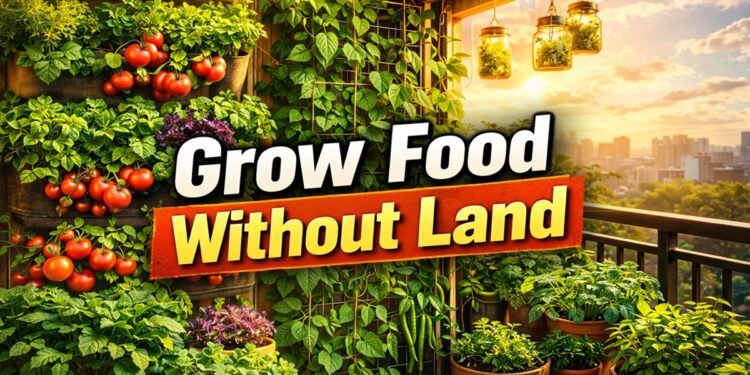


The standard assumption about food production is that you need land. A backyard, a farm, a patch of actual ground that belongs to you. For most of human history that was largely true. It is not anymore.
Preppers who live in apartments, condos, rental properties, or urban environments often write off food production as something that applies to other people. People with land. This is a significant mistake, because food production capability, even at a small scale, is one of the most valuable things you can build before a serious disruption hits. Stored food runs out. A working production system does not.
Every method in this guide has been used by real people in real small-space situations to produce meaningful quantities of food. None of them require land ownership. Several do not require outdoor access at all. Start with whatever fits your current situation and build from there.
The short version is available in this clip:
Read on for extra information about growing food without land.
Container Gardening: The Foundation of Landless Food Production
Container gardening is the entry point for most landless growers because the barrier is so low. Any container that holds growing medium and drains water can grow food. Pots, buckets, grow bags, wooden crates, repurposed storage bins. All of them work.
The practical rule for container sizing is to go bigger than you think you need. Lettuce and herbs tolerate 1 to 2 gallon containers reasonably well. Bush beans and radishes want at least 5 gallons. Tomatoes, peppers, and cucumbers need 10 gallons or more to produce well. Undersized containers stress plants, restrict root development, and dramatically reduce yield.
Use a quality potting mix rather than garden soil, which compacts in containers and restricts root oxygen. Adding perlite at a ratio of about 20 percent by volume improves drainage and aeration. Container plants need more frequent watering than in-ground plants because they have no surrounding soil to draw moisture from, and they need regular fertilizing because nutrients leach out with each watering. A balanced liquid fertilizer applied every two weeks maintains productivity through the growing season.
The crops best suited to container production are leafy greens of all kinds, herbs, bush beans, radishes, carrots in containers at least 12 inches deep, cherry and compact tomato varieties, peppers, and dwarf cucumbers. For preppers focused on calorie and nutrition density, beans and sweet potatoes grown in large containers or grow bags are worth adding to the list.
A 5-gallon bucket costs around two dollars at any hardware store. A bag of quality potting mix runs five to eight dollars. A seed packet is one to three dollars. For under twenty dollars you can be producing food within weeks. The National Gardening Association offers variety selection guides and space-optimization resources for container growers.
Vertical Growing: Multiplying Space You Do Not Have
Vertical growing solves the problem of limited horizontal surface area by using the third dimension. Walls, fences, railings, and any vertical surface become productive growing space. A 6-foot section of wall fitted with vertical planters can produce more food than a 4-by-4 foot raised bed because it uses three-dimensional space instead of two.
Pocket planters, made from fabric or felt panels, hang flat against a wall or fence and hold individual plants in each pocket. A standard 5-foot by 3-foot panel holds 20 or more plants in almost no floor space. These work well for lettuce, spinach, herbs, strawberries, and other shallow-rooted crops.
Tower planters stack growing pockets vertically around a central column, making them particularly efficient on balconies where floor space is the limiting factor. For a DIY option, PVC pipe with drilled holes mounted on a fence or wall creates an effective growing channel for herbs and greens at minimal cost.
Trellises extend vertical growing to larger crops. Cucumbers, pole beans, peas, and indeterminate tomatoes all train well onto a vertical structure, producing in far less space than they would spreading on the ground. A single panel of cattle panel or wire mesh fixed to a sunny wall can support a substantial harvest of vining crops through an entire season.
Water management requires attention in vertical systems because the top of the installation dries faster than the bottom. Check moisture levels at multiple heights and water accordingly, or install a simple drip line that delivers water consistently from top to bottom.
Read More: Vertical Gardening for Self-Sufficient Living
Sprouting and Microgreens: Fast Food With No Space Required
Sprouting is the most accessible food production method available. No soil, no outdoor space, no sunlight, no equipment beyond a mason jar and a mesh lid. Seeds are rinsed twice daily, kept at room temperature, and in three to seven days they produce fresh, living, nutritionally dense food.
Lentils, mung beans, alfalfa, broccoli, radish, sunflower, and chickpea are among the most productive and nutritious sprouting seeds. Broccoli sprouts deserve particular mention for preppers focused on health resilience: they contain sulforaphane at concentrations dramatically higher than mature broccoli, a compound with documented anti-inflammatory and antioxidant activity. Research from Johns Hopkins University established the sulforaphane content of broccoli sprouts as a significant nutritional finding, with coverage available through the Johns Hopkins Medicine health library.
Microgreens take the process one step further. Seeds are planted in a shallow tray with a thin layer of growing medium, allowed to develop for 7 to 14 days until the first true leaves emerge, and harvested by cutting at the stem base. Flavor is concentrated and intense compared to mature plants, and nutritional density per gram is significantly higher than the full-grown equivalent.
Both systems operate on a kitchen counter year-round, completely independent of season, climate, or outdoor conditions. A pound of sprouting seeds costing a few dollars produces multiple pounds of fresh food. There is no more efficient food production system per dollar and per square foot available to a landless grower.
Hydroponics: Soil-Free Production That Works Indoors Year-Round
Hydroponics grows plants in nutrient-enriched water rather than soil, delivering everything roots need directly to where they can use it. The result is growth rates significantly faster than soil-based methods and the ability to produce food entirely indoors without seasonal limitation.
The simplest entry point is the Kratky method, a passive hydroponic system that requires no pump, no electricity, and no moving parts. A container of nutrient solution with net pots suspended in the lid allows roots to grow down into the water. As roots absorb the solution the water level drops, leaving an air gap that oxygenates the roots. Refill with nutrient solution as needed. This system grows lettuce, kale, spinach, basil, and most herbs exceptionally well with almost no maintenance.
More advanced systems including NFT (Nutrient Film Technique) and deep water culture use pumps and timers to circulate and oxygenate nutrient solutions continuously, supporting faster growth and a wider range of crops including tomatoes, peppers, and cucumbers.
For preppers, the main consideration with hydroponics is input dependency. Nutrient solutions require purchased components that may not be available in a prolonged disruption. Hydroponics excels for current food production and skill development. A soil-based system that can be fed with compost and natural inputs is a more resilient long-term foundation. The ideal prepper growing setup uses both: hydroponics for year-round indoor production now, and soil-capable systems for long-term resilience.
The University of Minnesota Extension provides a solid overview of home hydroponic methods here.
Aquaponics: Growing Fish and Vegetables in the Same Closed Loop
Aquaponics combines fish farming with hydroponics in a self-regulating biological system. Fish produce waste. Beneficial bacteria convert that waste into plant-available nutrients. Plants absorb the nutrients and filter the water. Clean water cycles back to the fish. Once established, the system requires minimal external inputs beyond fish feed.
A functional home aquaponics system can operate in a spare room, a basement, or a garage. A 100-gallon fish tank paired with a properly sized grow bed produces both fish protein and vegetables from the same footprint. Tilapia are the standard choice for home aquaponics because they are hardy, fast-growing, tolerant of variable water conditions, and good to eat. Catfish and trout are also used depending on climate preferences.
Related: Aquaponics: Build Your Own Endless Food Supply At Home For SHTF
Plants that do consistently well in aquaponic systems include lettuce and most leafy greens, herbs, tomatoes, peppers, and cucumbers. The nutrient profile of fish waste supports a wide range of crops without additional fertilizer input.
The dual production of protein and vegetables from a single system that largely sustains itself is the primary appeal for preppers. Fish feed can be supplemented or eventually replaced with home-raised insects, duckweed, or other biological inputs, moving the system toward true self-sufficiency. The learning curve involves water chemistry monitoring and system balancing, but the long-term payoff in food production capability is significant.
Community Gardens and Land Access: Using Ground You Do Not Own
Owning land is not the only way to access it. Community gardens, informal land-sharing arrangements, and urban agriculture programs provide growing space to people who have none of their own.
Community garden plots are available in most American cities and many towns, typically renting for a nominal fee per season ranging from free to around fifty dollars. Beyond dedicated plot space, they offer access to water infrastructure, shared tools, and the accumulated knowledge of experienced growers in the same space. For someone building food production skills from scratch, the community garden environment accelerates learning considerably.
The American Community Gardening Association maintains a national directory of community gardens at communitygarden.org. The USDA also supports urban agriculture development through programs documented here.
Beyond formal programs, informal land access is often available to those who ask. Neighbors with unused yard space, landlords with vacant lots, churches, schools, and community organizations frequently have land sitting idle. Offering a share of the harvest in exchange for growing rights is a straightforward arrangement that benefits both parties. Use raised beds or containers rather than tilling rented or borrowed ground directly, which protects the property and makes the arrangement easy to exit if needed.
Indoor Growing Under Artificial Light: Removing the Sunlight Dependency
Sunlight is the assumed input in every growing system, but it is not the only option. Modern LED grow lights produce the full spectrum of light that plants require for photosynthesis at a fraction of the energy cost of older lighting technologies and at a price point that has dropped dramatically in recent years.
A quality full-spectrum LED panel sized for a 3-by-3 foot growing area costs between fifty and one hundred fifty dollars and draws roughly the same electricity as a standard light bulb. Under this light, herbs, leafy greens, and compact fruiting plants grow year-round in any interior space regardless of natural light availability.
Related: How To Grow Suspended Food Indoors
For preppers in northern climates, indoor grow lights extend the productive season to 12 months and eliminate the dependence on outdoor weather conditions. For apartment dwellers with north-facing windows or no windows at all, they make food production possible where it would otherwise be impossible. Combined with a hydroponic or container system, a grow light setup creates a fully self-contained food production unit that fits in a closet, under a bed frame, or on a shelf.
The single vulnerability is electricity dependence. A grow light system stops producing if the grid goes down without backup power. Factor this into your planning. A battery backup, a small solar setup, or simply maintaining a parallel outdoor or window-based system as a resilience layer addresses this gap.
Build the Skill That Keeps You Fed – Even Without Land
Growing food in small spaces is more than a gardening trick. It is a mindset shift toward true self-reliance. Once you realize you can produce calories, nutrients, and medicine without owning land, you stop depending entirely on supply chains that can fail without warning.
But food is only one part of resilience.
For most of history, the same people who grew their own food also knew how to treat illness, infections, pain, inflammation, digestive problems, and everyday health issues using plants that could be grown in small spaces, containers, windowsills, or balconies.
That is exactly where Forgotten Home Apothecary becomes invaluable.
This guide teaches how to turn simple plants into practical remedies using the same small-space growing methods you just learned:
- Herbs that grow easily in containers and vertical planters
- Balcony plants traditionally used for immune support and inflammation relief
- Simple preparations like teas, tinctures, salves, syrups, and infused oils
- Remedies made with ingredients you can produce yourself
- Knowledge passed down through generations before pharmacies existed
Many of the plants featured in Forgotten Home Apothecary can be grown in:
- balcony pots
- windowsill containers
- vertical pocket planters
- indoor grow light setups
- small hydroponic systems
- community garden plots
Even a tiny apartment can support a surprisingly capable home apothecary when you know what to grow and how to use it.
Food independence protects your calories.
Herbal knowledge protects your health.
Together, they create a powerful layer of resilience most people never build.
If you are serious about becoming less dependent on fragile systems, Forgotten Home Apothecary shows you how to build a practical, usable herbal toolkit using plants you can grow almost anywhere.
Learn how everyday plants can support immunity, digestion, pain relief, skin health, respiratory comfort, and long-term wellness — all from knowledge you control.
👉 Discover Forgotten Home Apothecary and start building a self-reliant herbal toolkit today.
Building Your Landless Growing System: Where to Start
The trap most people fall into is trying to build the perfect system before starting. There is no perfect system. There is only the system you are actually running.
Start with sprouting this week. Buy a jar, a bag of mung beans or lentils, and start rinsing. Within five days you will have fresh food you grew yourself. This matters less for the food it produces and more for what it does to your thinking. Once you have grown something, you start seeing growing opportunities everywhere.
Add containers next. Whatever outdoor or balcony space you have, put something in a container. Start with lettuce or herbs, which are fast and forgiving, and work up to larger plants as your confidence builds.
When you are comfortable managing containers, consider whether a vertical system would multiply your available space. Then decide whether indoor hydroponics makes sense for year-round production. Then think about aquaponics if you want to add protein production to the equation.
Each layer you add increases your food production capability and reduces your dependence on systems you do not control. The goal is not to grow all your own food immediately. The goal is to build the skill, the infrastructure, and the habit of production so that when you need it most, the capability is already there.
Land was never the real foundation of food security. Knowledge, systems, and the habit of growing are.
You may also like:
 Join The Official Ask A Prepper WhatsApp Channel For Weekly Advice
Battle-Tested Army Survival Tactics You Can Rely On When Crisis Strikes (VIDEO)
Pemmican: The Ancient Superfood Every Prepper Should Know
How To Choose The Best Food Grade Buckets
Parboiled Rice – The Survival Food Most Preppers Are Sleeping On