


When people think about prepping, they picture freeze-dried food, water filtration systems, or ammunition. Rarely does anyone mention what they’ll actually cook with. That oversight matters more than most people realize.
Cooking utensils wooden options have been used by every civilization on earth for thousands of years. Before plastic, before stainless steel, before silicone, there was wood. And there’s a reason those tools outlasted every empire that used them. They work. They hold up. They don’t leach chemicals into your food, they don’t shatter under heat, and they don’t need electricity or special cleaning equipment.
If you’re building a kitchen kit that functions in a grid-down situation, in a bug-out scenario, or just in a more self-sufficient everyday life, wooden utensils deserve serious attention. Here’s what makes them worth keeping around.
Wood Has Zero Chemical Leaching Risk
Plastic cooking utensils are everywhere, but they come with a real cost. When plastic tools are exposed to high heat, they release microplastics and chemical compounds into food. Researchers have found that a single stirring session with a plastic spoon can shed hundreds of thousands of microplastic particles into whatever you’re cooking.
Studies from the National Institutes of Health confirm that plastic kitchen tools are a significant source of microplastic ingestion. For preppers focused on long-term health, especially in scenarios where medical care is unavailable, eliminating unnecessary chemical exposure is a smart baseline practice.
Wood doesn’t melt. It doesn’t leach synthetic chemicals. The worst that happens with a quality hardwood utensil is that it picks up flavor over time, which most cooks consider an asset, not a liability.
Wooden Utensils Work on Any Heat Source
This is where wood pulls ahead of almost every other material in a prepping context. A silicone spatula might handle a gas stove fine, but put it over an open wood fire and you’re gambling. A nylon spoon left even briefly on a hot cast iron pan will melt or warp.
Wooden spoons and spatulas function the same whether you’re cooking on a modern stove, a propane camp burner, a wood-burning rocket stove, a fireplace, or an open pit fire. No material tolerances to worry about. No melting points to manage.
The USDA’s guidance on food safety and cookware notes that heat-stable, non-reactive materials are preferable for safe food preparation. Wood fits that profile completely when properly maintained.
For preppers who may be rotating through different cooking setups depending on the situation, a set of wooden utensils travels seamlessly across all of them. You don’t need to carry different tools for different heat sources.
They’re Naturally Gentle on Cookware
Cast iron cookware is a staple in serious prepper kitchens for good reason. It lasts generations with proper care and works over any heat source. But cast iron has one weakness: the seasoning layer, which is what makes it non-stick and rust-resistant, can be damaged by metal utensils.
Wooden utensils protect your investment. They won’t scratch the seasoning on cast iron, won’t score the interior of enamel-coated pots, and won’t scrape up the surface of stainless steel. A metal spatula dragged across a well-seasoned skillet can undo months of careful seasoning in seconds. Wood won’t do that.
If you’re building a long-term cookware collection meant to survive decades of use, using wooden utensils keeps that collection intact far longer.
Hardwood Lasts Decades With Basic Maintenance
A quality wooden spoon made from a dense hardwood like cherry, maple, teak, or olive wood doesn’t have an expiration date. Treat it right and it will outlast you. The maintenance required is minimal: hand wash, dry promptly, and oil occasionally with food-grade mineral oil or beeswax.
The FDA’s materials guidance for food-contact surfaces supports using dense, hard materials that can be adequately cleaned and maintained for food preparation. Properly dried and oiled hardwood meets these standards.
Compare that to plastic utensils, which discolor, warp, crack, and degrade on a timeline measured in months. Or silicone, which can develop tears and harbor bacteria in the gaps. Wood, treated with basic care, doesn’t have those failure modes.
In a long-term grid-down scenario where resupply isn’t guaranteed, utensils you never need to replace are far more valuable than cheap tools that need constant rotation.
Wood Handles Heat Without Burning Your Hands
Metal utensils conduct heat directly up the handle. Leave a metal spoon resting in a hot pot for a few minutes and that handle becomes a burn risk. Wood doesn’t conduct heat the same way. A wooden spoon can sit across a pot of simmering soup and the handle stays cool enough to grab without a second thought.
In a chaotic cooking environment, whether that’s managing multiple pots over a campfire or cooking for a group during an emergency, eliminating small hazards adds up. Wooden handles are naturally insulating, which is an engineering advantage that requires zero additional design.
That same property also means wooden utensils don’t get cold and clammy in the way metal does in cold weather. For winter camping or cold-weather prepping scenarios, this is more than a comfort detail.
They’re Antibacterial by Nature
This surprises most people. Wood, particularly certain hardwoods, has documented antimicrobial properties. Studies have found that bacteria introduced to wooden cutting boards and utensils are drawn into the wood fiber, where they die off and don’t reproduce.
Research from the University of California, Davis showed that wooden cutting surfaces actually outperformed plastic in bacterial survival rates. Bacteria pulled into wood grain didn’t recover and multiply the way they did on plastic, where surface scratches harbored and protected bacteria from cleaning.
This doesn’t mean wooden utensils don’t need washing. They do. But it does mean that wood is not the bacteria magnet many people assume it to be. In situations where rigorous sanitation isn’t always possible, wood’s natural antimicrobial qualities offer a meaningful advantage.
Wood Is Renewable and Locally Sourceable
If you’re thinking about true long-term self-sufficiency, the ability to produce your own tools matters. Wooden utensils can be carved from locally harvested wood with basic hand tools. You don’t need a factory, you don’t need plastic feedstock, and you don’t need a supply chain.
Whittling and woodworking are among the oldest human skills. A prepper with basic carving tools and access to a hardwood tree can produce a functional wooden spoon in an afternoon. That’s a level of supply-chain independence no plastic or metal utensil can match.
The USDA Forest Service provides guidance on sustainable wood harvest and stewardship. Understanding which local hardwoods are dense, food-safe, and durable is a practical skill worth developing.
Even if you never need to carve your own spoon, knowing that you could is consistent with the prepper mindset of reducing dependency on systems that can fail.
What to Look for When Choosing Wooden Utensils
Not all wooden utensils are created equal. The species of wood matters, as does the construction method.
Dense hardwoods hold up best. Cherry, maple, teak, olive, and walnut are among the most durable options. Softer woods like pine or basswood will split and splinter faster under regular use. Teak and olive are especially good for utensils that will see frequent water exposure because their natural oils add moisture resistance.
One-piece construction is stronger than glued or laminated designs. Any joint is a potential failure point and a place where bacteria can accumulate. A utensil carved or turned from a single piece of wood has no weak points.
Avoid wooden utensils with lacquer or varnish coatings unless those coatings are explicitly food-safe. Many mass-produced wooden items are finished with chemicals not meant to withstand repeated cooking contact. Raw, oiled hardwood is a safer and more durable choice for kitchen use.
The FDA’s food contact surface regulations cover what materials and finishes are approved for food contact. For preppers wanting to verify the safety of a specific product or finish, this is the reference point.
Maintaining Wooden Utensils the Right Way
Wooden utensils last as long as the maintenance routine they receive. The basics are straightforward and take seconds per use.
Always hand wash. The dishwasher is the fastest way to ruin a wooden utensil. The heat and prolonged water exposure will cause cracking, warping, and splitting over time. A quick wash with warm soapy water, a rinse, and prompt drying is all the cleaning they need.
Dry standing up or lying flat, never left soaking in water. Moisture sitting in wood promotes cracking. After washing, dry with a cloth and then allow to air dry fully before storing.
Oil regularly. A simple coating of food-grade mineral oil rubbed in and left overnight restores moisture to the wood, prevents drying and cracking, and keeps the surface from absorbing odors and stains. Beeswax board cream is another excellent option that adds a protective finish. Both are inexpensive and widely available.
Sand lightly if rough spots develop. A quick pass with fine-grit sandpaper followed by an oiling will bring most utensils back to smooth condition even after years of use.
Building a Wooden Utensil Kit for Prepping
You don’t need an extensive collection. A well-chosen set of four or five pieces will handle nearly any cooking task across both everyday and emergency use.
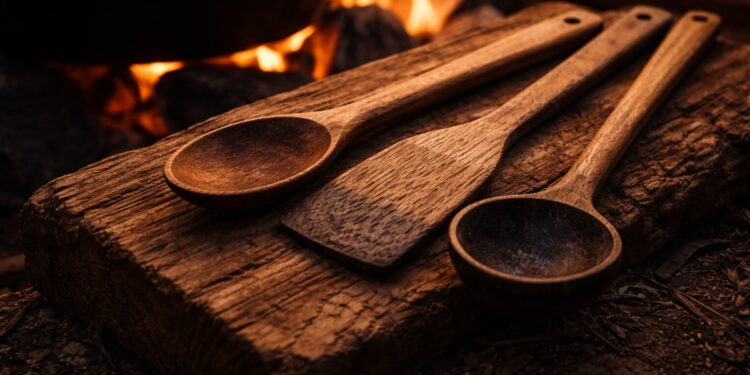
A large stirring spoon is the foundation of any cooking kit. It handles soups, stews, grains, and sauces. A slotted spoon adds versatility for draining and serving. A flat spatula covers pan work, flipping, and scraping. A long-handled spoon or ladle for working over high heat or open fire rounds out the core set.
If you’re building a bug-out kit or a go-bag cooking setup, a single quality wooden spoon and a flat spatula cover most scenarios. Lightweight, compact, and functional across every heat source you’re likely to encounter.
For long-term food storage pairing, the USDA’s Complete Guide to Home Canning covers preparation methods that wooden utensils support safely, including jams, preserves, and fermented goods where non-reactive tools are important.
The Bottom Line
Wooden cooking utensils are not nostalgia items. They’re practical, durable, chemically inert tools that function across every cooking scenario a prepper might face. They protect your cookware, they handle any heat source, and with basic care, they last longer than anything plastic or silicone will.
In a world where most of what fills kitchen drawers is designed to be replaced rather than maintained, wooden utensils stand apart. They improve with age, they can be repaired, and in a pinch, they can be made from scratch with nothing more than a knife and a piece of hardwood.
That kind of reliability is exactly what prepping is built on.
Frequently Asked Questions
Are wooden utensils actually safe to cook with?
Yes. Dense hardwood utensils are food-safe and have been used in cooking for thousands of years. Avoid utensils with non-food-safe lacquers or varnishes. Raw or food-grade oiled hardwood poses no health risk during normal cooking use.
Do wooden spoons harbor bacteria?
Research suggests that wood actually has natural antimicrobial properties that cause bacteria to die off once drawn into the wood grain. Proper washing and drying after each use keeps wooden utensils safe for ongoing food preparation.
What’s the best wood for cooking utensils?
Hardwoods like maple, cherry, teak, olive, and walnut are top choices. They’re dense, durable, and resistant to moisture damage. Avoid softwoods like pine for utensils that will see regular cooking use.
How do I oil a wooden spoon?
Apply a thin coat of food-grade mineral oil to the clean, dry utensil and let it soak in overnight. Wipe off any excess in the morning. Repeat monthly or whenever the wood looks dry. Beeswax board cream works equally well.
Can wooden utensils go in the dishwasher?
No. Dishwasher heat and prolonged water exposure cause warping, cracking, and splitting. Hand wash only in warm soapy water, rinse, and dry promptly.
How long do wooden utensils last?
Quality hardwood utensils can last decades with proper care. Hand washing, prompt drying, and periodic oiling prevent the cracking and warping that shortens their lifespan. Many well-maintained wooden spoons outlast their owners.
Are wooden utensils good for cast iron cooking?
Yes, and they’re among the best options for cast iron. Wooden utensils won’t scratch or damage the seasoning layer the way metal tools do, preserving the non-stick surface and extending the life of your cast iron cookware.
You may also like:
 Rice And Bean Casserole – An American Pantry Staple
10 Things to Do on the Day the Economy Collapses (VIDEO)
Why You Shouldn’t Stockpile Beans and Rice
Instant Eggs: The Survival Protein They Don’t Want You to Have